

Table of Contents
** Minutes
What inventory acquisition covers and how it differs from procurement
The tradeoffs behind every inventory acquisition decision
How inventory acquisition decisions affect fulfillment performance
How to build an inventory acquisition workflow for ecommerce
Metrics that keep inventory acquisition on track
How ShipBob helps brands make smarter inventory acquisition decisions
A fast-growing health and wellness brand runs a spring promotion on its top supplement. Orders pour in, and within 48 hours, the hero SKU hits zero. Not because supply failed, but because the reorder decision didn’t account for receiving timelines or the three-day lag between dock delivery and available inventory. The promotion drove traffic, but the stockout drove customers elsewhere.
This happens all the time in ecommerce, and most of those losses come down to timing failures, not supply failures. The root cause: inventory acquisition treated as a procurement task instead of a cross-functional decision.
This article covers what inventory acquisition actually includes, how it differs from general procurement, the tradeoffs you’ll face, and how your acquisition strategy connects directly to fulfillment outcomes.
What inventory acquisition covers and how it differs from procurement
Inventory acquisition is the full process of determining what to buy, how much, when, and from whom. It spans demand forecasting, supplier coordination, lead time management, safety stock calculations, and purchase order execution. Every decision in this chain has a direct effect on whether your fulfillment center has the right stock available when a customer clicks “buy.”
Procurement, by contrast, is broader. It covers vendor selection, contract negotiation, spend management, and purchasing across all business needs, from marketing services to office supplies. Inventory acquisition narrows the focus to one outcome: getting sellable products into your fulfillment pipeline at the right time.
For a mid-market ecommerce brand, inventory acquisition rarely lives in a single department. Consider this:
- Operations teams track SKU velocity and days on hand.
- Finance manages cash flow constraints and payment terms.
- Supply chain leads coordinate with suppliers and freight partners.
When these functions operate in silos, acquisition decisions break down and the fulfillment center bears the cost.
The tradeoffs behind every inventory acquisition decision
Every inventory acquisition decision is a balancing act between competing priorities: cost vs. speed, minimum order quantities vs. cash flow. There’s no single “right answer,” only tradeoffs that shift as your business grows and suppliers adjust their terms.
However, these tradeoffs become harder to manage at scale. Here are the macro constraints that make acquisition especially difficult for growing ecommerce businesses:
- Volatile demand. Seasonal peaks, promotions, and multi-channel selling increase the risk of over- or under-ordering.
- Rising product and freight costs. Increasing costs squeeze margins and limit purchasing flexibility.
- Supplier lead-time variability. Supplier reliability, transportation delays, and production interruptions all contribute to inconsistent delivery windows.
- Competition for limited inventory. Popular suppliers often have constrained supply, especially during peak periods.
You also need to consider how ordering too much ties up capital in inventory that won’t sell, while ordering too little leads to stockouts and missed sales. Supplier terms add another layer: a supplier requiring a 1,000-unit minimum with 45-day payment terms forces a very different acquisition calculus than one offering 200-unit minimums with net-30 terms.
The following table breaks down common inventory acquisition tradeoffs and when each option makes sense:
| Tradeoff | Option A | Option B | When A wins | When B wins |
| Order size | Large orders (lower per-unit cost) | Small orders (preserve cash flow) | Stable demand, strong cash position | Unproven SKUs, seasonal volatility |
| Sourcing | Single supplier (simpler ops) | Diversified suppliers (reduced risk) | Trusted supplier with reliable lead times | High-volume SKUs with demand spikes |
| Speed vs. cost | Faster freight (air/express) | Standard freight (slower, cheaper) | Stockout imminent, peak season | Stable inventory levels, long planning horizon |
| Safety stock | Higher buffer (fewer stockouts) | Lean buffer (less capital tied up) | Long or unpredictable lead times | Short lead times, fast replenishment cycles |
Understanding these tradeoffs gives your team a framework for making acquisition decisions that align with your financial reality and fulfillment capacity.
How inventory acquisition decisions affect fulfillment performance
Most brands treat buying and fulfillment as separate conversations. In practice, inventory acquisition decisions ripple directly into warehouse throughput, shipping speed, and delivery performance.
- Overbuying creates storage and throughput issues. Excess inventory drives up storage costs and causes warehouse congestion that delays picking and packing.
- Underbuying halts fulfillment. Stockouts stop fulfillment entirely for affected SKUs and can force split shipments, leading to longer delivery timelines.
- Inbound timing affects receiving capacity. Multiple large shipments arriving simultaneously create receiving backlogs that delay inventory availability.
- Lot tracking and kitting add complexity. Products with expiration dates require FEFO management, while kitting needs labor coordination before orders can ship.
Acquisition decisions should also account for fulfillment infrastructure. Brands fulfilling from multiple locations need to plan not just total quantity, but how inventory will be distributed across those locations.
How to build an inventory acquisition workflow for ecommerce
Moving from ad-hoc purchasing to a structured acquisition workflow doesn’t require a team of supply chain analysts. It needs a phase-by-phase process that connects acquisition planning to fulfillment execution. Here’s what this approach looks like.
Phase 1: Build demand forecasts and reorder triggers
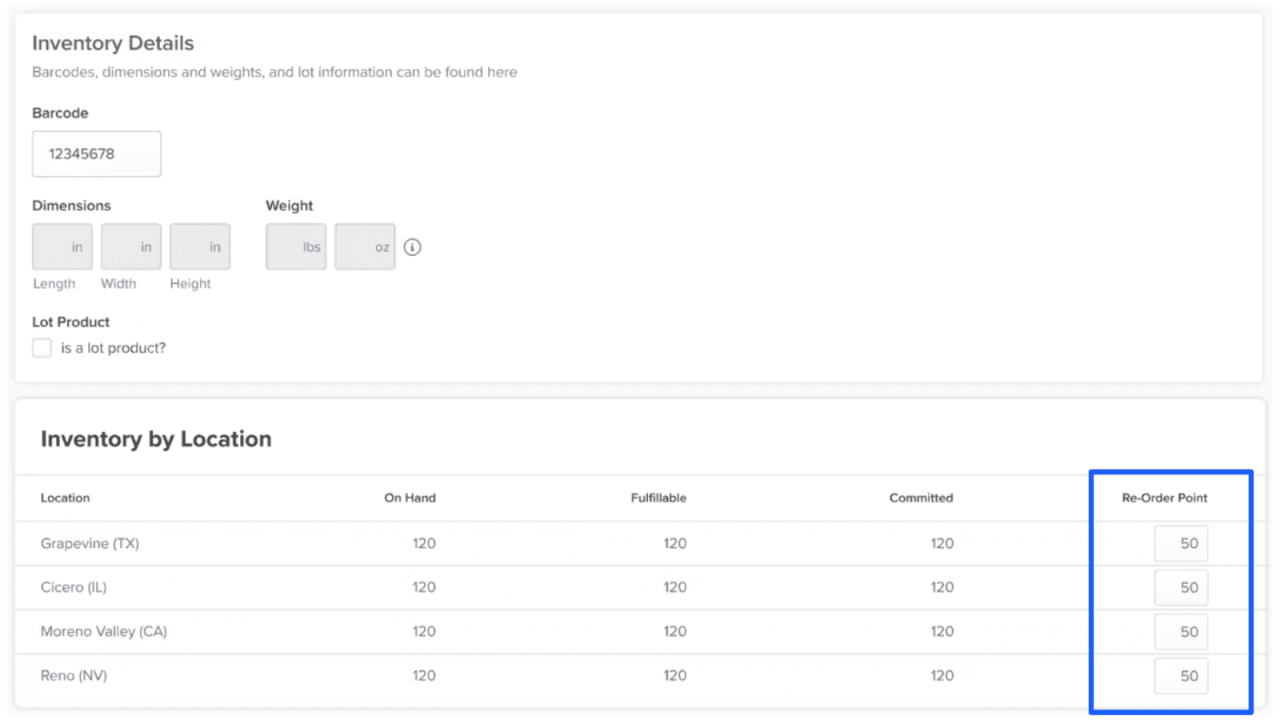
Every acquisition decision starts with a forecast: how much of each SKU will you sell, and when? Set reorder points that account for average daily sales velocity, supplier lead time, and a safety stock buffer.
If SKU A sells 50 units per day, your supplier needs 21 days to deliver, and you want 7 days of safety stock, your reorder point is 1,400 units (50 × 28 days).
Reorder triggers should also factor in the time it takes for inventory to be received and made available at the fulfillment center. If receiving takes an additional 2–3 days, that window needs to be built into the trigger.
Establish a standard review cadence (weekly or biweekly) to reassess forecasts and adjust reorder points based on changing sales patterns and upcoming promotions.
Phase 2: Evaluate suppliers and manage purchase orders
Evaluate suppliers on four dimensions: cost per unit, lead time reliability, minimum order quantities, and fill rate consistency. Consider diversifying your supplier base to reduce the impact of potential disruptions.
Additionally, assess whether a supplier’s MOQs align with your demand and cash flow. If a supplier requires a 2,000-unit minimum but you only sell 800 units per month, you’re sitting on 2.5 months of inventory that’s tying up capital and consuming warehouse space.
Regardless of your choice in supplier, standard PO workflow keeps acquisition on track:
- Forecast review — Identify SKUs approaching reorder points
- Approval — Finance and ops sign off on the order
- PO placement — Send the purchase order to the supplier
- Supplier confirmation — Confirm acceptance, pricing, and estimated ship date
- Shipment tracking — Monitor in-transit inventory
- Exception handling — Address delays, short-ships, or quality issues
Clear communication cadences with suppliers, including order confirmations, shipment ETAs, and delay alerts, prevent surprises at the fulfillment center.
Phase 3: Check operational feasibility before you buy
Before placing a purchase order (PO), validate that the fulfillment operation can handle the incoming inventory. Run these feasibility checks:
- Storage capacity. Does the fulfillment center have room for the incoming volume?
- Inbound timing conflicts. Will the shipment overlap with other deliveries or peak fulfillment periods?
- Special handling needs. Do any SKUs require lot tracking or expiration date management?
- Prep and labor requirements. Are there kitting or prep tasks that need labor coordination?
A beauty brand shipping 50,000+ orders a month that schedules a major inbound shipment during Black Friday week is asking for trouble. Coordinating inbound timing with peak outbound demand is what separates reactive purchasing from strategic acquisition.
Phase 4: Coordinate inbound logistics and place inventory strategically
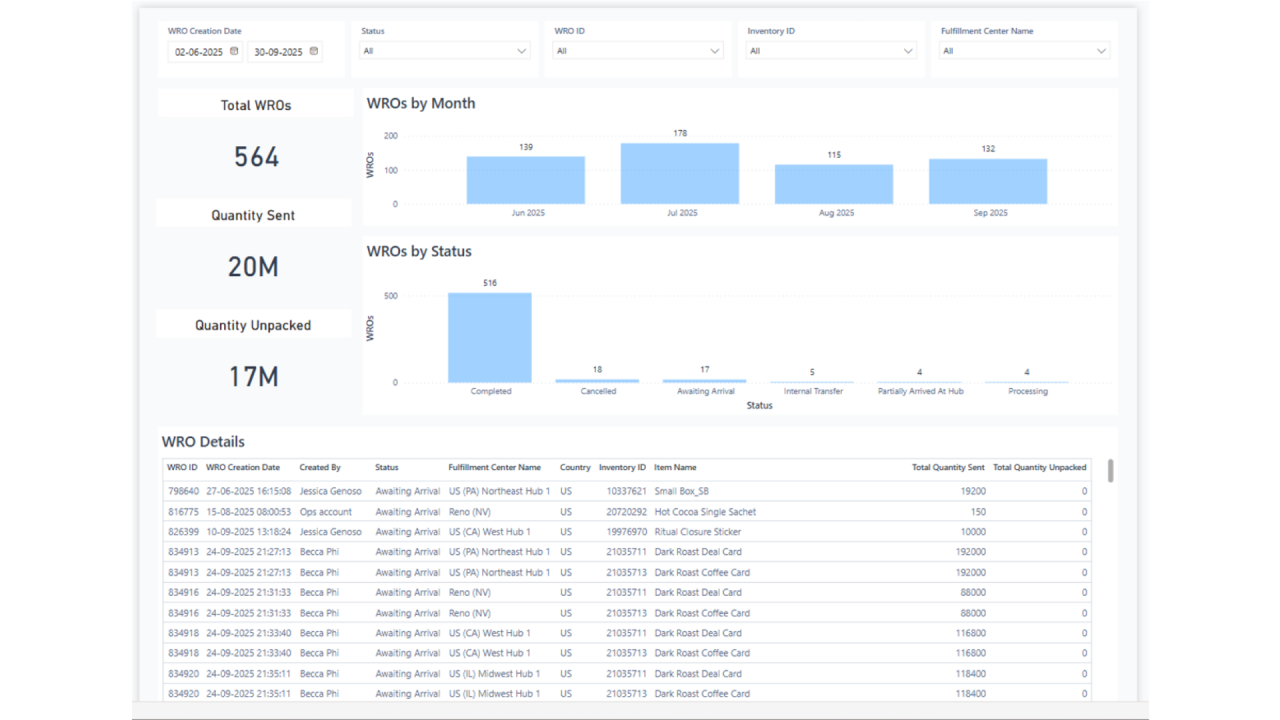
Once a PO is confirmed, the inbound logistics process begins. For brands working with a fulfillment partner, this typically involves booking freight, submitting a warehouse receiving order (WRO), and scheduling a dock appointment.
However, brands fulfilling from multiple locations also need a placement strategy, not just “how many units do I buy?” but “how do I split those units across fulfillment centers based on where my customers are?” Options include manually splitting inbound shipments across locations or shipping to a single hub for distribution.
The goal is to position inventory as close to customers as possible, reducing average shipping zones and lowering per-order costs. For example, a brand that stores all inventory on the East Coast but ships 40% of orders to California is paying a premium on every westbound shipment.
Metrics that keep inventory acquisition on track
The right metrics connect buying decisions to both fulfillment outcomes and financial health, giving your team early warning signals before small misses become expensive problems. Here are the metrics that matter most:
| Metric | What it measures | Why it matters for acquisition |
| Days on hand | How long current inventory will last at the current sales rate | Tells you how urgently you need to reorder |
| SKU velocity | How quickly each product sells | Informs reorder frequency and quantity per SKU |
| Inventory turnover rate | How many times inventory is sold and replaced over a period | Reveals whether you’re buying too much or too little |
| Stockout rate | How often SKUs go out of stock | Measures acquisition timing accuracy |
| Supplier fill rate | Percentage of ordered units delivered on time and in full | Flags unreliable suppliers before they cause fulfillment gaps |
| Carrying cost as % of inventory value | Total cost of holding inventory relative to its value | Shows whether you’re tying up too much capital in stock |
Review these metrics alongside sales and fulfillment data on a regular cadence — weekly for high-velocity SKUs, biweekly or monthly for the rest. Set alert thresholds for critical metrics so your team gets notified before a stockout happens, not after.
How ShipBob helps brands make smarter inventory acquisition decisions
ShipBob does not source or purchase inventory, but our fulfillment infrastructure and analytics tools give operations teams the data and visibility they need to make better-informed acquisition decisions.
- Data-driven reorder timing. ShipBob’s tools use historical data and customizable thresholds to provide reorder triggers and automated alerts, notifying your team when a SKU approaches its reorder point.
- Cash flow protection with a shared inventory pool. ShipBob’s shared inventory pool eliminates the need for channel-specific stock reserves across DTC, marketplace, and wholesale. One pool of inventory serves all channels, so you’re buying based on total demand, not siloed guesses.
- Inbound coordination with the Inventory Placement Program (IPP). IPP lets brands ship to one hub while ShipBob handles distribution across its US network, positioning inventory near end customers. This reduces shipping costs, transit times, and the complexity of coordinating multiple inbound shipments.
The results speak for themselves. Our Place, a modern kitchenware brand serving millions of customers across the US, the UK, Canada, and Australia, saved $1.5M in outbound freight costs by distributing inventory across ShipBob’s network. Currently, 98% of their domestic US shipments avoid the highest-cost zones, and fulfillment times dropped from 5-6 days to just 2.5 days.
“ShipBob has transformed our operations into a key competitive edge. I doubt any of our competitors can match our ability to receive orders and deliver them within two and a half days at average. With ShipBob, misshipments are rare occurrences, enabling us to consistently deliver on our promises to customers, ensuring they receive exactly what they’ve ordered.”
Ali Shahid, COO of Our Place
That’s what inventory acquisition looks like when buying decisions connect to fulfillment strategy.
Get started with ShipBob
Ready to align your inventory acquisition with fulfillment performance?
Inventory acquisition FAQs
What is inventory acquisition in ecommerce?

Inventory acquisition is the process of determining what products to buy, how much to order, when to reorder, and from which suppliers — with the goal of getting sellable inventory into your fulfillment pipeline at the right time.
How does inventory acquisition differ from procurement?
Procurement covers all business purchasing, from vendor contracts to office supplies. Inventory acquisition is specifically focused on getting the right sellable products into your fulfillment network at the right quantities and timing to meet customer demand.
What are the most important metrics for inventory acquisition?
The key metrics are days on hand, SKU velocity, inventory turnover rate, stockout rate, supplier fill rate, and carrying cost as a percentage of inventory value.
How does ShipBob help with inventory acquisition planning?
ShipBob provides real-time visibility into inventory levels, SKU velocity, and days on hand across all fulfillment locations. This data, combined with reorder notification tools and the Inventory Placement Program, helps operations teams make better-informed decisions about when to reorder and how to distribute inventory.
Can ShipBob’s analytics tell me when to reorder inventory?
Yes. ShipBob’s dashboard includes reorder notification points and inventory replenishment alerts based on customizable thresholds. These tools use historical sales data and current inventory levels to flag when SKUs are approaching reorder points, helping your team act before stockouts occur.
How does ShipBob help maintain inventory accuracy and visibility when inventory is received and distributed across locations?
ShipBob uses a structured receiving process with system scans and step-by-step inventory visibility in the dashboard. This visibility follows inventory as it is received, stowed, and moved through the network, including hub-based receiving and distribution for programs like IPP. For additional inbound exception detection, inventory can be verified with checks like product verification and 3D scanning before it’s distributed to fulfillment centers.


