
Table of Contents
** Minutes
Growing across channels sounds like a win, until your operations can’t keep up. In the Scale Playbook, the first episode of the Scale with ShipBob webinar series, ShipBob’s fulfillment experts broke down the real cost of fragmented fulfillment and what it takes to grow without the chaos.
This guide breaks down the playbook, so you have the tools you need to succeed in today’s omnichannel world.
Omnichannel isn’t the future. It’s now.
Single-channel selling is a liability. The vast majority of ShipBob brands already sell on multiple sales channels, and the brands scaling fastest are the ones whose operations can actually keep up. ShipBob’s Scale Playbook covers why omnichannel is now the baseline, what fragmented fulfillment actually costs, and how a unified platform eliminates the chaos.
The numbers don’t lie
86% of ShipBob brands sell on 2+ channels
67% ship internationally
98% offer customized orders
Omnichannel, global fulfillment, and customization aren’t differentiators anymore. They’re table stakes. The question isn’t whether your brand needs them, but whether your operations can actually support them.
That’s where most brands hit a wall.
The real problem with single-channel selling
When your entire revenue depends on one platform, whether that’s Shopify, Amazon, or anywhere else, you’re one algorithm change or policy update away from a serious operational problem. Spreading across channels connects you with customers wherever they shop, from fulfilling on TikTok Shop and Target to emerging platforms like Whatnot.
But adding channels without the right infrastructure doesn’t solve the problem. It amplifies it.
Three ways fragmented operations kill growth
Most scaling brands run into the same three problems:
- Inventory fragmentation. Managing stock across multiple channels, fulfillment centers, and warehouses creates compounding inefficiencies. You’re either over-allocating in one place or stocking out in another.
- Compliance headaches. Retailers have strict EDI requirements, and each retailer’s requirements vary. Without automation, meeting those requirements can result in errors, which can cause chargeback costs and strained retailer relationships.
- SLA failures. Miss a delivery window, and you’re looking at chargebacks and eroded seller ratings. Those are hard to recover from.
The fix isn’t more people managing more spreadsheets. It’s a connected system that handles the complexity for you.
What unified fulfillment actually looks like
In practice, that means three things working together.
- Unified inventory management. Direct-to-consumer (DTC), marketplace, wholesale, and retail orders are all managed through a single dashboard. No fragmentation, no reconciling between systems.
- Automated EDI compliance. ShipBob partners with SPS Commerce and other EDI partners to automatically handle retailer requirements on your behalf. One brand went from chargeback exposure to zero chargebacks and saved hundreds of hours weekly after integrating ShipBob’s EDI capabilities for their Target partnership.
- Intelligent inventory placement. With our Inventory Placement Program, ShipBob’s AI Decision Engine analyzes your historical order data, demand, and real-time sales information to recommend where to position inventory across our US fulfillment network. When inventory is placed closer to customers, it results in faster delivery and lower costs.
Growth that scales, not just ships
Nood started with one SKU in 300 Target stores. By automating EDI through ShipBob, they scaled to six SKUs across 1,500 locations, in time for Black Friday.
“There’s no way we would have been able to manage all those details at scale without ShipBob’s expertise.”
Hayden Pembridge, VP of Operations at Nood
That kind of retail growth isn’t possible when you’re managing compliance by hand.
The same logic applies to inventory strategy. One brand moved over 10,000 orders of dead stock per month through Whatnot, turning stagnant inventory into real revenue. Brands that can flex across channels move faster and waste less.
Speed expectations have also shifted. 85% of ecommerce brands now target 2-3 day domestic shipping. That standard isn’t going away, and it applies whether you’re selling DTC or through retail partners.
ShipBob’s B2B volume grew 55% year-over-year, with over 200 retailer relationships managed through EDI integrations. The brands driving that growth have one thing in common: they’re not doing it manually.
3 signs your fulfillment setup is holding you back
- You can’t see your inventory in real time. You’re finding out about stockouts after customers already have, and it’s harming your reputation and customer experience
- You’re managing compliance manually. Your team is spending hours on retailer requirements that should run automatically. When errors occur, you’re dealing with chargebacks and other implications from the retailer
- Adding channels creates more chaos, not more revenue. Operations get harder and more complicated every time you grow. You’re often juggling the issues associated with adding new channels, not growing the business.
If any of those sound familiar, you’re facing an infrastructure problem. The good news? This problem is fixable with a network of solid partners.
Where to start
Assess where you’re selling today and identify the channels where your customers actually shop. Map your current inventory visibility gaps. And if compliance is still manual, that’s the first thing to automate.
Brands managing multiple channels don’t need a bigger team. They need a better system.
Expand globally with ease
67% of ShipBob brands already ship internationally. The brands growing across borders aren’t building separate logistics stacks for each market. They’re using localized fulfillment, a unified dashboard, and partners who’ve done it before. This chapter covers how to start smart, where to go first, and what makes international feel like domestic.
Your customers are already global
“Every brand has global customers whether they realize it or not. The question is whether you’re set up to serve them well — or losing them to a competitor who is.”
Jonathan Oates, Director of Merchant Expansion at ShipBob
The data is already in your analytics. Look at your support tickets and where your site traffic comes from. International demand is often there before a brand formally launches in a market.
Why most international attempts stall
Going global sounds exciting, but the operational reality usually isn’t. Brands run into the same friction every time:
- Slow shipping times that kill conversion and drive up support volume.
- Surprise duties and fees that land on customers at delivery and damage brand image.
- Fragmented dashboards across multiple regional logistics providers, with no single source of inventory truth.
But luckily these challenges aren’t inevitable. Using a single fulfillment provider helps unify and streamline global fulfillment that creates a better experience for you and your customers.
ShipBob’s framework for global fulfillment
Jonathan outlined the three-pillar approach ShipBob uses to remove those barriers
- Localized fulfillment. When brands store inventory closer to international customers, they’re able to provide faster delivery, lower duties, and a better customer experience.
- Real-time inventory management. Using a single, global fulfillment partner like ShipBob gives you one dashboard for every fulfillment center, every region, and every channel. That means you aren’t manually reconciling inventory or waiting for data to sync.
- Strategic expansion guidance. ShipBob’s global expansion team and partner network guide merchants through market entry. We support you throughout the process of choosing the right market all the way to getting the first order out the door, and beyond.
“With ShipBob, you can manage inventory across a single dashboard for all of your fulfillment centers, all of your global regions — in real time.”
Jonathan Oates, Director of Merchant Expansion at ShipBob
Plus, ShipBob’s foreign trade zone (FTZ) solutions in the US add a financial benefit. Brands can defer paying duties until inventory ships to end customers, improving cash flow without changing how operations run.
Treat international like an extension of your domestic operations
Chris Ziomek, SVP of Revenue at Passport, brought a useful reframe to the conversation. International shipping doesn’t have to feel like a different business. The goal is to make it feel like domestic.
Passport’s approach focuses on compliance, logistics, and market enablement so the mechanics of cross-border commerce stay invisible to both merchants and their customers.
What winning global fulfillment looks like
Here’s how real-life brands have succeeded in global markets:
GoPure expanded into Canada through ShipBob’s localized fulfillment. Delivery times improved, cross-border tariffs disappeared from the customer experience, and operations didn’t skip a beat.
Ridge Wallet scaled to global household-name status by building a partner-led international infrastructure rather than trying to own every piece of it.
The pattern is the same: brands that go global efficiently aren’t doing it themselves. They’re doing it with partners who have the scale and the expertise to make it repeatable.
“Go with people who know, who have experience, who have scale — because that matters.”
Chris Ziomek, SVP of Revenue at Passport
3 signs you’re ready to go global
- You’re already getting international orders. The next step is to give them a better, more localized experience.
- Your domestic operations are stable. Global expansion rewards brands with clean infrastructure. Once your domestic business is solid, you’re in great shape to expand into new markets.
- You’re losing conversions to shipping cost or speed. Localized fulfillment solves both of these common international fulfillment challenges.
International expansion isn’t just for enterprise brands anymore. The tools and partnerships that exist today make it accessible for brands at every stage of growth.
Where to start
As you’re looking at new markets to expand into, start with markets that look like home.
The US, Canada, the UK, Australia, and Europe all share common buyer behaviors. Lower risk, faster ramp, and real demand already there.
“If you’re a US brand, Canada is the easiest decision when you start to think about global expansion. It’s a no-brainer.”
Jonathan Oates, Director of Merchant Expansion at ShipBob
From there, use your customer data to prioritize. Look at where you’re already getting orders, where your traffic originates, and where support tickets are coming from. That’s your expansion roadmap.
The brands that win globally plan accordingly and start their expansion journey with the right infrastructure.
Delight every customer
98% of ShipBob brands customize their orders. So while customization is no longer a differentiator, execution is. This chapter covers what it takes to deliver a consistent, on-brand experience at scale: from branded packaging and accurate delivery promises to post-purchase tracking, returns, and the numbers that prove it all adds up.
Fulfillment is part of your brand image
The last mile is where brand promises get kept or broken. Ashley Pakenham, Merchant Success Enablement Manager at ShipBob, put it directly: “Delivery is an experience your customer associates with your brand, not just your fulfillment partner.”
Getting that right at scale, especially during peak periods, is what separates brands that grow from brands that crumble.
Customization is baseline. Execution is the differentiator.
Branded packaging, custom kitting, gift inserts — these are all expected. What varies is whether brands can deliver them consistently across every channel, at every volume, without the wheels coming off during a peak.
ShipBob’s Customization Suite handles branded packaging, subscription kitting, and promo bundles directly from the dashboard. Merchants configure kitting requests, track progress in real time, and don’t have to manage it outside the system.
Branded packaging isn’t a nice-to-have
55% of shoppers are more likely to return to a brand that uses branded packaging.
That’s not an unboxing metric. That’s repeat purchase rate, lifetime value, and the return on your acquisition spend.
Every shipment is a brand touchpoint. Brands that treat it that way keep customers, and brands that don’t are funding their competitors’ retention.
Your delivery promise has to be real
ShipBob’s Delivery Promise feature shows customers an accurate delivery date at checkout.
“When a customer logs on to your website, they see a delivery date at checkout. And that date needs to be real, not a best guess, not a range. That’s what ShipBob Delivery Promise provides.”
Ashley Pakenham, Merchant Success Enablement Manager at ShipBob
The platform uses intelligent fallback routing to handle carrier disruptions without breaking the promise. Reliable delivery dates reduce “where is my order?” (WISMO) tickets and build the kind of trust that drives repeat purchases.
Learn more about ShipBob’s ongoing commitment to delivering consistent, accurate fulfillment.
WISMO is costing you more than you think
30–40% of all ecommerce support tickets are WISMO inquiries
50%+ during peak periods
At 10,000 orders a month with 35% WISMO tickets, that’s $35,000 a month in support costs. Not a fulfillment problem, but a communication problem.
ShipBob’s post-purchase tools cut that volume by keeping customers informed before they have to ask.
4.6 tracking checks per order. Make them count.
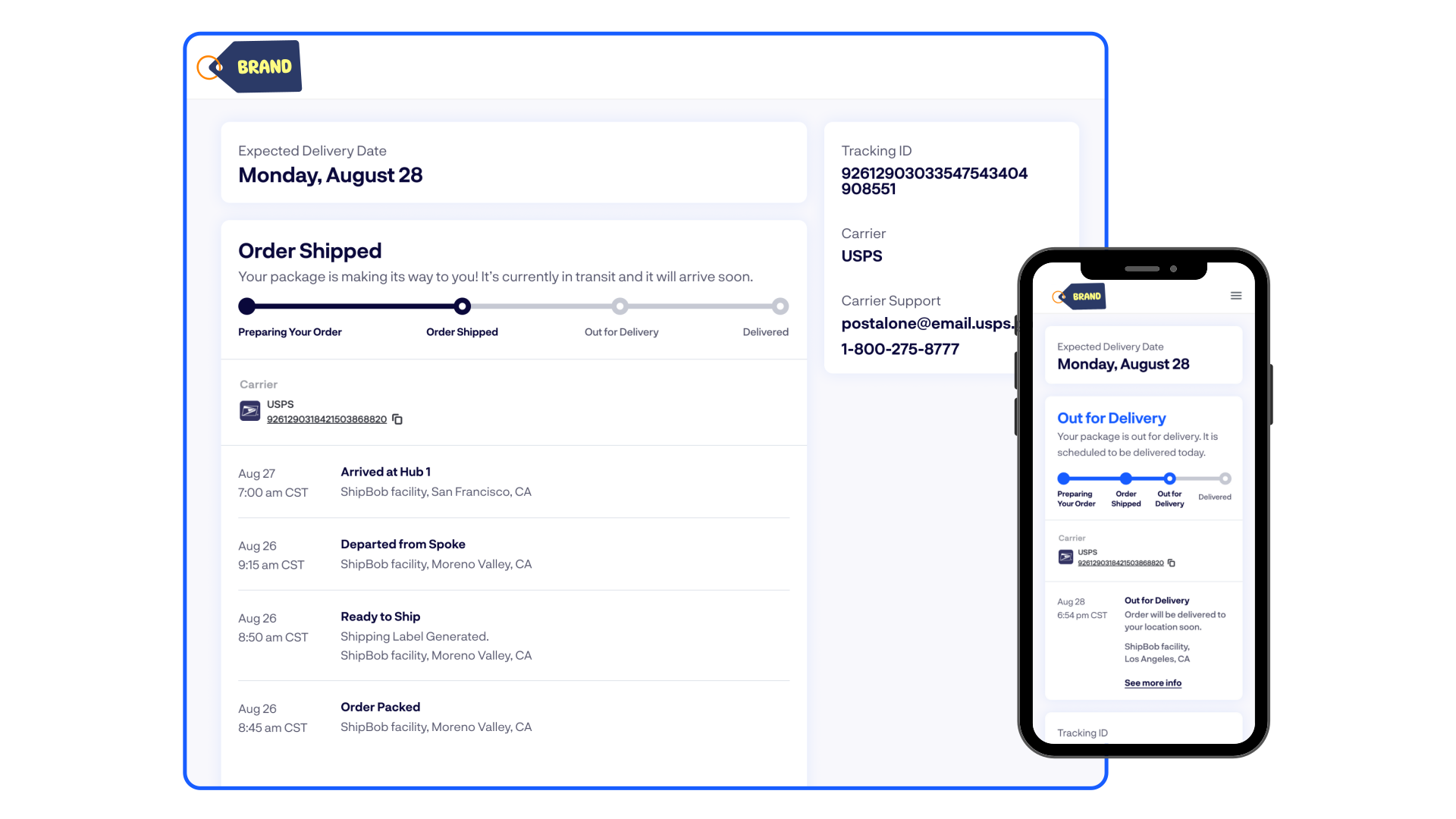
Customers check their tracking an average of 4.6 times per order. ShipBob’s branded tracking page, TrackBob, turns those touchpoints into branded experiences instead of generic carrier pages.
“Your customers check their tracking about 4.6 times per order. That’s 4.6 opportunities to reinforce your brand.”
Ashley Pakenham, Merchant Success Enablement Manager at ShipBob
TrackBob integrates with Klaviyo and Gorgias so marketing and support teams can deliver real-time, tailored communications through the post-purchase journey without building anything custom.
Check out how ShipBob has been improving and growing its own customer support.
Returns are a retention tool
A frictionless return converts a disappointed customer into a loyal one. A painful return converts them into an angry one who tells people about it.
ShipBob’s QR-based return labels remove the friction. Customers get a simple, low-effort experience. Brands get fewer escalations and more second chances.
Consistency across every market
Global growth means nothing if the experience degrades outside your home market. ShipBob’s infrastructure is built to deliver the same customization, accuracy, and reliability across all of our 60+ global fulfillment centers.
Customers get the same experience, no matter if they’re in Southern California or London.
What this looks like in practice
Candle, a premium home fragrance brand, operates across five channels and ships to 14 countries. Their logistics are complex by any measure.
Their customer satisfaction score: 4.96.
“Every new channel or market is another variable that could dilute the customer experience. Yet they’ve maintained a 4.96 c-sat score — and that’s not a marketing initiative. It’s an operational outcome.”
Ashley Pakenham, Merchant Success Enablement Manager at ShipBob
That score doesn’t come from good intentions. It comes from infrastructure that delivers consistently, everywhere, every time.
3 signs your post-purchase experience needs work
- Your WISMO ticket volume is high. Customers are asking where their orders are because your communications aren’t getting there first.
- Your tracking page looks like a carrier page. Every check is a missed brand moment and missed upsell.
- Returns feel like a penalty. If your return process is painful, customers remember it. If it’s frictionless, they come back.
Where to start
Audit the post-purchase experience your customers are actually having. Check your tracking page. Check your return flow and your WISMO ticket rate.
Fulfillment isn’t the end of the customer journey. For most brands, it’s the most memorable part of it.
Get started with ShipBob
Talk to a ShipBob fulfillment expert to see where your operations have gaps and how to close them.


