

Table of Contents
** Minutes
Define the scope, goals, and constraints of your supply chain contingency plan
Build a risk register and prioritize what is realistic to plan for
Design triggers, owners, and KPIs so the plan can be activated quickly
Build runbooks and communication templates your team can execute under pressure
Test, review, and keep supply chain contingency planning current
Make contingency planning simpler with ShipBob’s fulfillment platform and support
A supply chain contingency plan is a living playbook that helps teams respond quickly to disruptions. It protects service levels and keeps customers informed. A usable plan pairs realistic scenarios with measurable triggers, clear ownership, and actionable runbooks that teams can drill and execute under pressure.
This guide walks through every step of building a modern supply chain contingency plan. You’ll find a practical template and realistic examples. You’ll also find advice on structuring a plan that’s actually usable.
By the end, you’ll know how to identify the right risks and set up clear triggers and KPIs. You’ll be able to make your plan a tool your team can rely on, especially when it matters most.
Define the scope, goals, and constraints of your supply chain contingency plan
A supply chain contingency plan must be grounded in the realities of your business model and customer promise. Start by defining which parts of your supply chain directly impact customer experience. Then clarify what you’re trying to protect.
Scope:
A comprehensive supply chain contingency plan covers all nodes that affect the customer journey:
- Suppliers: raw materials, finished goods
- Inbound transportation: freight, customs clearance
- Storage: fulfillment centers, inventory on hand
- Fulfillment: picking, packing, kitting, bundling
- Shipping: carrier performance, last-mile delivery
- Returns routing: including options to send returns to a non-ShipBob location
When to use what:
- Risk management is about identifying and mitigating potential threats.
- Business continuity ensures the company can operate during a major crisis.
- Supply chain contingency planning is for operational disruptions that threaten service levels or customer experience — think of it as the bridge between daily ops and crisis response.
Operational goals:
Your plan should protect key metrics:
- Protect on-time, in-full (OTIF) delivery rates
- Maintain high fill rates for key SKUs
- Control lead-time variability
- Reduce backlog growth during disruptions
- Keep customer updates accurate and timely
Constraints:
Every plan operates within real-world limitations:
- Cash tied up in inventory that won’t sell
- Supplier minimum order quantities (MOQs)
- Marketplace service level agreements (SLAs)
- Limited operations headcount
- International expansion (US, UK, EU, Canada, Australia) with varying local requirements
Scenario examples by category:
Tailor your plan to your industry’s common disruptions:
- Beauty: Launches with unpredictable demand, packaging shortages
- Apparel: Seasonal surges, supplier delays on new collections
- Supplements: Replenishment cycles, ingredient lead times
- Home goods: Long lead times, customs delays
A clear scope and set of goals keep your plan focused and actionable, rather than overwhelming or generic.
Build a risk register and prioritize what is realistic to plan for
Not every risk deserves a full playbook. Focus on the scenarios that actually move the needle for your service levels and margin, and plan those deeply.
Here we’ll walk you through building a disruption list, prioritizing risks with a simple scoring method, and choosing resilience strategies that match each threat. The goal is to focus your efforts where they’ll have the most impact.
Create a disruption list that matches your business model
Start by mapping disruptions to where they occur in your supply chain. This helps you see which issues are most likely to impact your customer promise.
Disruption categories:
Group potential issues by where they occur:
- Supplier: Raw material shortages, production delays, quality issues
- Inbound transportation: Port congestion, customs holds, freight delays
- Fulfillment/warehouse: Capacity constraints, labor shortages, system outages
- Carrier performance: Missed pickups, weather delays, carrier strikes
- Demand volatility: Viral moments, influencer campaigns, unplanned spikes
- Systems outages: OMS/WMS downtime, integration failures
Ecommerce-specific examples:
Common scenarios by vertical:
- Supplements: Ingredient delays due to regulatory changes
- Beauty: Packaging lead-time slips ahead of a launch
- Apparel: Inventory arriving late before a seasonal drop
- Home goods: Container stuck at port before a major promo
When Food Huggers experienced a viral moment after a TV appearance, order volume spiked overnight. By using ShipBob’s scalable fulfillment and real-time inventory visibility, they maintained high OTIF rates and avoided backlogs, even as demand surged far beyond forecasts.
International expansion risks:
Brands operating globally face additional challenges:
- Customs delays and restrictions (brand responsibility)
- Local carrier variability (service levels differ by country)
- Replenishment timing for US, UK, EU, Canada, and Australia
A disruption list tailored to your business model ensures you’re not wasting time on unlikely scenarios.
Prioritize scenarios with a simple scoring method your team will actually use
Once you have your disruption list, score each risk. Focus on its likelihood and impact on customer experience and cash flow. A practical approach borrows from FMEA but keeps it simple:
Scoring criteria:
- Severity: How badly would this disrupt service or margin?
- Occurrence: How likely is it to happen in the next 12 months?
- Detection: How quickly would you know it’s happening?
Example scoring table:
| Scenario | Severity | Occurrence | Detection | Priority |
| Supplier delay | High | Medium | High | 1 |
| Carrier strike | Medium | Low | Medium | 3 |
| OMS outage | High | Low | Low | 4 |
| Demand spike (viral) | High | Medium | Medium | 2 |
| Inbound customs hold | Medium | Medium | Medium | 5 |
Top 5 scenarios:
Build full runbooks for your highest-priority risks: those that scored highest for severity, occurrence, and detection impact. These are the disruptions most likely to threaten your OTIF rates, fill rates, or customer experience. Each runbook should include triggers, owners, step-by-step actions (T-0, T+24, T+72), KPIs to monitor, and communication templates.
Watchlist scenarios:
For lower-priority risks that didn’t make your top 5, document brief responses that outline the basic action and owner. This keeps them on your radar without overloading your team with full playbooks for unlikely events. Review your watchlist quarterly. Some risks may rise in priority as your business or supply chain evolves.
Prioritizing this way keeps your plan focused and actionable, not overwhelming.
Choose resilience strategies that match each risk (not one blanket approach)
Each risk deserves a tailored resilience strategy. Avoid a “one size fits all” thinking. Below, you’ll find practical examples of how to match your response to the risk type, where to place inventory buffers strategically, and how to balance resilience with the tradeoff of capital tied up in stock.
Strategy examples:
Match your response to the risk type:
- Supplier failure: Multi-sourcing, alternate suppliers
- Fulfillment disruption: Alternate fulfillment centers, rerouting orders
- Lead-time variability: Inventory buffers at key nodes
Inventory buffer placement:
Strategic buffers reduce risk without tying up excess capital:
- Supplier: Hold extra raw materials for long-lead SKUs
- In-transit: Use safety stock in transit for high-velocity SKUs
- Fulfillment center: Buffer only A- and B-class SKUs using ABC/XYZ segmentation
Tradeoff:
More resilience means more capital tied up in inventory that may not sell. To balance protection with cash flow, limit buffers to SKUs that drive the majority of your revenue and margin, typically your A-class items in an ABC analysis.
Set a review cadence (monthly or quarterly) to adjust buffer levels based on actual sell-through rates, lead-time changes, and shifts in demand patterns. If a buffered SKU’s velocity drops or a supplier’s reliability improves, reduce the safety stock to free up working capital. This disciplined approach ensures you’re protecting service levels without over-investing in slow-moving inventory.
Matching strategies to risk type this way ensures your plan is both effective and efficient.
Design triggers, owners, and KPIs so the plan can be activated quickly
A supply chain contingency plan only works if it’s clear when to act. It must also clarify who acts and what success looks like.
Create a trigger matrix with thresholds and activation rights
Define clear triggers for each scenario so teams know exactly when to activate a playbook.
Trigger types:
Different scenarios require different activation signals:
- Time-based (e.g., supplier misses ship date by 48 hours)
- Service-level-based (e.g., OTIF drops below 95%)
- Inventory-based (e.g., on-hand days remaining < 7)
- Supplier-performance-based (e.g., two consecutive late shipments)
Sample thresholds:
Set measurable activation points for each scenario:
- Lead-time variance > 3 days vs. plan
- On-hand inventory < 10 days for top SKUs
- ETA delay window > 24 hours
- Backlog size > 200 orders
- Fill rate dips below 98%
Activation authority:
Clarify who has the power to declare an incident and trigger the plan:
- Operations manager can declare a supplier delay incident
- Head of fulfillment can switch to alternate node
- Customer support lead must be informed within 1 hour
A trigger matrix makes it obvious when to move from “watch” to “act.”
Assign ownership with a RACI that matches how work gets done
Assigning clear roles prevents confusion and delays during a disruption. When everyone knows who owns each decision and who needs to be looped in, your team can move quickly without waiting for approval chains or second-guessing next steps. A well-defined RACI matrix ensures accountability and keeps work flowing, even under pressure.
RACI roles:
Define who does what at each step:
- Responsible: Executes the task (e.g., operations team reroutes orders)
- Accountable: Owns the outcome (e.g., head of supply chain)
- Consulted: Provides input (e.g., finance, marketing)
- Informed: Needs updates (e.g., customer support, leadership)
Handoffs:
Clarify how internal teams and external partners (manufacturers, carriers, fulfillment partners) coordinate during disruptions.
Escalation paths:
Define how issues move up if not resolved; don’t wait for the weekly meeting.
Example RACI snippet (supplier delay):
| Task | Ops | Finance | Support | Marketing | Supplier | ShipBob |
| Identify delay | R | C | C | |||
| Activate alternate supplier | A | C | R | |||
| Update customers | R | A | ||||
| Adjust inventory plan | R | A | C | C |
A well-structured RACI keeps decisions moving and prevents bottlenecks.
Tie KPIs to each playbook so you can measure recovery (not activity)
KPIs should measure whether your contingency actions are working.
Core KPIs:
Track the metrics that matter during a disruption:
- OTIF (on-time, in-full)
- Fill rate
- Lead-time variability
- Backlog size
- Dwell time (inventory sitting idle)
- Service level by carrier/service
KPI bands:
Define clear thresholds for normal, degraded, and recovery states:
- Target: Normal operations (e.g., OTIF > 98%)
- Degraded: Trigger for action (e.g., OTIF < 95%)
- Recovery: Back to target for 3 days
Decision links:
Connect KPI thresholds to specific actions:
- If OTIF drops below threshold, activate alternate fulfillment
- If backlog rises for 2 consecutive days, escalate to leadership
Customer experience indicators:
Monitor signals that show how disruptions affect customers:
- Ticket volume
- WISMO (“where is my order”) rate
- Refund requests
Pairing operational KPIs with customer-facing metrics ensures you’re protecting both service and satisfaction.
Build runbooks and communication templates your team can execute under pressure
Runbooks turn strategy into a checklist. They clarify what to do, when, and how to communicate, especially when time is tight.
Build runbooks by scenario with T-0 / T+24 / T+72 timelines
Each runbook should fit on 1–2 pages and break actions into clear time blocks.
Runbook format:
Every runbook should include these elements:
- Trigger: What starts the playbook
- Goal: What you’re trying to achieve
- Owners: Who does what
- Steps: Action items by timeline
- Data checks: What to monitor
- Comms: Who needs updates
Example: Supplier misses ship date
| Time | Action | Owner | KPI to Monitor |
| T-0 | Confirm delay, notify ops, activate alternate supplier if needed | Ops manager | OTIF, fill rate |
| T+24 hrs | Update inventory plan, adjust promise dates, inform customer support | Inventory mgr | Backlog, WISMO rate |
| T+72 hrs | Review recovery, update leadership, send customer comms if needed | Head of ops | OTIF, ticket volume |
Breaking actions into T-0, T+24, and T+72 helps teams focus on immediate containment, stabilization, and recovery.
Prepare routing and fulfillment contingencies without overcomplicating operations
Pre-approve alternate fulfillment paths so teams can act quickly.
Routing rules:
Document fallback options for common scenarios:
- Ship from a different fulfillment center if primary is constrained
- Adjust promise dates on site and marketplaces
- Temporarily pause low-priority channels if needed
Partial fulfillment:
Only split shipments when it improves customer experience and economics. For example, ship available items to subscription customers in health and wellness. Meanwhile, delay low-velocity SKUs.
Backorder handling:
Document how to manage backorders in your OMS/WMS. Decide whether to hold or split based on SKU priority and customer segment.
These steps keep operations nimble without adding unnecessary complexity.
Create communication templates that reduce confusion and ticket spikes
Clear, timely communication reduces confusion and prevents a flood of support tickets.
Internal escalation (example):
“Supplier X missed the ship date for SKU 123. The estimated delay is 3 days. Ops is activating alternate suppliers. Next update at 2 pm.”
Customer-facing update (example):
“Due to an unexpected supplier delay, your order will ship 2–3 days later than planned. We’re working to resolve this and will keep you updated. Thank you for your patience.”
Partner update (wholesale/retail, example):
“PO #456 will be delayed by 3 days due to a supplier issue. Revised ship window is now May 10–12. Please confirm if this impacts your allocation needs.”
Approval checklist:
Streamline message approval to avoid delays:
- Message drafted
- Reviewed by ops and support
- Approved by leadership (if needed)
- Scheduled for release
A streamlined approval flow ensures messages go out quickly, not days later.
Test, review, and keep supply chain contingency planning current
A supply chain contingency plan is only as good as its last test. Regular reviews and drills keep your plan relevant and actionable.
Schedule a quarterly tabletop drill. 90 minutes is enough to walk through a scenario and assign roles. Use this time to spot gaps. Assign a facilitator and a note-taker to capture lessons learned.
Once a year, run a live drill on a high-impact scenario. Set guardrails so you don’t disrupt daily fulfillment.
After each drill, conduct an after-action review. Update triggers and clarify roles. Revise inventory rules based on what worked and what didn’t. Tie your maintenance cadence to your business cycle and review before peak season, major promos, product launches, or international expansion.
Audit checklist:
Keep track of plan maintenance with these checkpoints:
- Last drill date
- Last runbook update
- Current contact list
- Current data sources
Regular testing and updates keep your supply chain contingency plan ready for whatever comes next.
We’re managing hundreds of thousands of orders regularly, working on new product launches, assessing OTIF data, determining inventory placement, preparing for peak season, and planning inventory availability around major marketing campaigns – we couldn’t do that without a partner like ShipBob, who helps us navigate so many of those obstacles.”
Stephanie Lee, Co-CEO of PetLab Co.
Make contingency planning simpler with ShipBob’s fulfillment platform and support
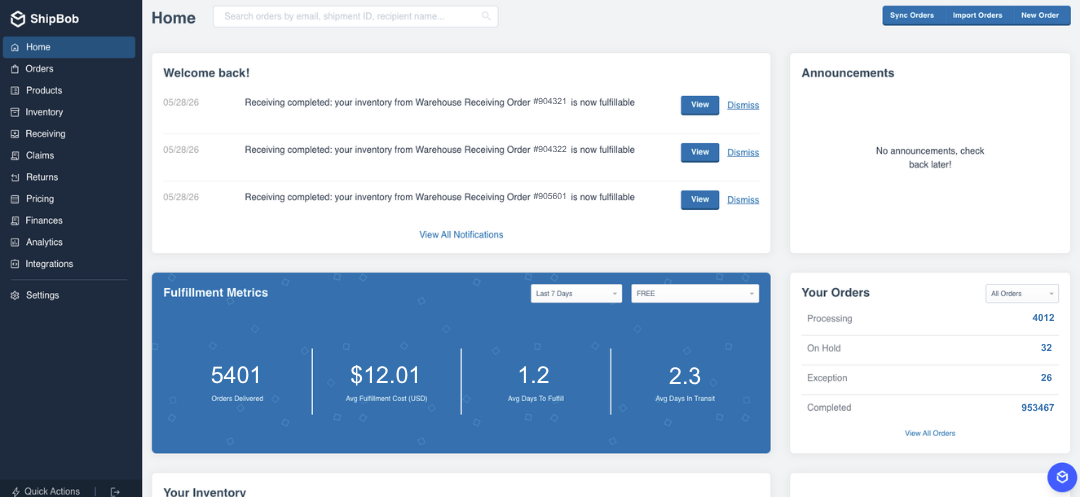
ShipBob’s fulfillment platform gives brands the real-time visibility and operational flexibility needed to execute a supply chain contingency plan. The dashboard provides a single source of truth for inventory and order status across all fulfillment centers and channels. This makes it easy to spot disruptions and act quickly.
Merchant Success teams also help operationalize escalation paths. They document “who to contact for what” inside your contingency plan. For example, if a fulfillment center faces a capacity crunch, ShipBob coordinates with your ops, support, and marketing teams—updating customers at each operational checkpoint.
ShipBob’s global fulfillment network spans the US, UK, EU, Canada, and Australia. Our vast network enables brands to reroute orders when demand shifts or a location is constrained. ShipBob’s Inventory Placement Program (IPP) automates US inventory distribution to reduce shipping zones and costs. This is especially helpful for heavier orders and brands with broad customer distribution.
Get started with ShipBob
With ShipBob, you get hands-on support, real-time analytics, and a scalable fulfillment solution that adapts as your business grows.
Supply chain contingency planning FAQs
Do brands need to execute every part of a supply chain contingency plan themselves?

No. While brands are responsible for defining priorities, triggers, and escalation paths, many execution steps are handled by external partners. Fulfillment, shipping, and inventory reallocation are often executed by logistics providers, making clear ownership boundaries and pre-defined handoffs more important than doing everything internally.
How often should you test and update a supply chain contingency plan?
Test your supply chain contingency plan with a tabletop drill every quarter and a live drill at least once a year. Update the plan after each drill. Review before major business events like peak season or international expansion.
What are realistic triggers and thresholds for supply chain contingency planning?
Realistic triggers include supplier delays beyond 48 hours and OTIF dropping below 95%. They also include inventory on hand falling under 10 days for key SKUs, or a backlog exceeding a set order count. Thresholds should be tailored to your business’s service level commitments and cash flow needs.
How does ShipBob help with real-time visibility during supply chain disruptions?
ShipBob’s dashboard provides instant visibility into inventory and order status across all fulfillment centers and channels. This allows brands to monitor disruptions and activate contingency plans quickly. Real-time data supports fast, informed decision-making during incidents.
How does ShipBob’s customer support team assist with fulfillment issues or disruptions?
ShipBob provides hands-on support from in-house Merchant Care and a dedicated Merchant Success Manager for larger brands. Support is available through localized hours and multiple channels (case portal, email, phone, and live chat), plus on-site reps in fulfillment centers.


