

Table of Contents
** Minutes
What is predictive inventory management?
The evolution of inventory management
6 key benefits of predictive inventory management
How predictive inventory management works
Best practices to implement predictive inventory management
Advanced predictive inventory forecasting strategies
Effective inventory management is vital for ecommerce success today. With customers expecting faster shipping and supply chains becoming less predictable, proactive inventory management gives businesses a competitive edge.
Predictive inventory management uses AI and analytics to transform data into action, analyzing both real-time signals and historical patterns to optimize stock levels before demand shifts.
This guide explains how predictive inventory management surpasses traditional forecasting and shows ecommerce brands how to use these tools to enhance operations, increase customer satisfaction, and improve profitability.

What is predictive inventory management?
Predictive inventory management optimizes stock levels using advanced analytics, AI, and machine learning.
This data-driven approach goes beyond traditional forecasting by accurately anticipating demand and proactively managing inventory.
At its core, predictive inventory management combines historical data with real-time signals to generate actionable insights.
By analyzing past sales patterns, seasonal trends, and other factors, these models identify potential stockouts or overstock situations before they happen. This helps businesses make smarter decisions about when to reorder, how much to order, and where to allocate inventory.
Inventory forecasting vs. predictive inventory management
Inventory forecasting and predictive inventory management serve different purposes.
- Traditional forecasting simply uses past sales data to project future demand through statistical analysis.
- Predictive inventory management offers a more robust solution by combining historical data with real-time signals (including current sales, website traffic, and external factors like weather or economic trends) for more accurate insights.
Consider a product going viral on social media. Traditional forecasting would miss this surge until the next cycle, likely causing stockouts. A predictive system would immediately detect increased demand and automatically adjust reorder points to prevent shortages.
Unlike basic forecasting that only provides projections, predictive management:
- Integrates with warehouse systems and operational tools to automatically initiate reordering, inventory transfers, or pricing changes to optimize stock levels.
- Continuously improves as algorithms process more data and develop a deeper understanding of demand patterns and supply chain dynamics.
The evolution of inventory management
Inventory management has evolved dramatically from manual stock counts and paper records. As technology has advanced and customer expectations have risen, inventory tracking and optimization methods have transformed significantly.
Early commerce relied on simple inventory tracking like periodic physical counts and basic reorder points. While these provided minimal control, they were time-consuming, error-prone, and reactive. As businesses grew and supply chains became more complex, these traditional methods showed clear limitations.
Traditional inventory methods like Economic Order Quantity (EOQ), safety stock calculations, and periodic reviews use historical data and basic statistics to set stock levels, but have four key limitations:
- They rely on past sales rather than real-time demand.
- They can’t adapt to market changes or shifting preferences.
- They frequently cause stockouts or excess inventory.
- They require time-consuming, error-prone manual work.
For example, a business using a simple 100-unit reorder threshold will face stockouts and lost sales if demand suddenly spikes. Similarly, EOQ formulas often create excess inventory when demand drops, tying up capital and increasing costs.
As customer delivery expectations rise and competition intensifies, these limitations become critical. Modern businesses need tools that provide real-time insights, predict demand shifts, and automatically adjust inventory.
Predictive inventory management solves these problems by leveraging AI, machine learning, and analytics to generate accurate forecasts that drive proactive decisions. This evolution from basic tracking to predictive systems has been driven by both technological advances and market demands, making effective inventory management a crucial competitive advantage.
For today’s businesses, predictive inventory management is essential for optimizing stock, satisfying customers, and achieving sustainable growth in a dynamic market.
6 key benefits of predictive inventory management
Predictive inventory management delivers significant advantages for both operations and customer satisfaction. Here are just some of the ways that these AI-powered tools give ecommerce brands a competitive edge in today’s fast-paced market.
1. Reduced stockouts
Predictive inventory management significantly reduces stockouts by using AI algorithms to forecast demand spikes and alert you before inventory runs low. This prevents lost sales while maintaining your brand’s reputation for product availability.
These tools automatically trigger reorders at optimal times based on real-time sales data and historical trends, ensuring you have the right stock levels without excess capital tied up in slow-moving inventory. This reliability builds customer loyalty and increases lifetime value as shoppers return to well-stocked stores.

2. Minimized overstock
While preventing stockouts, predictive inventory management also helps avoid overstocking. Excess inventory drains resources by occupying warehouse space and tying up working capital.
These systems identify slow-moving products and warn when items risk becoming dead stock. By analyzing sales velocity and seasonal patterns, they recommend optimal inventory levels across warehouses, reducing carrying costs and freeing capital for growth initiatives or improved cash flow.

3. Lower supply chain risk
In our interconnected global economy, supply chain disruptions can severely impact ecommerce businesses. Predictive inventory management mitigates these risks by identifying potential issues early. By analyzing supplier lead times, production capacity, and reliability history, AI models warn of possible delays or shortages in advance.
This early warning enables proactive contingency planning, such as securing alternative suppliers or adjusting production schedules. When you reduce reliance on manual forecasting, you can navigate supply chain challenges with greater confidence.

4. Demand shaping capabilities
Beyond reacting to demand, predictive inventory management empowers you to actively shape it. Using AI-generated insights, you can create targeted promotions and marketing strategies that balance inventory and optimize revenue.
When the system identifies surplus stock, you can create special offers to boost sales and reduce overstock. If it predicts demand spikes for specific items, you can adjust pricing or promote complementary products to maximize profits. This proactive approach helps you make data-driven decisions that drive business results.

5. ESG & sustainability improvements
Predictive inventory management supports your environmental, social, and governance goals by reducing waste and optimizing resource use, creating a more sustainable supply chain.
Accurate forecasting minimizes product obsolescence and waste, while optimized inventory placement and shipping routes reduce your carbon footprint. These sustainability efforts resonate with eco-conscious consumers, helping differentiate your brand and strengthen customer relationships.

6. Enhanced customer experience
The ultimate benefit of predictive inventory management is its impact on customer experience. By ensuring product availability and fast delivery, you exceed expectations and build long-term loyalty.
Consumers are more likely to make repeat purchases from brands offering reliable, fast shipping. Predictive inventory management enables accurate delivery promises that you can consistently fulfill. This seamless shopping experience helps your brand stand out in a crowded market and builds a loyal customer base that drives sustainable growth.

How predictive inventory management works
Predictive inventory management is a continuous cycle that uses AI and machine learning to turn data into action. This approach works through four key components:
1. Data collection & preparation
Quality data forms the foundation of predictive inventory management. This includes sales history, promotions, seasonal trends, and other demand factors. Businesses must clean and standardize this data across all channels to create an accurate picture of inventory performance.
For effective forecasting, include at least one year of sales history to capture seasonal patterns. Combining data from all sales channels and fulfillment systems provides the comprehensive view needed for accurate predictions.
2. AI & machine learning algorithms
Advanced algorithms analyze historical patterns to forecast demand accurately. These models use techniques like time series forecasting and regression analysis while incorporating external factors such as economic indicators, weather, and social media trends.
The key advantage is continuous improvement through feedback loops.
As new data comes in, the models refine their predictions, identifying complex patterns that humans might miss, like subtle shifts in consumer preferences or emerging trends.
3. System integration
To maximize value, these insights must connect with your existing systems.
Creating real-time data flows between predictive models and warehouse management (WMS) or enterprise resource planning (ERP) platforms through APIs and other integration methods.
Integration enables automated actions. When a model predicts a demand spike, it can trigger automatic reorders. If it forecasts slowing sales, it can suggest production adjustments or promotional strategies. This automation reduces manual work while improving accuracy and response time.
4. Ongoing model refinement
Predictive inventory management requires continuous improvement. As markets evolve, regular monitoring and adjustment of models is essential.
Compare forecast performance against actual sales and making necessary improvements.
Businesses need a framework for testing model updates, which might include running parallel forecasts with new algorithms to compare results.
Throughout this process, human expertise remains crucial. While AI identifies patterns, inventory professionals must interpret these insights and make strategic decisions.
Best practices to implement predictive inventory management
Implementing predictive inventory management can seem daunting, but by following these best practices, you can create a roadmap for successful adoption.
🤝 Achieve executive stakeholder buy-in
Gaining support from executive stakeholders is crucial for the success of any major initiative. To build a compelling business case:
- Project the ROI of predictive inventory management and connect it to strategic business goals.
- Be prepared to address common objections and demonstrate quick wins to maintain momentum.
- Use templates or frameworks that clearly communicate the benefits and align with company priorities.
- Highlight how predictive inventory management can drive growth, improve customer satisfaction, and increase profitability.
By tying the initiative to broader organizational objectives, you’ll be more likely to secure the necessary resources and support.
🎢 Prepare for volatility & external factors
In today’s dynamic market conditions, it’s essential to incorporate external data sources into your predictive models. This includes factors like weather patterns, economic indicators, and consumer sentiment. By considering these variables, you can create more accurate forecasts and build contingency plans for supply chain disruptions.
You should also:
- Develop strategies for handling seasonal fluctuations and trend shifts, and use scenario planning to prepare for different market conditions.
- Make sure your predictive inventory management software can adapt quickly to sudden and unexpected shifts in demand.
- Regularly review and adjust your models to account for changes in the external environment.
🛠️ Cross-functional collaboration & training
Predictive inventory management requires collaboration across multiple teams, including purchasing, marketing, fulfillment, and finance.
- Identify the key stakeholders and ensure they have the necessary skills and training to support the initiative.
- Develop a change management strategy to drive adoption and align incentives across departments.
- Create feedback loops between teams to foster continuous improvement.
- Encourage open communication and knowledge sharing to break down silos and optimize performance.
By involving all relevant functions from the start, you can ensure a smooth implementation and maximize the benefits of predictive inventory management.
💯 Monitor real-time metrics & track ROI
To gauge the success of your predictive inventory management initiative:
- Monitor key performance indicators (KPIs) in real-time, such as forecast accuracy, inventory turns, and stockout rates.
- Create dashboards that provide visibility across the organization and use them to identify opportunities for further optimization.
- Regularly calculate the financial impact of improvements and track the ROI of your predictive inventory management system.
- Consider both leading and lagging indicators to get a comprehensive view of performance.
When you can demonstrate tangible results, you can justify continued investment and secure ongoing support from stakeholders.
📦 Avoid bulk-buying pitfalls
While volume discounts can be tempting, it’s important to evaluate bulk purchases carefully.
- Use predictive analytics to inform optimal order quantities and balance cost savings with inventory flexibility.
- Calculate the true cost of holding excess stock, including carrying costs and the risk of obsolescence.
- When negotiating with suppliers, leverage your demand forecasts to secure favorable terms without overcommitting to large orders.
- Aim to maintain a lean inventory while still taking advantage of strategic purchasing opportunities.
This helps you optimize your working capital and reduce the risk of overstocking.
🤩 Leverage ongoing performance evaluation
Continuous improvement is essential for the long-term success of predictive inventory management.
- Establish a regular cadence of forecast accuracy reviews and use them to identify and address systematic prediction errors.
- Document your learnings and incorporate them into future iterations of your models.
- Regularly refine your algorithms based on new data and insights, and don’t be afraid to experiment with different approaches.
- Celebrate successes, but also learn from failures and use them to drive improvement.
Advanced predictive inventory forecasting strategies
Beyond basic predictive inventory management, several advanced strategies can give your business a competitive edge.
These targeted approaches solve specific challenges and can be implemented individually based on your needs.
Beyond traditional forecasting
Unlike traditional supply chain forecasting that relies on historical sales data, AI-driven approaches use real-time signals from multiple channels to enable more accurate predictions and dynamic inventory adjustments.
Advanced models can also optimize product placement across fulfillment networks, positioning inventory closer to customers to reduce shipping costs and improve delivery times (which is especially valuable for businesses with wide geographic reach).
Global expansion & localized forecasting
For businesses expanding globally, predictive models account for regional differences in demand patterns, cultural preferences, and seasonal trends. This allows for market-specific inventory optimization that prevents stockouts and overstock situations.
When entering new markets, these tools help determine optimal inventory placement by analyzing shipping costs, customs regulations, and regional demand forecasts, creating balanced strategies for emerging markets and complex supply chains.
AI-powered rebalancing
Managing inventory across multiple warehouses becomes simpler with advanced predictive models that automate rebalancing. These systems use real-time data to determine the ideal product mix for each location, applying SKU velocity rules to prioritize warehouse transfers.
By continuously monitoring demand signals and inventory levels, they prevent stockouts, reduce expedited shipping costs, and create resilient networks that adapt quickly to changing conditions.
Sustainability & waste reduction
Predictive inventory management supports sustainability by reducing overstock and minimizing waste. Advanced forecasting identifies products at risk of obsolescence before they become a problem.
Optimized inventory levels also enable more efficient shipping practices by reducing reliance on expedited delivery methods, lowering carbon emissions, and identifying opportunities to consolidate shipments and optimize routing.
Executive buy-in & strategic ROI
To secure ongoing support, demonstrate how predictive inventory management delivers strategic value beyond basic ROI.
Show how it improves customer lifetime value, cash flow, and working capital efficiency. When presenting to executives, frame these capabilities as enablers of strategic objectives like new product launches, market expansion, or channel diversification, connecting inventory performance directly to high-level business goals.
Risk mitigation in volatile markets
Advanced predictive models help businesses navigate market volatility by identifying potential supply chain disruptions before they occur. By incorporating external data sources and scenario planning, these systems provide early warnings that support proactive decision-making.
Develop contingency plans for various disruptions, from natural disasters to geopolitical events, and use predictive analytics to identify vulnerable supply chain points and guide strategies for supplier diversification and safety stock levels.
How ShipBob powers predictive inventory management
ShipBob transforms inventory management through AI-powered solutions that address the challenges modern ecommerce brands face.
Unlike traditional 3PLs, ShipBob is a global omnifulfillment and supply chain platform that serves as your strategic partner in inventory optimization, providing the tools and expertise you need to thrive in today’s competitive market.
Strategic, automated inventory placement
ShipBob’s intelligent algorithm analyzes your historical sales data to determine optimal inventory distribution across our fulfillment network. The system considers regional demand patterns and seasonal trends to position your products closer to customers.
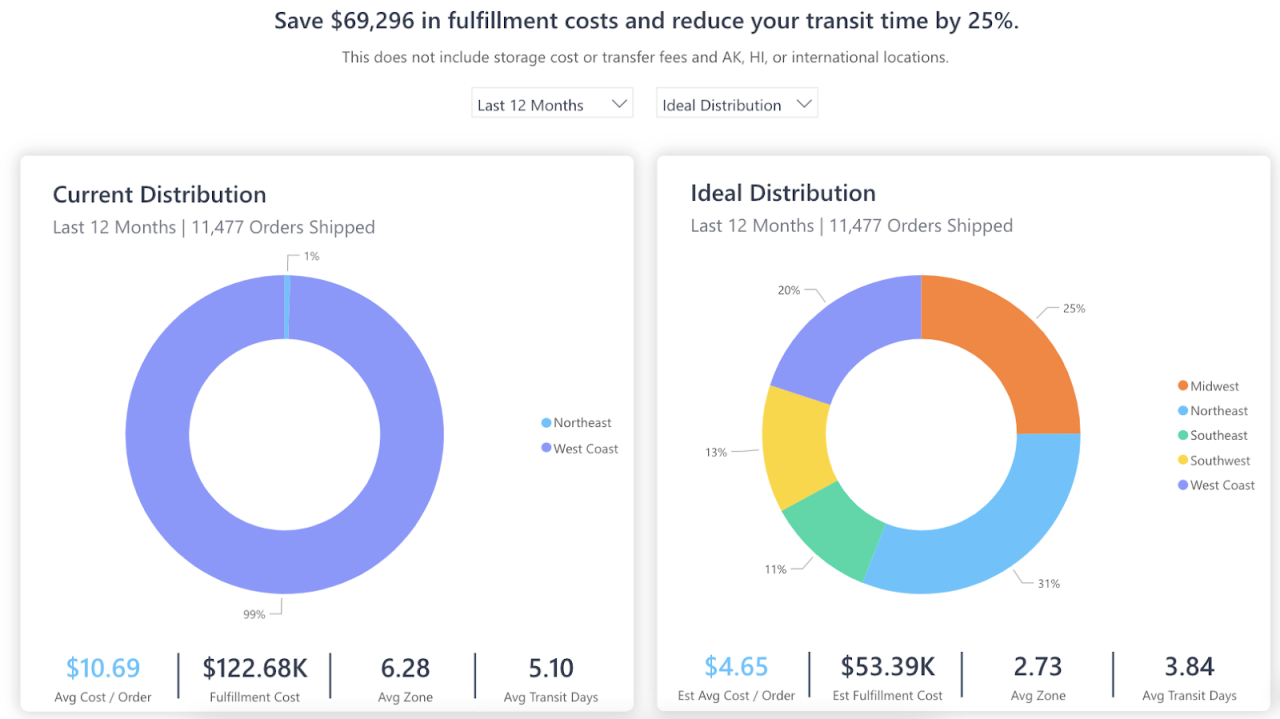
This automated approach reduces shipping costs and delivery times while simplifying inventory management for growing brands. Customers using our Inventory Placement Program have seen up to 13% reduction in shipping costs and 25% faster delivery times.
“On top of cost savings and fast shipping, we’ve been able to take a more hands-off approach to fulfillment and inventory distribution. We don’t have to be super involved in the day-to-day details and coordination, which is very helpful for our team.
IPP works overwhelmingly well. It’s efficient, seamless, and super automated. When you combine that with the fast, personal customer support ShipBob provides us with, it allows us to have full confidence that things are running well.”
Lizzie Vance, Sales Director at P.F. Candle Co.
Real-time inventory visibility & reorder point notification
Our intuitive dashboard provides complete visibility into your inventory with visual analytics that highlight performance trends. Automated reorder triggers alert you when stock levels fall below customized thresholds, preventing stockouts of your best-selling products.
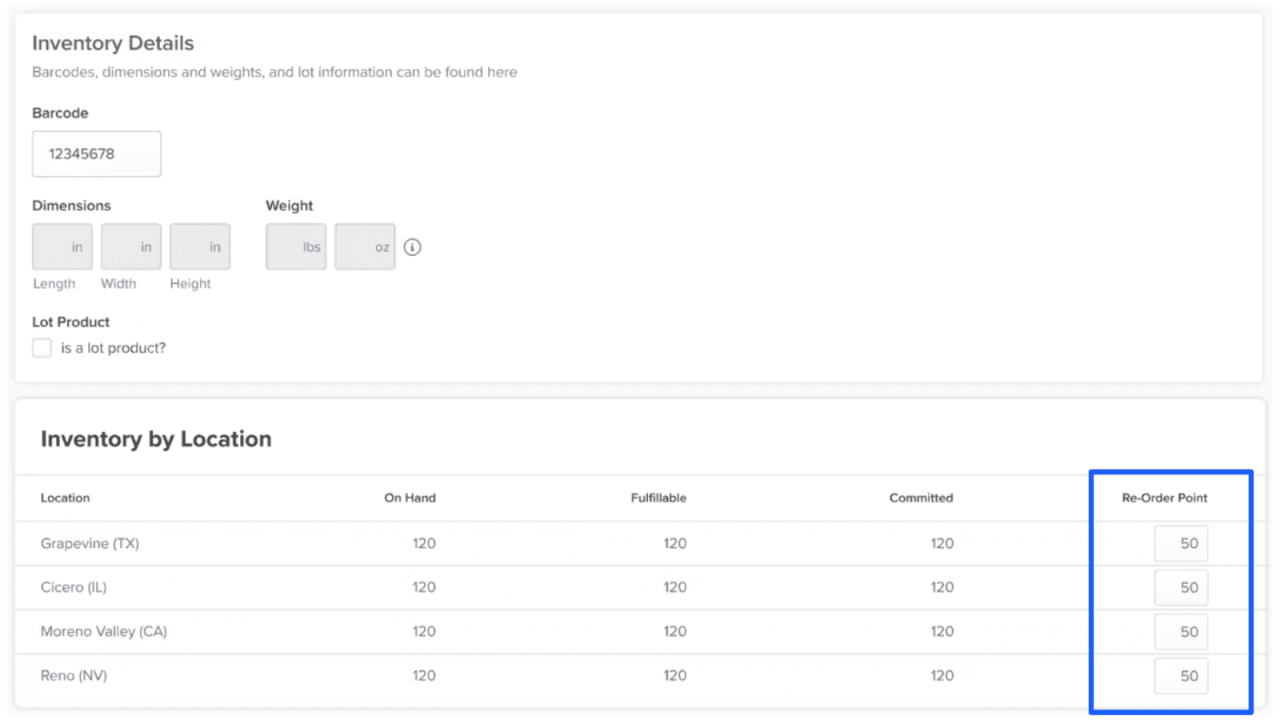
SKU velocity rules automatically adjust stock levels based on item performance, while early warning systems flag potential inventory issues before they impact sales. These features eliminate manual monitoring and free up your time to focus on growing your business.
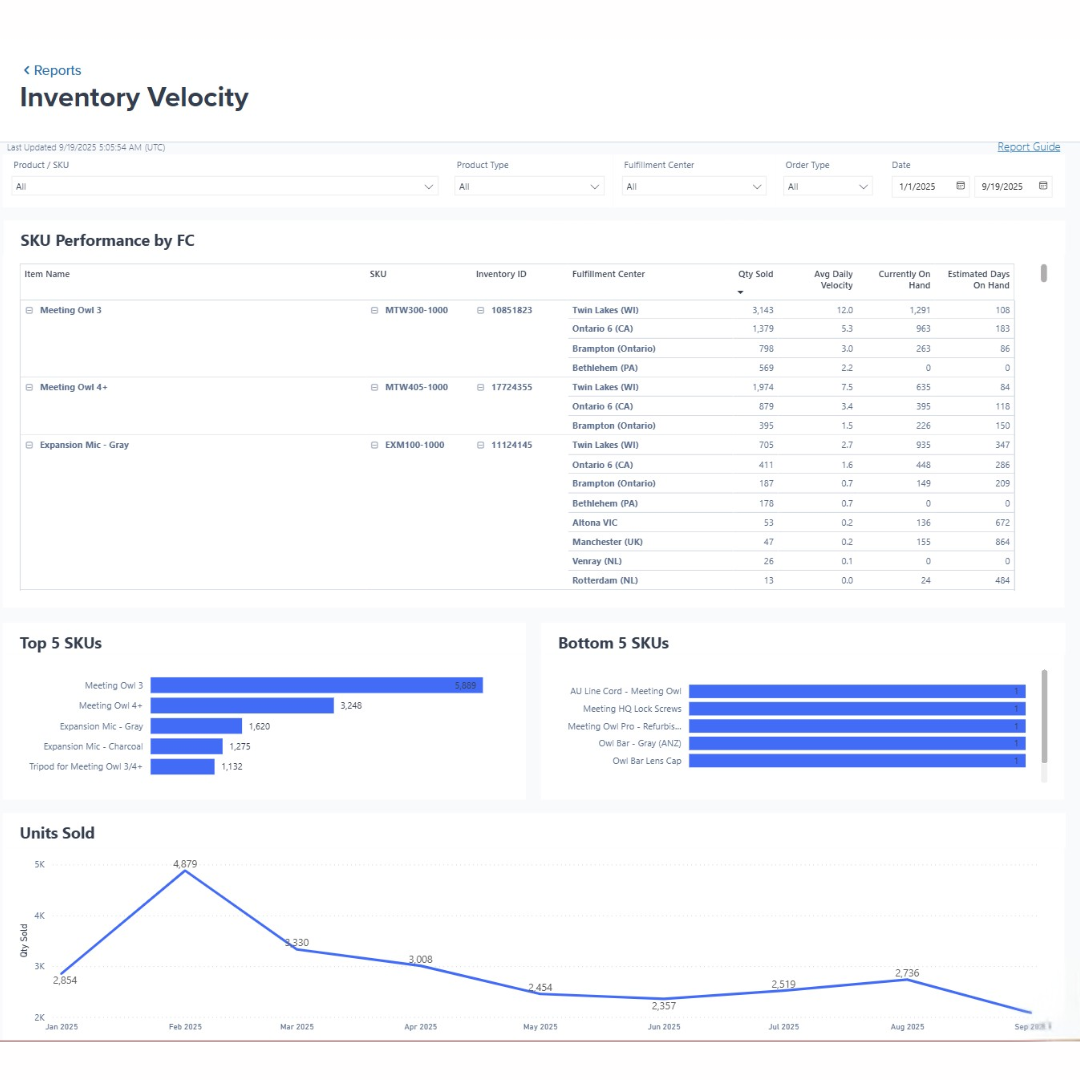
“One of my favorite parts of ShipBob’s solution is the analytics I get through the ShipBob dashboard. I use the reporting constantly, especially to track my stock. It’s even helping me get better at inventory forecasting.
Before, I was just fumbling through the demand planning process and just ordering inventory based on what sold out. But now I have insight into metrics like SKU velocity and inventory days on hand, and I’m using that to decide what to reorder and how much of it I need. That helps a lot, especially now that the brand is scaling and I’m ordering my products in bigger batches.”
Luke Rolls, Founder of The Protein Pancake
ShipBob’s WMS & fulfillment engine
ShipBob’s warehouse management system seamlessly integrates AI for continuous optimization. The platform connects with your existing sales channels and platforms to create a unified inventory ecosystem.

Our algorithm makes real-time adjustments based on incoming data, streamlining operations and reducing fulfillment costs. The system continuously learns from each order, improving accuracy and efficiency over time to maximize your fulfillment performance.
“ShipBob’s WMS has built-in inventory management features, and I’m constantly discovering new ways to take advantage of the technology. We’re actually doing cycle counts now; before ShipBob, we had some cycle counting, but you couldn’t trust any of it. As we’ve spent more time on ShipBob WMS, our trust is going up, and our inventory accuracy is improving with it.”
Tucker Robinson, Warehouse Director at Savannah Bananas
Streamlined rebalancing & inbound allocation
With ShipBob, you can send inventory to a single location, and our system strategically distributes products across our fulfillment centers based on demand forecasts. This approach dramatically simplifies logistics while ensuring optimal inventory positioning.
Internal transfer orders automatically adjust to shifting demand patterns, creating a dynamic solution that adapts to your business needs. This flexibility allows you to scale efficiently without the complexity of managing multiple warehouse relationships.
“Through IPP, we’ve distributed our inventory across four fulfillment centers on both US coasts and in the South and Southeast regions of the country. This means that our fulfillment locations are a lot closer to major ports and our manufacturers, which cuts down our dock-to-stock time and middle-mile costs.
Better yet, leveraging IPP, I don’t have to worry about arranging – or paying for! – inventory transportation to all four warehouses. All we have to do is send our inventory to ShipBob’s Northeast hub (which is only a four hours’ drive from our manufacturer) and then dictate what amount of inventory goes where through the ShipBob dashboard. From there, ShipBob takes care of the rest. They have their own trucks and distribute our inventory to each fulfillment center on our behalf.”
Nadav Haras, VP of Supply Chain at Particle
For more information about how ShipBob can help your brand optimize inventory management, click the button below to get in touch.
FAQs about predictive inventory management
Here are answers to common questions about predictive inventory management.
What makes predictive inventory management different from standard inventory forecasting?

Predictive inventory management uses AI and machine learning to generate actionable insights from real-time data. Unlike traditional forecasting that only uses historical data, predictive systems continuously learn and adapt, helping businesses anticipate demand shifts before they impact operations.
These systems analyze diverse data points to provide accurate forecasts that minimize both stockouts and excess inventory.
What role do AI and advanced analytics play in predictive inventory management?
AI and analytics form the core of predictive inventory management, identifying patterns humans would miss. These technologies excel at demand forecasting, anomaly detection, and scenario planning in dynamic markets.
Machine learning algorithms continuously improve predictions using real-time feedback. Rather than replacing human decision-making, these tools enhance it by providing insights for better planning and risk management.
How do I measure ROI for predictive inventory management?
Track both cost savings and revenue improvements by comparing before-and-after metrics: inventory turnover, stockout rates, carrying costs, and fulfillment speed.
When presenting to stakeholders, highlight broader benefits beyond cost reduction. Better product availability and faster delivery improve customer satisfaction, driving revenue growth and increasing customer lifetime value.
Can predictive inventory strategies help mitigate unexpected supply chain disruptions?
Yes, predictive inventory management provides early warnings of potential disruptions. By analyzing multiple data sources, these systems identify issues like supplier delays or demand spikes before they impact your business.
Distributing inventory across multiple fulfillment centers creates resilience, with predictive tools automatically rebalancing stock based on real-time signals. While no system eliminates all disruptions, predictive management helps businesses minimize risk and adapt quickly.
How does ShipBob’s approach to predictive inventory management differ from other solutions?
ShipBob combines advanced technology with physical fulfillment infrastructure for complete inventory optimization. Our fulfillment engine analyzes supply chain data to generate forecasts we execute through our global fulfillment network.
By integrating predictive analytics with warehousing and logistics, we streamline the entire inventory lifecycle without complex integrations.
What types of businesses benefit most from predictive inventory management?
While all businesses benefit, those with seasonal demand or unpredictable sales cycles see strongest results. These companies often struggle with traditional forecasting, leading to inventory problems.
Growing businesses scale more efficiently using data-driven insights across multiple channels. Companies with perishable goods or short-lifecycle products minimize spoilage and obsolescence, ensuring inventory sells before losing value.
How can I get started with predictive inventory management if I’m currently using basic forecasting methods?
First, evaluate your data infrastructure. Identify gaps, integrate systems, and standardize data formats.
Once your data foundation is solid, target quick wins like adjusting reorder points for top sellers or identifying slow movers for markdown. As you gain confidence, expand to more advanced strategies.
Partner with a provider like ShipBob that combines technology and expertise. Our specialists will guide your implementation from defining goals to setting up predictive models, helping you see results sooner.


