

Table of Contents
** Minutes
EDI and API integration options for 3PLs
6 steps to implement a 3PL integration solution
Benefits of integrated third party logistics
Common 3PL integration challenges (and how to overcome them)
Advanced 3PL integration strategies for ecommerce growth
ShipBob: the omnifulfillment platform that’s more than a 3PL
In today’s competitive ecommerce landscape, business success hinges on efficient logistics. As customers demand faster, cheaper shipping, many retailers can’t keep up. A well-integrated 3PL partnership is the solution.
3PL integration directly connects your ecommerce platform and inventory systems to your logistics provider’s technology, enabling real-time communication that streamlines operations, reduces costs, and enhances customer satisfaction.
In this article, you’ll learn how 3PL integrations work, their key advantages, and implementation steps.
How do 3PL integrations work?
A 3PL integration is the seamless connection between a business’s digital ecosystem and a third-party logistics provider.
This integration enables automated data flow, real-time communication, and streamlined operations, allowing ecommerce businesses to move beyond traditional logistics outsourcing and establish fully integrated partnerships.
By transforming logistics from a cost center to a strategic advantage, integrated 3PL solutions empower businesses to focus on growth and customer satisfaction.
3PL integration vs. traditional 3PL approach
In a traditional 3PL approach, businesses often rely on manual processes such as spreadsheets, emails, and phone calls to manage their logistics operations. This can be time-consuming, error-prone, and inefficient, especially as order volumes grow.
In contrast, an integrated 3PL solution automates these processes by enabling seamless data flow between the business’s systems and the 3PL’s technology stack.
For example, when a customer places an order on an ecommerce platform, an integrated 3PL system automatically imports the order details, updates inventory levels, and triggers the fulfillment process. The 3PL’s warehouse management system (WMS) then guides the picking, packing, and shipping of the order, with real-time updates sent back to the ecommerce platform at each stage.
This automation eliminates the need for manual data entry and reduces the risk of errors, saving time and resources.
| Feature | Traditional 3PL | Integrated 3PL |
| Order processing | Manual entry | Automated import |
| Inventory updates | Periodic reconciliation | Real-time synchronization |
| Shipping notifications | Manual emails | Automated tracking updates |
| Scalability | Limited by manual processes | Supports high-volume growth |
| Visibility | Fragmented, delayed data | Unified, real-time dashboards |
By leveraging the power of integration, businesses can streamline their logistics operations, reduce costs, and improve the speed and accuracy of their order fulfillment. This ultimately leads to a better customer experience, with faster shipping times, more reliable delivery estimates, and proactive communication throughout the order lifecycle.
EDI and API integration options for 3PLs
When it comes to integrating your systems with a 3PL company, there are two primary methods to consider: Electronic Data Interchange (EDI) and Application Programming Interface (API) integrations.
The choice between EDI and API (or using both) largely depends on your business model, the systems you currently use, and the requirements of your trading partners. It’s crucial to work with a 3PL that supports multiple integration methods to accommodate your unique needs and facilitate seamless connectivity.
EDI integrations
EDI has been a staple in the world of business-to-business (B2B) communication for decades. This standardized format for exchanging documents electronically is particularly prevalent in retail, wholesale, and B2B relationships.
EDI’s strength lies in its ability to handle high-volume, structured transactions efficiently and securely. If your business deals primarily with large retailers or suppliers who require EDI compliance, this integration method is likely a necessity.
API-based integrations
In recent years, API integrations have gained popularity due to their flexibility, real-time capabilities, and customization options.
APIs enable dynamic, two-way communication between systems, allowing for more granular control over data flow and functionality. This makes APIs particularly well-suited for modern ecommerce and direct-to-consumer (D2C) business models, where agility and responsiveness are key.
With an API integration, you can build custom workflows, access real-time data, and easily connect with a wide range of ecommerce platforms and tools.
Choosing the right integration method
Deciding between EDI and API (or using a combination of both) requires careful consideration of your business type, sales channels, and partner requirements.
For example, if you primarily sell wholesale to large retailers, EDI is likely a must-have. On the other hand, if you’re a D2C brand focused on ecommerce growth, API integrations with your ecommerce platform and other tools may be more critical.
In some cases, a hybrid approach that leverages both EDI and API integrations may be necessary to support different aspects of your business.
Whichever option you choose, it’s essential to assess your current systems, technical resources, and long-term goals. A forward-thinking 3PL partner can provide guidance on future-proofing your integration strategy as your business scales and evolves.
6 steps to implement a 3PL integration solution
Introducing a 3PL integration solution can seem like a daunting task, but with proper planning and execution, you can successfully streamline your logistics operations.
While the specifics may vary depending on your unique circumstances, here are the fundamental steps to a successful 3PL integration.
1. Define your integration needs and goals
Before diving into the technical aspects of integration, take the time to clearly define your business’s unique needs and goals.
- Document your current pain points and the desired outcomes you hope to achieve through integration.
- Involve stakeholders from various departments, such as operations, IT, and customer service, to gain a comprehensive understanding of the challenges and opportunities.
- Prioritize your integration requirements into must-haves and nice-to-haves, ensuring that you focus on the features that will deliver the most significant impact.
- Set specific, measurable objectives for the integration project, such as reducing order processing time by 50% or increasing inventory accuracy to 99%.
These clear goals will guide your decision-making throughout the implementation process.

2. Evaluate potential 3PL providers and their tech capabilities
With your integration needs and goals in mind, it’s time to assess potential 3PL partners and their technological capabilities.
- Look for providers that offer pre-built connectors for your essential systems, such as ecommerce platforms, ERPs, and inventory management tools.
- Evaluate the depth and quality of their API documentation, as this will be crucial for seamless integration.
- Don’t hesitate to ask questions about the level of technical support and implementation assistance each 3PL provides.
- Inquire about their experience with integrations similar to your requirements and request case studies or references from clients in your industry.
- Ensure that the 3PL’s technology stack is compatible with your existing systems to avoid costly customizations or workarounds.

3. Map out data flows and connect essential systems
A successful 3PL integration relies on the smooth flow of data between your business’s systems and the logistics provider’s platform.
- Begin by documenting the movement of critical information, such as order details, inventory levels, and customer data.
- Next, identify the key integration points between your ecommerce platform, ERP, warehouse management system (WMS), and other essential tools.
- Third, create detailed data mapping documents and workflow diagrams to visualize how information will be exchanged between systems.
Pay close attention to data validation rules and error handling procedures to ensure the accuracy and integrity of your logistics data, and collaborate closely with your 3PL’s technical team during this stage to ensure that all necessary connections are established and thoroughly tested.

4. Configure and test EDI/API setups
Before going live with your 3PL integration, it’s crucial to configure and test your EDI or API setups in a controlled environment.
Work with your provider to set up test scenarios that mimic real-world transactions, such as processing sample orders and handling edge cases. This will help you identify any issues or discrepancies before they impact your live operations.
During the initial testing phase, consider running your existing logistics processes in parallel with the new integrated system. This approach allows you to validate the accuracy of data flows and system performance while maintaining a safety net.
Monitor the results closely, comparing the output of the integrated setup against your current methods to ensure consistency and reliability.

5. Train your team and establish clear SOPs
Integration is not just a technical endeavor; it also requires your team to adapt to new processes and workflows.
- Training: Invest in comprehensive training for all staff members who will be interacting with the integrated systems, ensuring they understand how to perform their roles effectively in the new environment.
- SOPs: Develop clear standard operating procedures (SOPs) that outline the step-by-step processes for common tasks, such as order fulfillment, inventory management, and returns handling. These SOPs should be easily accessible and regularly updated as your operations evolve.
- Troubleshooting: Document troubleshooting guides for common issues, empowering your team to resolve problems quickly and independently.
- Responsibilities: Establish well-defined roles and responsibilities for the ongoing management and maintenance of your integrated logistics setup. This clarity will help ensure that your team can effectively collaborate with your 3PL partner and address any challenges that arise in a timely manner.

6. Monitor performance and optimize continuously
Implementing a 3PL integration solution is not a one-time event, but rather an ongoing process of monitoring, evaluation, and optimization.
- Establish key performance indicators (KPIs) to track the success of your integration, such as order accuracy, fulfillment speed, and shipping costs. Regularly review these metrics with your team and your 3PL partner to identify areas for improvement.
- Schedule periodic review meetings to address any issues or concerns that arise and to explore opportunities for further optimization.
- Encourage open communication and collaboration between your internal teams and your 3PL’s staff to foster a culture of continuous improvement.
- Stay informed about updates and new features released by your 3PL and other integration partners.
By adopting a mindset of continuous optimization, you’ll ensure that your 3PL integration remains a valuable asset for your ecommerce business in the long run.

Benefits of integrated third party logistics
Integrated 3PL solutions have the power to transform operations across multiple business functions, delivering benefits that compound over time as businesses scale and complexity increases.
💸 Cost reduction and efficiency
One of the most significant advantages of 3PL integration is the potential for cost savings and increased efficiency.
By eliminating manual data entry and automating order processing, businesses can significantly reduce labor costs associated with logistics operations.
Moreover, the accuracy achieved through automation minimizes costly errors in picking, packing, and shipping, further reducing expenses.
Integrated systems also enable 3PLs to optimize carrier selection and shipping routes, ensuring that orders are sent via the most cost-effective and efficient methods.
👀 Real-time visibility across your supply chain
Another key benefit of 3PL integration is the unprecedented level of visibility it provides across the entire supply chain.
Integrated dashboards offer instant updates on inventory levels across multiple locations, allowing businesses to make informed decisions about stock allocation and replenishment. This real-time data also enables more accurate inventory forecasting and planning, reducing the risk of stockouts or overstocking.
Additionally, integration allows businesses to track order status from placement through delivery, providing a clear picture of the fulfillment process. This visibility empowers proactive problem-solving and enhances communication with customers, as businesses can provide accurate updates on order progress and quickly address any issues that arise.
⚙️ Workflow automation
Integrated 3PL solutions streamline logistics processes by automating key workflows, such as order routing, label creation, and tracking updates. By programming business rules into the system, exceptions can be handled without human intervention, further reducing the need for manual oversight.
This automation frees up team members to focus on higher-value activities, such as customer service, product development, and strategic planning.
🌎 Scalability for omnichannel and global expansion
As ecommerce businesses expand into new sales channels and international markets, the complexity of their logistics operations increases exponentially.
Integrated 3PL solutions provide the scalability needed to handle this growth, making it easier to add new sales channels, marketplaces, and global regions without rebuilding logistics infrastructure from scratch.
With integration, businesses can ensure a consistent customer experience across all channels, as orders are processed and fulfilled through a unified system. This consistency is crucial for building brand loyalty and driving repeat purchases, regardless of where or how customers choose to shop.
🛍️ Improved customer experience
Ultimately, the benefits of 3PL integration converge to create a superior customer experience. Faster shipping times, accurate delivery estimates, and real-time tracking information all contribute to increased customer satisfaction and trust. Integrated systems also enable flexible delivery options and streamlined returns processes, further enhancing the post-purchase experience.
By leveraging 3PL integration to optimize logistics operations, businesses can foster long-term customer relationships and drive revenue growth.
Common 3PL integration challenges (and how to overcome them)
While 3PL integration offers clear benefits, these projects can be complex. With proper planning and the right partner, you can navigate these challenges successfully.
Technical hurdles
System compatibility is often the biggest challenge. Legacy systems may not easily connect with modern platforms, and data format inconsistencies can disrupt information flow. Some ecommerce platforms may also have limited API functionality.
Solution: Use middleware or integration platforms to bridge system gaps. Look for 3PLs that offer pre-built connectors for popular ecommerce platforms. If your technical resources are limited, partner with a 3PL that provides strong implementation support.
Operational complexities
Aligning existing processes with new automated workflows can be challenging, especially when synchronizing inventory across multiple channels or defining order routing logic.
Solution: Implement in phases, gradually rolling out and thoroughly testing new processes. Maintain clear communication between your team and the 3PL to quickly identify and resolve operational issues.
Organizational alignment
Integration requires buy-in from stakeholders across your organization. Resistance to change can be a significant barrier, especially from team members comfortable with existing processes.
Solution: Clearly communicate project goals and expected outcomes. Involve key stakeholders early in planning to build consensus. Provide thorough training on new systems to ensure a smooth transition and minimize disruption.
Advanced 3PL integration strategies for ecommerce growth
Ready to take your logistics to the next level? These advanced strategies can give you a competitive edge in adapting to changing market conditions and customer expectations.
From “one-size-fits-all” to expandable ecosystems
Rather than implementing rigid, all-in-one solutions, successful companies now choose flexible, modular approaches.
💡
Select a 3PL with a robust partner network and open APIs to easily connect specialized tools as your needs evolve.
This adaptable approach future-proofs your logistics operations, allowing quick responses to shifts in business models and customer preferences without being locked into inflexible solutions.
The 3PL integration “health check” framework
Regularly assess your integration’s performance using a structured approach.
💡
Monitor technical metrics (system uptime, error rates, processing speed) alongside operational KPIs (inventory accuracy, fulfillment speed, shipping costs).
Include customer impact measures like delivery times and satisfaction scores. Conduct quarterly reviews to identify optimization priorities and continuously improve your logistics operations.
Streamlining both B2B & D2C in a single integrated ecosystem
For businesses serving both wholesale and direct-to-consumer channels, a unified approach is key.
💡
Advanced 3PLs can handle the unique requirements of each channel within a single system, from EDI compliance for retailers to ecommerce processing for D2C sales.
Use real-time visibility and advanced inventory allocation to optimize stock levels across all channels. Integrated reporting simplifies managing multiple business models through consolidated performance data.
Turning inventory data into a competitive edge
3PL integration provides rich inventory insights beyond basic stock levels.
💡
Use real-time data and analytics to make informed decisions about reordering, allocation, and distribution. Leverage predictive capabilities for demand forecasting to reduce stockouts.
Actionable dashboards help optimize inventory management and improve cash flow, turning your data into a strategic advantage.
Building a resilient supply chain for seasonal peaks
Seasonal demand fluctuations can strain logistics operations. 3PL integration provides tools to build resilience through distributed inventory strategies and automated order processing and routing, optimizing fulfillment speed and cost during high-volume periods.
💡
Integrated systems allow temporary scaling without disruption, ensuring you meet customer expectations even during peak seasons.
ShipBob: the omnifulfillment platform that’s more than a 3PL
Integrated 3PL solutions turn logistics challenges into competitive advantages.
If you’re facing manual workflow issues, poor visibility, or growth limitations, partnering with an expert fulfillment and supply chain platform like ShipBob provides the automation and efficiency that today’s market demands.
ShipBob solves these problems with solutions built specifically for growing ecommerce brands that need operational excellence and global expansion capabilities.
Seamless integration for operational excellence
ShipBob’s robust integration capabilities eliminate the technical hurdles discussed earlier, offering both EDI and API solutions that connect effortlessly with your existing tech stack.
Our platform synchronizes with dozens of ecommerce platforms and marketplaces, enabling real-time data flow that transforms manual processes into automated workflows, reducing operational costs while minimizing fulfillment errors.
“Because we’ve been able to utilize ShipBob to fulfill all of our orders as a mini-ERP – including integrating directly to Amazon, multiple B2B channels, and our Shopify store – everything is so streamlined.”
Tyler McCann, Co-Founder of Taste Salud
Global fulfillment network with local expertise
Leverage ShipBob’s strategically located fulfillment centers across the US, Canada, the UK, Europe, and Australia to position inventory closer to your customers.
This distributed approach reduces shipping costs, accelerates delivery times, and provides the scalability needed for both seasonal peaks and sustained growth.
Whether you’re expanding into new markets or optimizing existing channels, our global infrastructure supports your business without requiring capital investment in physical facilities.
“We have a lot of customers in Canada, and we just recently expanded into one of ShipBob’s Canadian fulfillment centers. We’re providing a better delivery experience for Canadian customers since we’re shipping locally.
If customers get their products shipped directly from that Canadian warehouse, they’re saving three to four days of transit time and getting their orders faster – so being able to leverage ShipBob’s international footprint has been really beneficial.”
Oscar Gutierrez, Operations Fulfillment Manager at goPure
Advanced inventory intelligence
Convert the real-time visibility advantages of 3PL integration into actionable business insights with ShipBob’s analytics dashboard.
Our system provides demand forecasting tools that help prevent stockouts and overstocking, (improving both customer satisfaction and cash flow management) and that help you make data-driven decisions about inventory allocation, reorder timing, and distribution strategy based on comprehensive metrics.
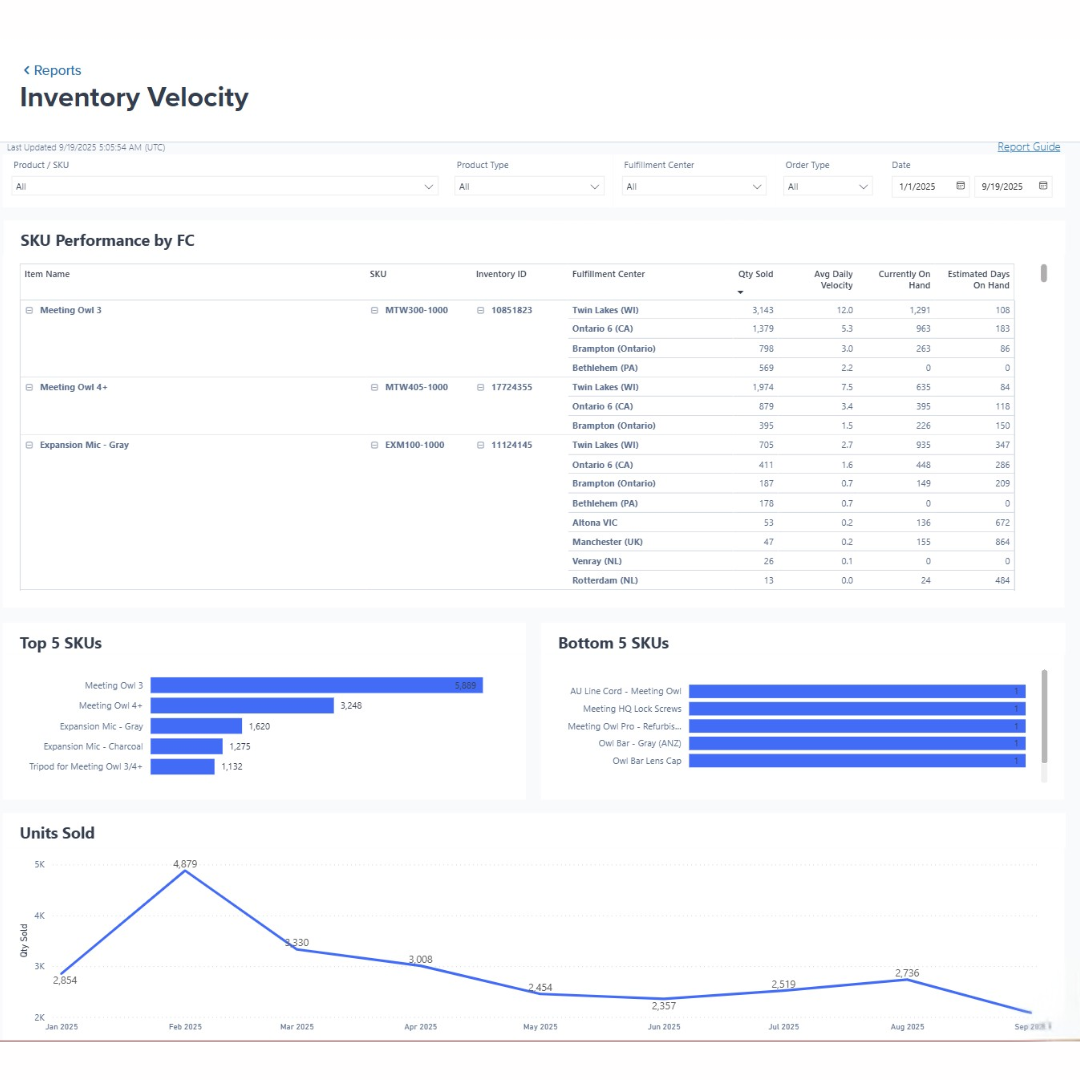
“One of my favorite parts of ShipBob’s solution is the analytics I get through the ShipBob dashboard. I use the reporting constantly, especially to track my stock. It’s even helping me get better at inventory forecasting.
Before, I was just fumbling through the demand planning process and just ordering inventory based on what sold out. But now I have insight into metrics like SKU velocity and inventory days on hand, and I’m using that to decide what to reorder and how much of it I need. That helps a lot, especially now that the brand is scaling and I’m ordering my products in bigger batches.”
Luke Rolls, Founder of The Protein Pancake
Omnichannel fulfillment expertise
ShipBob’s unified platform seamlessly handles both B2B and D2C orders through a single integration, allowing you to manage orders from wholesale and direct-to-consumer streams through one unified system.
Our specialized workflows accommodate the unique requirements of each channel, from EDI compliance for major retailers to personalized unboxing experiences for your direct customers.
“Our 3 big channels are DTC, marketplaces like Amazon and TikTok, and B2B across the UK and across Europe.
We work with over 50 B2B retailers, including ASOS, Boots, and Druni. ShipBob handles our freight, as well as DTC and B2B fulfillment.
We have our entire logistics and fulfillment operation under one roof and not split up across different companies. Having a partner that can do it all has been really beneficial for our business.”
Callum Jones, Director of Operations & Marketplace, and Rachel Hicks, Operations Manager at Hairburst
Ready to transform your logistics operations with a truly integrated outsourced fulfillment and logistics solution? Click the button below to get in touch.
FAQs about 3PL integration solutions
Here are answers to some of the most common questions about 3PL integration solutions.
What is the difference between a 3PL integration and a standard 3PL partnership?

Standard 3PL partnerships typically involve manual processes like spreadsheets and emails to share order information. This approach is time-consuming, error-prone, and offers limited visibility.
3PL integration establishes automated data flows between your systems and the 3PL’s software. This connection eliminates manual tasks, reduces errors, and provides real-time insights into inventory, orders, and shipping.
What systems can typically be integrated with a 3PL?
Common systems that integrate with 3PLs include:
- Ecommerce platforms: Shopify, WooCommerce, Magento, BigCommerce
- Marketplaces: Amazon, Walmart, eBay, Etsy
- Back-office systems: ERP, inventory management, WMS
- Specialized tools: Returns management, shipping software, customer service solutions
These integrations create a cohesive fulfillment ecosystem supporting your unique business needs.
How do I measure ROI from a 3PL integration solution?
Track these key areas when measuring ROI:
- Labor cost reduction: Time and resources saved by automating data exchange
- Error rate decrease: Reduction in picking, packing, and shipping errors
- Inventory carrying costs: Impact of real-time visibility on stock optimization
- Customer impact: Improvements in delivery speed, satisfaction scores, and repeat purchases
Quantifying these benefits helps determine your overall ROI and guides future optimizations.
Can I use a customizable API to build a tailored ecommerce workflow?
Yes. Custom API development allows seamless integration between your systems and the 3PL’s software, enabling workflows that perfectly fit your operational needs. This approach offers greater flexibility and control than pre-built connectors alone.
However, balance customization with maintenance considerations. Ensure your 3PL provides comprehensive documentation and ongoing technical support for successful implementation.
How can 3PL integration help with returns management?
Key benefits include:
- Automated returns initiation: Customers start returns online with information automatically synced to the 3PL
- Real-time visibility: Track return status and inventory impact instantly
- Customer-friendly policies: Offer hassle-free returns that enhance satisfaction and loyalty
- Data-driven insights: Analyze returns data to identify trends and improve products
Integration helps you efficiently handle reverse logistics while maintaining positive customer experiences.
Does ShipBob support advanced 3PL integrations?
Yes, ShipBob offers advanced integration capabilities including:
- Open API: Build custom integrations connecting your unique systems
- Pre-built connectors: Quick integration with popular platforms and marketplaces
- Partner ecosystem: Access to specialized solutions for a tailored fulfillment stack
- Unified dashboard: Centralized view of inventory, orders, and shipping across channels
ShipBob’s global fulfillment network and automated routing help you scale and reach customers worldwide, with dedicated technical support for implementation and ongoing optimization.


