

Table of Contents
** Minutes
What is Fulfilled by Amazon (FBA)?
How much does Amazon FBA cost?
What are common Amazon FBA fees?
Amazon raised FBA fulfillment fees by roughly $0.08 per unit on January 15, 2026. Then on April 17, it layered a 3.5% fuel and logistics surcharge on top of every FBA and MCF fee in the US and Canada. For brands already juggling a dozen fee types, the math just got harder.
Though for brands selling exclusively on Amazon, FBA is still powerful. But as fees compound year over year, understanding when FBA economics work and when they don’t is the difference between growth and margin erosion.
In this article, we break down every major Amazon FBA fee, show you how to calculate your true per-unit cost, and explain how a hybrid fulfillment strategy can protect your margins across channels.
What is Fulfilled by Amazon (FBA)?
FBA is Amazon’s fulfillment service. You ship inventory to Amazon’s warehouses, and Amazon handles picking, packing, and shipping each order to the customer. Your products become eligible for Prime, which can accelerate sales velocity and improve Buy Box positioning.
FBA products often sell faster thanks to Prime eligibility. But it’s also the most expensive fulfillment option Amazon offers, with fees spanning storage, fulfillment, referrals, and surcharges that add up quickly.
Other types of Amazon fulfillment methods
If you sell on Amazon, you have three fulfillment methods to choose from:
- Fulfilled by Amazon (FBA): You ship inventory to Amazon, and Amazon fulfills orders on your behalf.
- Fulfilled by Merchant (FBM): You (or your fulfillment partner) ship products directly to customers after receiving orders from Amazon.
- Seller-Fulfilled Prime (SFP): You fulfill orders yourself while displaying the Prime badge, provided you meet Amazon’s strict shipping standards.
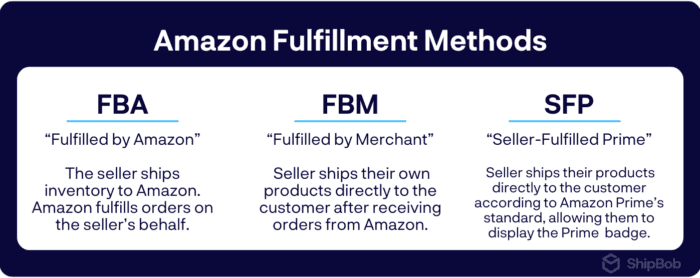
Many brands now run a hybrid FBA and FBM model. They use FBA for Prime-eligible bestsellers and FBM through a fulfillment partner for DTC, B2B, and lower-velocity SKUs. Each method has its own pricing structure. The right mix depends on your product catalog, margins, and channel strategy.
Disclaimer: This article provides an overview of common Amazon FBA fees at the time of writing. Actual fees vary depending on your industry, products, seasonality, sales channels, order volume, and more. Rates and fee types are subject to change.
Keep these variables in mind as you work through the fee breakdown below.
How much does Amazon FBA cost?
There’s no single “FBA fee.” A seller’s true cost per unit is the sum of referral fees, fulfillment fees, storage fees, inbound placement fees, and surcharges.
Here’s what that can look like for a standard-size item priced at $25.00:
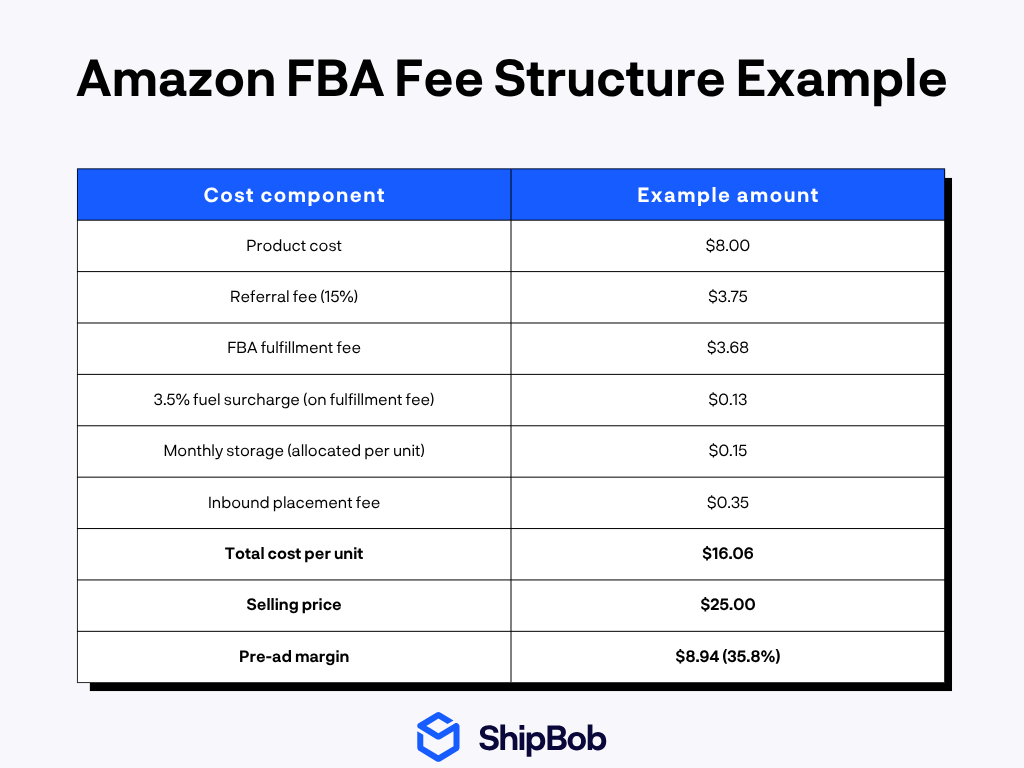
That 35.8% margin looks workable until you factor in advertising spend, FBA returns, and aged inventory surcharges. For lower-priced or bulkier products, the math gets worse fast.
Amazon’s FBA Revenue Calculator and Fee Preview Report are the best tools to verify per-SKU fees before sending inventory. Below, we break down each fee type so you know exactly where your margin goes.
| Fee Type | Price |
|---|---|
| Low-Price FBA fulfillment fees (per unit) — Items priced under $10.00 Cost depends on shipping weight, season, product type, and packaging material. Excludes apparel, dangerous goods, and Ships in Product Packaging (SIPP). |
Small Standard: $2.29 – $3.10 Large Standard: $2.91 – $6.69 + $0.08 per 4 oz interval above first 3 lb Large Bulky: $8.84 – $9.88 + $0.38/lb interval above first lb Extra-Large: From $25.56 + $0.38/lb interval above first lb to $202.69 + $0.19/lb interval above 151 lb |
| FBA fulfillment fees (per unit) — Items priced $10.00+ Cost depends on shipping weight, season, product type, and packaging material. Excludes apparel, dangerous goods, and Ships in Product Packaging (SIPP). |
Small Standard: $3.06 – $3.87 Large Standard: $3.68 – $7.46 + $0.08 per 4 oz interval above first 3 lb Large Bulky: $9.61 – $10.65 + $0.38/lb interval above first lb Extra-Large: From $26.33 + $0.38/lb interval above first lb to $203.46 + $0.19/lb interval above 151 lb |
| Monthly inventory storage | $0.56 – $4.28 per cubic foot, depending on season, size, item type, and storage utilization surcharge eligibility |
| Aged inventory surcharge | $0.50 – $6.90+ per cubic foot, depending on days stored |
| Inventory storage overage fee | $10 per cubic foot monthly |
| Product return fees Excludes apparel and shoes. | $1.78 – $157.35+ per unit returned above product category threshold |
| Inventory removal and disposal fees | $1.04 – $14.32+ per unit depending on shipment weight |
| Unplanned services fees | $0.20 – $2.00 per unit depending on problem group |
| Manual processing fees | $0.15 – $0.30 per unit |
| Package prep fees | $0.70 – $2.55 per unit depending on product category, size tier, and selected service(s) |
| Inbound placement service fee | $0.21 – $6.00 per unit depending on item sizing tier, item weight, number of fulfillment centers, and inbound location |
| Low-level inventory fee | $0.89 – $1.11 per unit depending on item sizing tier, shipping weight, and historical days of supply |
| Inbound defect fee | $0.04 – $0.07 per unit depending on item sizing tier, shipping weight, and defect type |
(Source: Amazon Seller Central)
What are common Amazon FBA fees?
Amazon FBA fees fall into two main buckets. The first is fees you pay on every sale, including referral fees and fulfillment fees. The second is fees tied to inventory management, including inventory storage, placement, and surcharges. Here’s what each one means and why costs vary so widely.
Referral fees
Amazon charges a referral fee on every sale, regardless of your fulfillment method. This fee is a percentage of the item’s selling price and varies by product category.
Most categories fall between 8% and 17%, but Amazon device accessories go as high as 45%. The commonly cited “15% flat fee” is a rough average, not a universal rate. Check Amazon’s referral fee schedule for your specific category before projecting margins.
FBA fulfillment fees
With its FBA fulfillment fee, Amazon bundles picking, packing, and shipping into a single per-unit charge. Many ecommerce fulfillment providers break those out as separate line items, which makes per-order economics easier to read.
Two pricing structures apply:
- Low-price FBA fulfillment fees for items priced under $10
- Regular FBA fulfillment fees for items priced at $10 or above
Within each structure, the fee depends on your product’s size tier and shipping weight. Amazon uses four main size tiers: Small Standard, Large Standard, Large Bulky, and Extra-Large. Each has its own sizing specifications, which you can find on Amazon Seller Central’s 2026 FBA fee changes page.
Amazon uses the greater of unit weight or dimensional weight as the “shipping weight.” The heavier or bulkier your product, the higher the fee.
As of January 15, 2026, standard-size items priced $10 to $50 saw an average increase of roughly $0.08 per unit. Small standard-size items saw increases of about $0.12 per unit. On top of that, the 3.5% fuel and logistics surcharge effective April 17, 2026 applies to all base fulfillment fees. For a product with a $3.68 base fee, that adds approximately $0.13 per unit.
Brands can reduce fee exposure by right-sizing packaging to hit a lower size tier. Dynamic bundling can also improve unit economics on bulkier or low-AOV SKUs. ShipBob offers box-size variety and value-added services like kitting at the fulfillment center. For brands that bundle, that’s a structural difference from Amazon MCF, which stores bundles as a single ASIN.
Amazon ships your products in Amazon-branded boxes. If custom unboxing and branded packaging are part of your customer experience strategy, FBA limits what you can control.Amazon also ships your products in Amazon-branded boxes.
FBA storage fees
To use FBA, you store inventory in Amazon’s fulfillment centers and pay monthly storage fees based on the cubic footage your products occupy.
As of 2026, monthly storage fees range from $0.53 to $4.28 per cubic foot for standard-size items. The exact rate depends on the time of year (Q4 rates are higher), the physical size of your items, and whether they’re classified as dangerous goods. Whether you qualify for the storage utilization surcharge also affects the rate.
For inventory that sits too long, Amazon charges escalating aged inventory surcharges:
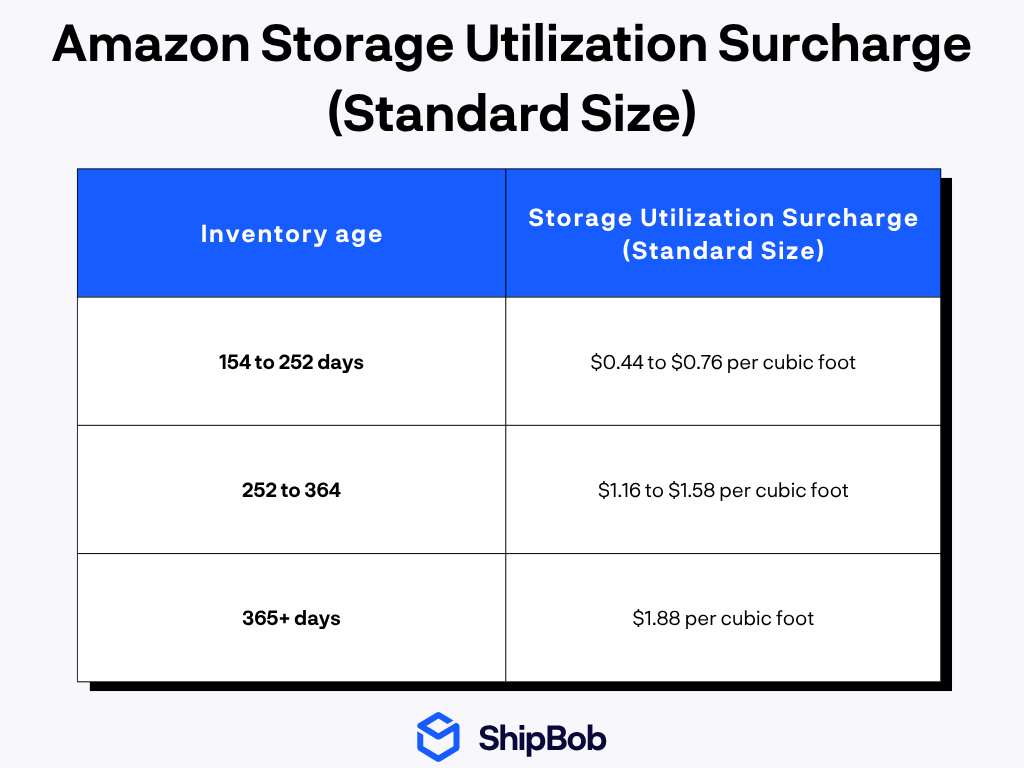
Aged inventory fees signal weak demand forecasting and poor replenishment timing. Brands that over-ship to Amazon without matching inventory to sell-through velocity pay surcharges that erode margin on every unit that sits too long.
ShipBob’s Inventory Placement Program uses time-series demand forecasting to distribute inventory across ShipBob’s US network of fulfillment centers based on actual demand patterns. Our Place, a cookware brand, saved over $1.5 million in outbound freight costs using IPP. This approach reduces aged inventory risk by matching stock levels to regional demand rather than overshipping to a single location.
Other FBA fees explained
Beyond the core fees above, FBA can trigger several additional charges depending on your operations:
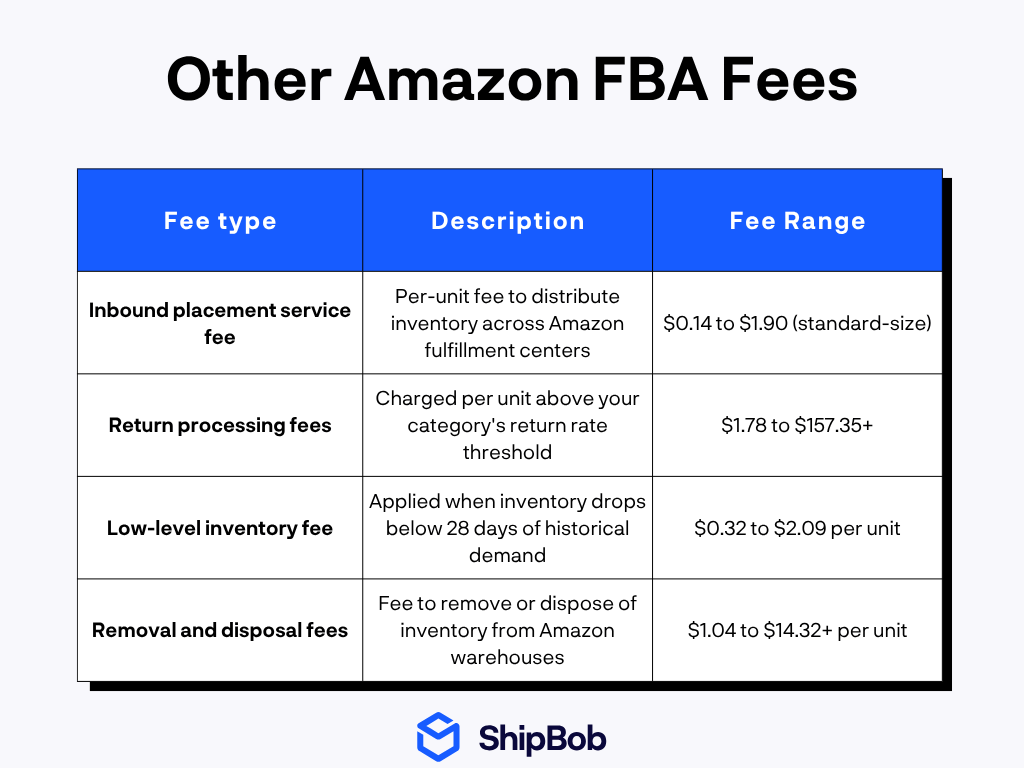
Manual processing fees, unplanned services fees, and package prep fees may also apply in specific situations. See Amazon’s full fee schedule for details.
Amazon’s fee structure is complex, and small charges add up across thousands of units.
How to calculate Amazon FBA seller fees
Once you understand the fee types, the next step is calculating your actual per-unit cost. Here’s a five-step process.
Step 1: Determine your size tier and shipping weight
Measure your product’s dimensions and weight, then classify it into one of Amazon’s four size tiers (Small Standard, Large Standard, Large Bulky, or Extra-Large). Remember that Amazon uses the greater of unit weight or dimensional weight. Getting this right is the foundation of every fee calculation.
Step 2: Look up your fulfillment fee and referral fee
Use Amazon’s FBA Revenue Calculator to look up the fulfillment fee for your size tier and weight. Then add your category’s referral fee percentage. This tool is the single most useful resource for pre-listing fee estimation.
Step 3: Estimate storage, inbound, and surcharge costs
Factor in your monthly storage allocation per unit, inbound placement fees (if you’re not using Amazon-optimized shipment splits), and the 3.5% fuel and logistics surcharge on your fulfillment fee. If your product has slower turnover, model the aged inventory surcharge at the 181-day mark.
Step 4: Calculate your per-unit margin
Add all fees together and subtract from your selling price, along with your product cost. Reference the worked example in the “How much does Amazon FBA cost?” section above. If your pre-ad margin falls below roughly 20%, that SKU may not be viable in FBA after advertising spend.
Step 5: Compare against an FBA alternative
Once you know your per-unit FBA cost, compare it against a fulfillment partner like ShipBob. This comparison matters most for SKUs you also sell on your own site, through retail, or internationally.
ShipBob’s pricing model offers a few structural advantages over FBA:
- No peak-season fulfillment rate increases. FBA’s fuel surcharge plus peak storage fees make Q4 costs unpredictable. ShipBob doesn’t raise fulfillment rates during peak season.
- No referral fee on non-Amazon orders. Every order you fulfill outside Amazon avoids the 8% to 45% referral fee entirely.
- Transparent line-item billing. Storage, shipping, and fulfillment charges are separated in the ShipBob dashboard, not bundled into opaque per-unit fees.
FBA gives you the Prime badge and free onboarding, which matter. But if you’re selling across channels, FBA’s fee structure adds cost on every order that isn’t pure Amazon.
Shipping costs are variable in nature, based on weight, dimensions, destination, service, and more.
Running these five steps before committing inventory to FBA gives you a clear picture of true per-unit economics across every channel you sell on.
Reduce your FBA fee exposure with a hybrid ShipBob and Amazon strategy
You don’t have to choose between FBA and an ecommerce fulfillment partner that goes beyond a traditional 3PL. The most effective approach for multi-channel brands is a hybrid strategy: use FBA for what it does best (winning on Amazon) and ShipBob for everything else. Amazon fulfills orders. ShipBob fulfills your brand, with custom packaging, multi-channel visibility, and a partner that works for you, not alongside you.
ShipBob FBA Prep: Keep selling on Amazon, reduce the headaches
ShipBob offers FBA Prep services that handle receiving, inspecting, labeling, poly-bagging, and shipping your inventory to Amazon fulfillment centers on your behalf. You keep your Prime eligibility and Buy Box positioning without managing the prep process in-house.
This is the entry point for a hybrid strategy. Use ShipBob to prep and ship inventory to Amazon for your Prime-eligible bestsellers, while fulfilling DTC, B2B, and international orders directly from ShipBob’s network. One partner, one inventory pool, two fulfillment channels.
FBA Prep is available for US merchants and select international markets including the UK, Canada, Australia, and several European countries.
“Because we’ve been able to utilize ShipBob to fulfill all of our orders as a mini-ERP – including integrating directly to Amazon, multiple B2B channels, and our Shopify store – everything is so streamlined.”
Tyler McCann, Co-Founder of Taste Salud
That kind of consolidation is the point. One fulfillment partner handling both Amazon prep and direct-to-consumer shipping removes the operational overhead of managing multiple providers.
Predictable pricing with no peak-season surcharges
FBA’s cost structure shifts constantly. January brought a per-unit fulfillment fee increase. April added a 3.5% fuel surcharge. Q4 brings elevated storage fees. Each year adds another layer.
ShipBob doesn’t increase fulfillment rates during peak season. There’s no referral fee on non-Amazon orders. Billing is broken out line by line in the ShipBob dashboard so you can see exactly what you’re paying for storage, shipping, and fulfillment separately.
“Everybody expects Amazon-level shipping speeds and 2-day or next-day delivery. To provide that to our customers via ground shipping, we need to increase the number of fulfillment centers we use to reduce shipment time. Instead of partnering with a bunch of different providers that each have one or two warehouses, we can just distribute inventory across ShipBob’s dozens of US fulfillment centers.”
Jessica Cedarleaf, VP of Operations at Tonies
For brands forecasting margins across quarters, that predictability matters more than saving a few cents on any single shipment.
Smarter inventory distribution to reduce fee leakage
Amazon’s aged inventory surcharges and low-level inventory fees are both symptoms of the same problem: inventory in the wrong place at the wrong time.
As an ecommerce fulfillment expert and supply chain enablement platform, ShipBob addresses this through its Inventory Placement Program (IPP), using demand forecasting to distribute inventory across ShipBob’s US network of fulfillment centers based on where your customers actually are. You ship to one hub location, and ShipBob handles distribution to regional spoke locations.
This cuts shipping costs because you’re shipping from locations closer to customers. It also speeds up delivery times and reduces the risk of inventory aging out in a single warehouse. DTC, B2B, and marketplace orders all pull from the same inventory pool, eliminating the need to segment stock by channel.
“Expanding our warehouse network from 2 to 4 warehouses has translated into $1.5 million in freight cost savings for Our Place. It also cut our fulfillment and shipping times in half, from 5 or 6 days to just 2.5 days.”
Ali Shahid, COO of Our Place
That kind of cost reduction starts with placing inventory where demand actually exists rather than concentrating it in a single location.
Where FBA still wins (and where it doesn’t)
Being honest about this makes the decision clearer:
FBA wins on:
- Prime badge and Buy Box weighting for Amazon orders
- Free onboarding with no upfront costs
- Amazon’s massive fulfillment center network optimized for Amazon orders
FBA loses on:
- Multi-channel economics: MCF fees plus referral fees apply on every channel, not just Amazon
- Fee unpredictability: annual increases, surcharges, and peak-season storage spikes
- No packaging customization: every order ships in an Amazon-branded box
- No bundling flexibility: MCF requires pre-assembled bundles stored as a single ASIN
- Punitive storage and aged inventory fees for slower-moving SKUs
Most brands scaling across channels run a hybrid model: FBA for Prime-eligible Amazon orders, and an ecommerce fulfillment expert like ShipBob for DTC, B2B, and international. One inventory pool, full visibility across every channel.
“Most other companies like Amazon are structured in such a way that you don’t have flexibility — you’re just a small part of their business, so there’s no patience for you.
The amazing thing about ShipBob has not just been its flexibility and ability to customize, but also the support it’s given us whenever we’ve faced problems. Having support through ShipBob has really allowed us to capture growth well.”
Aaron Patterson, COO of The Adventure Challenge
Get started with ShipBob
Need an ecommerce fulfillment partner that goes beyond a traditional 3PL? Connect with our team to get a customized quote.
Amazon FBA FAQs
Here are some of the most commonly asked questions about Amazon FBA fees.
Is there a monthly fee for Amazon FBA?

Amazon charges a $39.99 monthly subscription for its Professional seller plan, which is required for most FBA sellers. The Individual plan has no monthly fee but charges $0.99 per item sold. These seller plan fees are separate from FBA fulfillment, storage, and referral fees, which are charged on top of the subscription.
How much is the Amazon seller fee?
Amazon sellers pay three types of fees. First, a seller subscription fee ($0.99 per item on the Individual plan or $39.99 per month on the Professional plan). Second, a referral fee on every sale that varies by category, typically 8% to 17% but up to 45% in some categories. Third, FBA-specific fees for fulfillment, storage, and surcharges if you use Fulfilled by Amazon.
How do I start an Amazon FBA business?
Before you choose Amazon as a sales channel and FBA as a fulfillment method, take a step back and look at your ecommerce strategy as a whole. What products will you sell? What brand experience do you want to create?
The FBA fulfillment model is not for everyone. While it can maintain healthy margins for some businesses, it may not make sense for others.
To get started, check out this Ecommerce Store Launch Checklist for a step-by-step guide to getting started selling online.
How does Amazon FBA work?
Sellers using FBA sell their products on Amazon’s marketplace and store their inventory in Amazon’s fulfillment centers. FBA sellers pay Amazon for inventory storage space.
The order is then picked, packed, and shipped to the customer by Amazon in an Amazon-branded box or poly mailer, and the seller is charged a predetermined fulfillment fee.
How can I reduce my Amazon FBA fees?
Four strategies help reduce FBA costs. First, optimize packaging dimensions to qualify for a lower size tier. Second, improve inventory turnover to avoid aged inventory surcharges that kick in at 181 days. Third, use Amazon’s FBA Revenue Calculator before listing to identify SKUs with thin margins. Fourth, consider a hybrid FBA and FBM strategy where a fulfillment partner like ShipBob handles non-Amazon orders without the referral fee or peak-season surcharges.
Why should I choose FBM over FBA?
Many brands don’t choose one or the other. They use FBA for Prime-eligible Amazon orders and FBM through an ecommerce fulfillment partner like ShipBob, which delivers more than a traditional 3PL, for DTC, B2B, international, and lower-margin SKUs where FBA fees erode profitability. FBM also gives you control over branded packaging, bundling, and the customer experience in ways FBA doesn’t allow.
How can I reduce my Amazon FBA fees?
Four strategies help reduce FBA costs. First, optimize packaging dimensions to qualify for a lower size tier. Second, improve inventory turnover to avoid aged inventory surcharges that kick in at 181 days. Third, use Amazon’s FBA Revenue Calculator before listing to identify SKUs with thin margins. Fourth, consider a hybrid FBA and FBM strategy where a fulfillment partner like ShipBob handles non-Amazon orders without the referral fee or peak-season surcharges.
What is the Amazon FBA fuel surcharge in 2026?
Starting April 17, 2026, Amazon applies a 3.5% fuel and logistics surcharge on top of all FBA and MCF fulfillment fees. For a product with a $3.68 base fulfillment fee, this adds approximately $0.13 per unit. The surcharge is calculated on the base fee amount before any other adjustments.
Can I use a fulfillment partner and FBA at the same time?
Yes. Many brands run a hybrid model where FBA handles Prime-eligible Amazon orders and ShipBob, the ecommerce fulfillment expert and supply chain enablement platform, handles DTC, B2B, and international fulfillment. ShipBob’s FBA Prep service bridges both channels by receiving, labeling, and shipping inventory to Amazon fulfillment centers on your behalf while also fulfilling non-Amazon orders from the same inventory pool.


