

Table of Contents
** Minutes
How do you get discounted shipping rates?
Shipping costs can quickly eat up profit margins for ecommerce businesses. With everything else involved in running an online store, finding ways to reduce these expenses can feel overwhelming. However, securing discounted rates can dramatically improve profitability. For brands looking to grow and scale, minimizing shipping costs not only improves margins but also helps businesses remain competitive.
The question is, how do you get those discounts? In this article, we’ll explore a few strategies to help ecommerce businesses secure discounted shipping rates, such as negotiating with carriers, optimizing inventory distribution, and partnering with third-party fulfillment providers like ShipBob.
How do you get discounted shipping rates?
Shipping costs vary based on multiple factors, including size, weight, destination, shipping speed, and carrier.
Even a slight reduction in shipping and handling costs can lead to significant savings, particularly as you scale your operations. But how do ecommerce businesses secure discounted shipping rates? Here are a few strategies.
Brands can use these strategies to get discounted shipping rates.
Negotiate with carriers
One of the most direct ways to secure discounted shipping rates is to negotiate directly with carriers like USPS, UPS, FedEx, or DHL. While it might seem daunting, carriers are often willing to offer reduced rates to businesses that can provide consistent shipping volumes, have specific needs, or present a growth opportunity. Many carriers also offer free shipping supplies as part of these partnerships, which can further reduce costs for businesses.
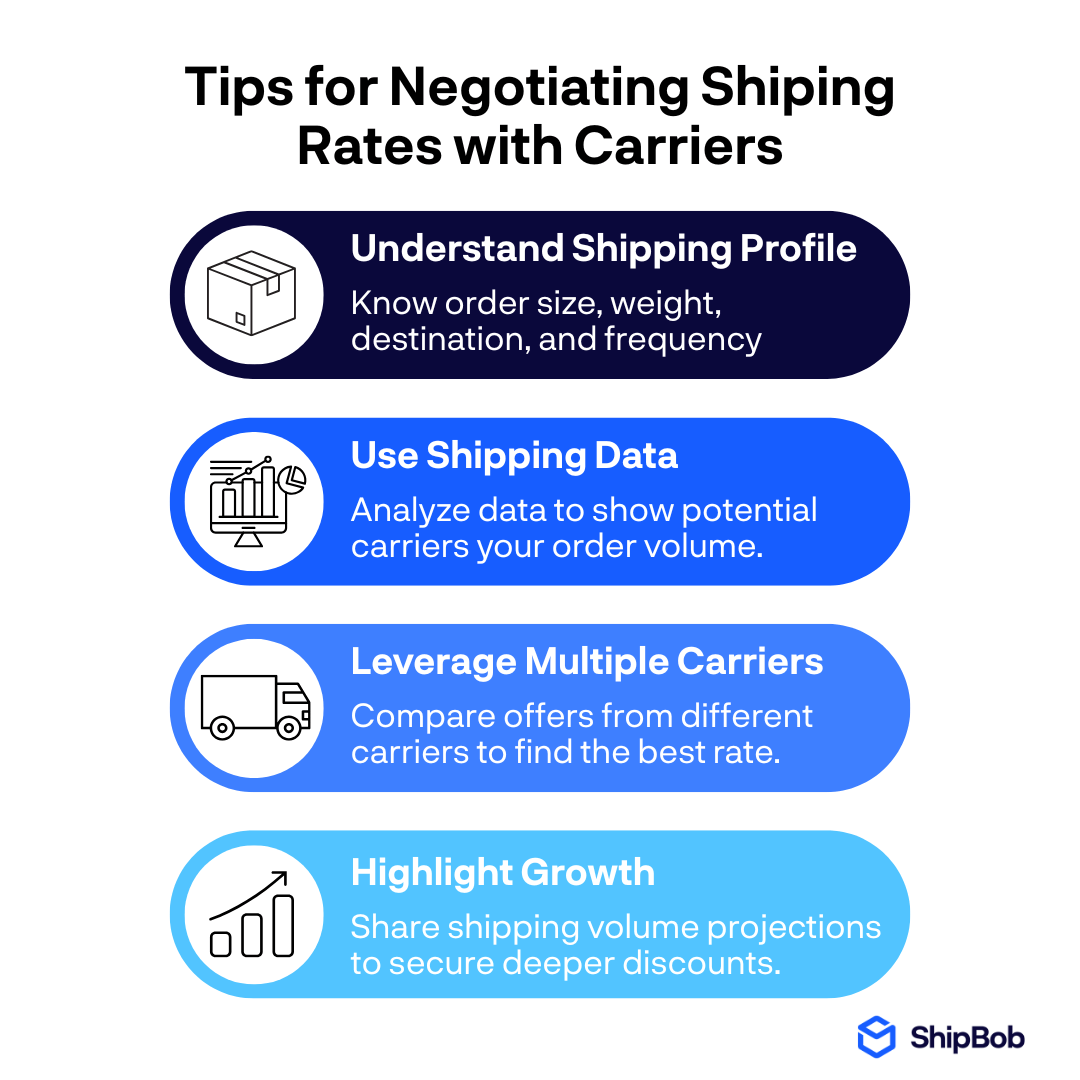
Here are some tips for negotiating with carriers:
- Understand your shipping profile: Carriers are more likely to offer discounts if you can demonstrate a steady or growing volume of shipments. Make sure to know your average order size, weight, destination, and shipping frequency when negotiating.
- Use shipping data to your advantage: Analyze your shipping data to identify patterns and volume, and use this information during negotiations to show potential carriers how much business you could bring them.
- Leverage multiple carriers: Don’t rely on just one carrier. Compare offers from multiple carriers, and let them know you’re shopping around for the best rate.
- Highlight your growth: If you expect your shipping volume to increase over time, share those projections with your carriers. Carriers are often willing to provide deeper discounts to businesses with long-term potential.
Implement shipping zones and distributed inventory strategies
Shipping costs aren’t just about the weight or size of the package; they’re also influenced by the distance between your fulfillment center and the customer. By utilizing ecommerce shipping zones and implementing a distributed inventory strategy, you can reduce both the distance your products travel and the cost of shipping.
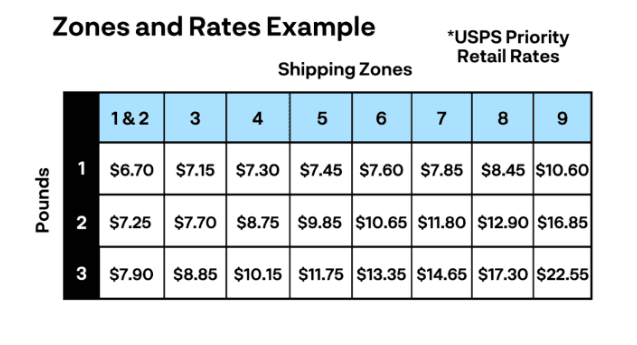
Shipping zones divide regions into areas based on their proximity to your shipping origin. The further a package has to travel, the more expensive it is to ship. Here is an example of how shipping costs increase as you move from Zone 1 (closest to the origin) to Zone 9 (furthest away)
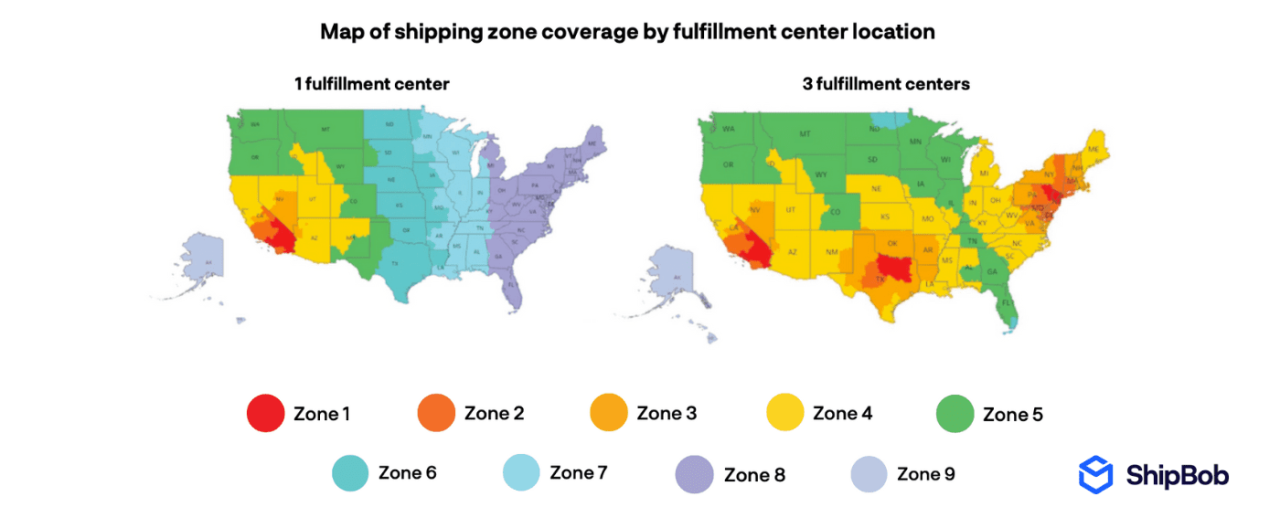
One of the most effective ways to ensure packages stay within lower-number shipping zones is by implementing a distributed inventory strategy. This involves spreading your stock across several fulfillment centers, often in key locations near high-density customer areas. By doing so, you can minimize the number of shipping zones a package crosses, therefore lowering the cost of delivery and reducing transit times.
Explore shipping & fulfillment software
Another way to secure discounted shipping rates is to leverage shipping and fulfillment software. These tools help ecommerce businesses compare shipping rates across multiple carriers, automate the shipping process, and identify the most cost-effective options.
Some benefits of using shipping software include:
- Rate shopping: Shipping software can compare shipping rates from various carriers in real-time, allowing you to choose the best option.
- Automation: Automation tools can streamline the fulfillment process, from printing labels to tracking shipments, reducing labor costs and minimizing errors.
- Discount opportunities: Some shipping platforms have pre-negotiated rates with carriers that allow you to take advantage of discounts without the need for direct negotiation.
Shipping software may also help you calculate shipping costs more accurately based on the package’s size, weight, and destination. When used effectively, shipping software can save both time and money, ensuring that you are always getting the best rate for each order.
Partner with a leading fulfillment provider
One of the best ways to secure discounted shipping rates is to partner with a third-party logistics provider (3PL). A fulfillment provider like ShipBob handles and ships millions of packages, so brands can leverage our scale and relationships with carriers to secure competitive shipping rates.
However, partnering with a fulfillment provider means more than just access to better shipping rates. ShipBob also offers streamlined logistics and ecommerce fulfillment solutions, helping you optimize your operations and ensure fast, reliable delivery to your customers.
Enjoy discounted shipping rates by partnering with ShipBob
ShipBob makes it easy for ecommerce businesses to access discounted shipping rates and manage their logistics more efficiently. Here are a few ways merchants can leverage our platform to reduce shipping costs.
Inbound inventory (freight/first-mile)
ShipBob’s FreightBob solution assists with any and all freight needs. By managing the end-to-end freight process, from coordinating pickups to managing carriers and delivery to our fulfillment centers, ShipBob is able to optimize freight costs and simplify the often complex first-mile logistics.
ShipBob middle-mile logistics
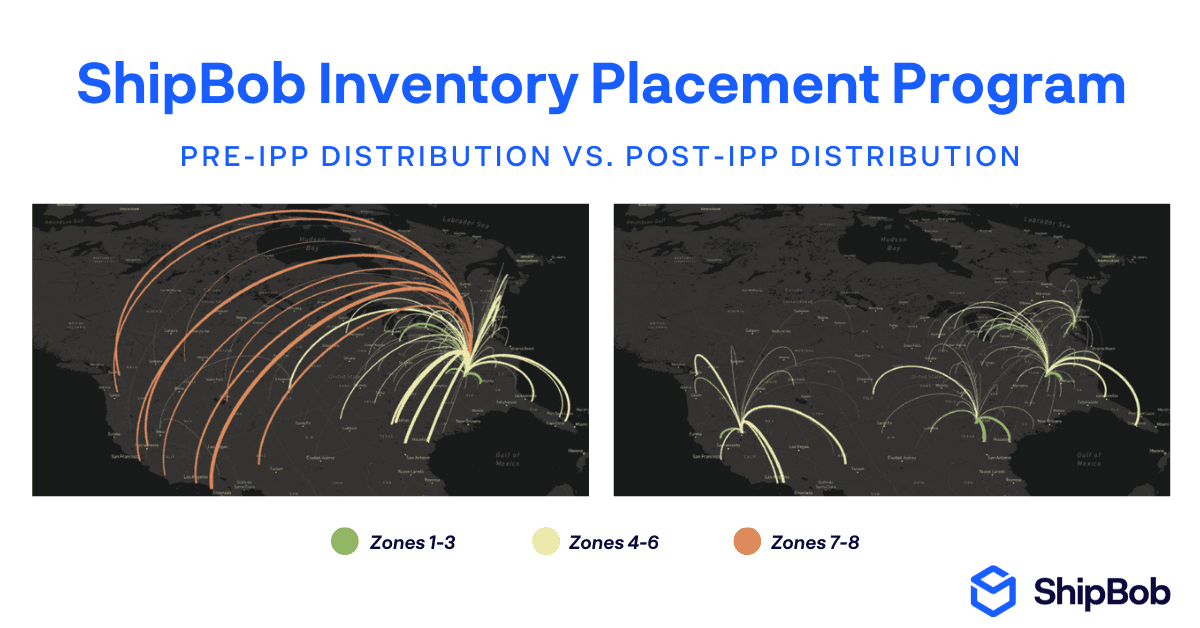
ShipBob’s transportation network efficiently moves packages between fulfillment centers and regional hubs, helping to reduce both transit times and costs. By leveraging our strategic Inventory Placement Program (IPP), merchants can automate the process of rebalancing and distributing their inventory across the US.
Carrier partnerships

ShipBob’s strong partnerships with major and regional carriers enable us to offer competitive shipping rates to our merchants. By leveraging our extensive shipping volume, we negotiate favorable rates that ecommerce businesses can take advantage of.
Thanks to the transportation management system that’s built into our warehouse management system (WMS), we have access to the best real-time carrier rates and are able to shop across all carrier partners to find the most cost-effective and fastest shipping solutions for each order. This ensures that merchants don’t have to manually compare carriers, ShipBob automatically selects the best option on their behalf.
“Our subscribers are some of our closest, most valued customers, so we want to give them the option of receiving their first order in 2 days. With ShipBob, we can make that happen. Not only that, we can make it happen without compromising on cost. Because of ShipBob’s overall order volume, they can negotiate bulk discounts with carriers that we simply couldn’t. By partnering with ShipBob, we get better quality fulfillment and shipping for a better price.”
— Maria Osorio, Logistics and Operations Director at Oxford Healthspan
Distributed inventory
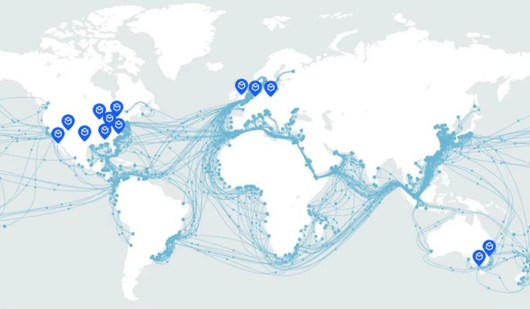
A strategic distributed inventory strategy can significantly reduce shipping costs by positioning your products closer to customers. ShipBob’s fulfillment network in the US, UK, EU, Canada, and Australia allows ecommerce businesses to take full advantage of this strategy.
By storing inventory in multiple warehouses around the country (and the globe), you can minimize shipping distances, reduce costs, and shorten delivery times.
2-Day Express shipping
In addition to discounted rates, ShipBob offers a 2-Day Express shipping option that uses hybrid shipping services to provide fast delivery at lower costs. This program optimizes routes and transit times to give customers a premium shipping experience without the high price tag.
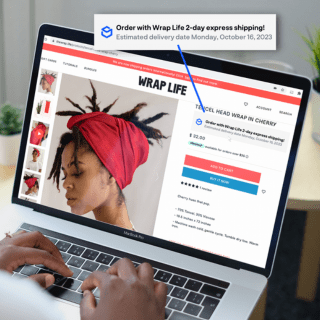
“We worked with ShipBob and introduced a Prime-like badge showcasing 2-day shipping on our product pages and immediately saw a 230% increase in customers using 2-day shipping!”
— Larissa Jeanniton, Operations at The Wrap Life
Get started with ShipBob
Interested in leveraging ShipBob’s fulfillment solution for competitive shipping rates? Fill out the form to connect with our team of fulfillment experts and get started.
Discounted shipping FAQs
Here are answers to commonly asked questions about discounted shipping.
What shipping discount tiers does ShipBob offer for high‑volume brands?

ShipBob offers batch pricing for high volumes of the same orders. ShipBob’s batch picking capabilities for large volumes of the same order allow it to pass on cost savings from reduced operational overhead.
ShipBob also leverages its aggregated volumes across all customers to negotiate better rates with carriers, passing these savings on to its customers.
How can brands negotiate custom peak‑season rates through ShipBob volume commitments?
ShipBob’s system is designed to handle surges in demand, including seasonal spikes, by utilizing real-time insights, data-driven forecasting, and efficient operations.
To help ShipBob manage capacity and maintain service level agreements (SLAs), brands are required to notify ShipBob at least 3 business days in advance for expected increases in B2C order volume, and 10 business days for large B2B order requests.
What parcel pooling programs does ShipBob support to maximize savings?
ShipBob utilizes a hub-and-spoke network in the US to streamline the movement of orders. Its middle-mile network enables “zone skipping” within the US, which speeds up delivery and reduces the number of touchpoints in the order’s journey.
This involves consolidating shipments heading to nearby destinations, leading to faster transit times, fewer handoffs, and a lower risk of damage. ShipBob also aggregates shipping volumes across all its customers to negotiate competitive rates with carriers.
What carrier discount factors should I consider across FedEx, UPS, and DHL?
When evaluating carrier savings, consider:
- Volume-based rate cards, including base-tier and mid-tier discount levels
- Dimensional weight vs. actual weight thresholds and associated pricing models
- Surcharges for oversized, Saturday delivery, residential delivery, etc, and how they scale by provider
- Regional rates, as certain carriers may offer better terms in specific zones or international corridors
Understanding how each provider structures these fees helps brands model shipping costs more precisely.
How can brands forecast savings before switching to a 3PL like ShipBob?
Smart pre-move planning includes:
- Running cost models using your current order mix (weight, size, zone distribution) through the provider’s tiered pricing structure.
- Comparing current rates vs. projected 3PL-negotiated rates, including forecasted surcharges and seasonal tariffs.
- Estimating blended rates, which combine all shipping-related costs to evaluate total per-order cost vs. fulfillment throughput.
ShipBob’s pricing model is designed to be transparent, covering receiving, warehousing, and shipping in a single fee, including 4 free picks per order. Merchants can estimate shipping costs using the Pricing page in the ShipBob dashboard, inputting details such as origin and destination countries, units of measure, and shipping options. The Billable Weight Estimator can also assist in this process.
Brands have reported significant savings, such as Our Place saving $1.5 million on shipping costs and Spikeball saving over $400,000 annually in postage and 40% on total fulfillment costs with ShipBob.
What minimum volume thresholds must brands meet to unlock shipping discounts?
Thresholds vary, but common markers include:
- 1,000 shipments/month (a baseline for basic discounted rates)
- 3,000-5,000 shipments/month (mid-tier rate bands with significant cost reductions)
- 10,000+ shipments/month (enterprise-level discounts and custom service tiers)


