
Table of Contents
** Minutes
How RF scanners transform warehouse operations
Implementing RF scanners: A 5-step roadmap
Measurable benefits of RF scanning in warehouses
Advanced strategies for RF scanning success
Speed and accuracy don’t happen by accident in a fulfillment center. They’re built into the tools your team uses every day. RF scanners are one of those tools.
These wireless handheld devices transmit barcode data to your systems instantly, eliminating manual entry errors and giving you real-time visibility into inventory movement. RF scanning helps maintain order accuracy while keeping orders moving fast.
If you’re scaling your ecommerce operation, this guide covers how RF scanners work, why they matter, and how to get the most out of them.

What is an RF scanner?
An RF (radio frequency) scanner is a handheld device that wirelessly transmits barcode data to your database in real time. Unlike traditional scanners that require manual syncing or physical connections, RF scanners provide instant data updates.
This wireless capability sets RF scanners apart from other technologies. While RFID scanners can read multiple tags simultaneously without line-of-sight (useful for high-volume items), their tags cost more than standard barcodes, making RF scanners more cost-effective for most warehouse needs.
For ecommerce fulfillment, RF scanners are crucial for maintaining accurate inventory. By instantly updating inventory and order information, these devices help brands meet online retail demands while preventing overselling and stockouts.
Key terms to know:
- Barcode: Visual data representation (usually parallel lines) that scanners can read
- SKU: Or “stock keeping unit,” is a unique identifier for each product and variant
- WMS: Or “warehouse management system,” tracks inventory, orders, and fulfillment
- Cycle count: Periodic inventory check where a portion of inventory is counted for accuracy verification
How RF scanners transform warehouse operations
RF scanners serve as the bridge between physical inventory and digital systems, enabling real-time data capture at every touchpoint in the fulfillment process. These devices help warehouses maintain accuracy while increasing throughput speeds, making them essential for meeting customer expectations for fast, accurate fulfillment.
Streamlining receiving processes
Warehouse teams use RF scanners to quickly validate inbound shipments against purchase orders. By scanning WRO (warehouse receiving order) labels, they can automatically update inventory records. This immediate receiving confirmation reduces delays in making inventory available for sale and creates the foundation for accurate inventory management.
Accelerating picking accuracy
RF scanners guide pickers through optimized routes in the warehouse, ensuring they select the correct items. Scan verification at each pick location prevents costly mispicks, while batch picking with RF confirmation increases throughput.
Accurate picking directly impacts customer satisfaction.
Enhancing packing and shipping verification
At packing stations, items are scanned to confirm order accuracy before they are packed and shipping labels are applied. This process creates real-time shipment tracking updates and reduces shipping errors that lead to returns and customer complaints.
Revolutionizing inventory management
RF scanning enables cycle counting without operational disruption, providing real-time inventory updates that prevent overselling across sales channels. This accurate inventory visibility enables better forecasting and purchasing decisions.
Synchronized inventory data is especially helpful for businesses with multiple locations.
Implementing RF scanners: A 5-step roadmap
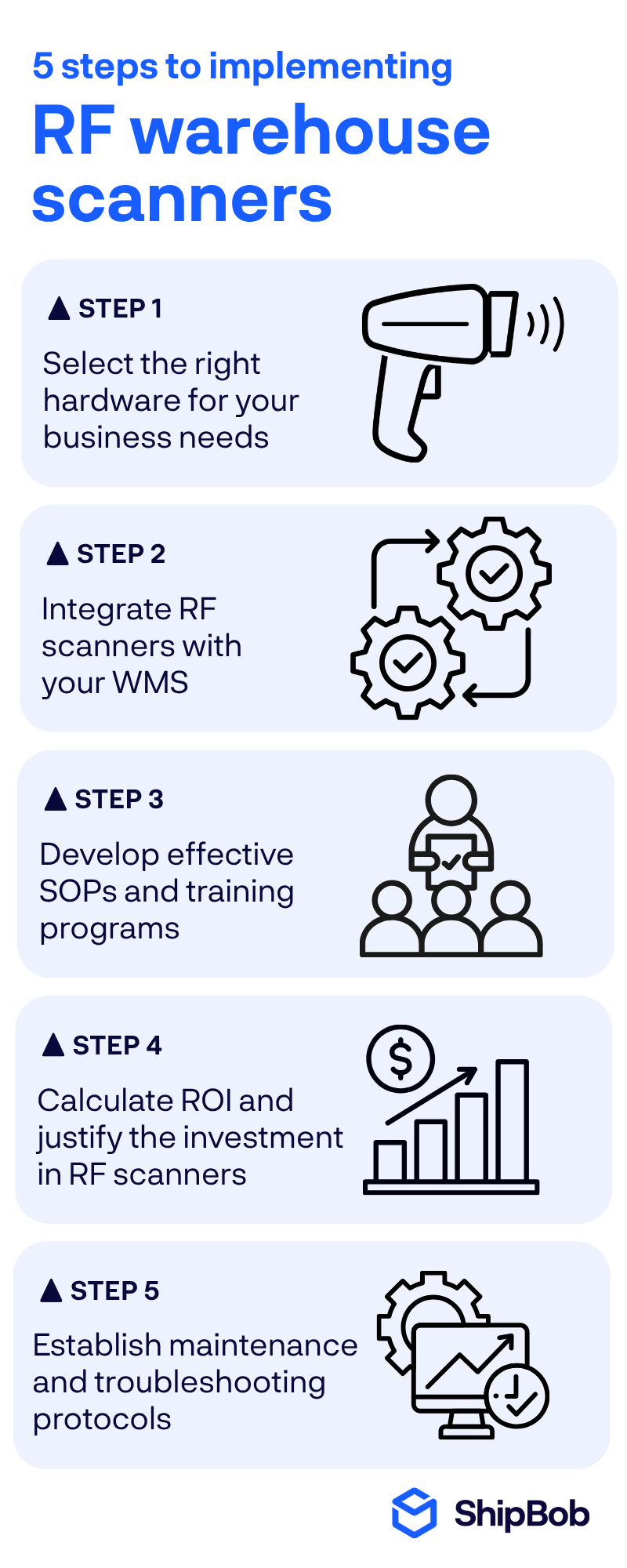
Implementing RF scanners in your warehouse is straightforward with the right approach. Follow this five-step roadmap whether you’re adopting new technology or upgrading existing systems.
Before you adopt a full rollout, start with a small pilot program in one section of your warehouse. This reduces disruption, controls costs, and gives you time to refine processes and train your team effectively.
1. Select the right hardware for your needs
The first step in implementing RF scanners is choosing the right devices for your warehouse. There are several key considerations, including durability requirements, battery life, screen size, and ergonomics.
Think about the specific needs of your operation. Will scanners be exposed to potential drops? Do your workers need devices that can last an entire shift without recharging?
When evaluating options, compare consumer-grade vs. rugged enterprise devices and consider the total cost of ownership over time. While rugged scanners may have a higher upfront cost, they often provide better long-term value through increased durability and longer lifespans. Also, consider connectivity options (Wi-Fi, cellular) based on your warehouse layout and IT infrastructure.
Typical price ranges for RF scanners vary widely, from a few hundred to several thousand dollars per device, but most operations see a positive ROI within 6-12 months of implementation.
2. Integrate with your warehouse management system
To fully leverage the power of RF scanning, it’s essential to integrate your devices with your warehouse management system (WMS) or ERP platform. Seamless integration enables real-time data synchronization, allowing you to make informed decisions based on real-time information. When evaluating integration options, consider native compatibility, middleware solutions, and API connections to find the best fit for your tech stack.
If you’re considering a new WMS platform to support your RF scanning implementation, be sure to ask potential providers detailed questions about their scanner compatibility and integration process. Look for systems that offer real-time data syncing and support for omnichannel fulfillment workflows.
3. Develop effective SOPs and training programs
Once you have your hardware and software in place, it’s time to develop standard operating procedures (SOPs) for each scanning touchpoint in your fulfillment process. Clear, detailed SOPs ensure that everyone on your team follows best practices and uses the technology consistently. Create step-by-step guides for receiving, putaway, picking, packing, and shipping, with specific instructions for how to handle exceptions and errors.
Effective training is equally important for a successful RF scanning implementation. Develop training programs that cater to different learning styles, using a mix of written documentation, visual aids, and hands-on practice. Consider creating quick reference guides that workers can easily access on the warehouse floor. For seasonal or temporary staff, develop streamlined training that focuses on the most critical scanning procedures. Finally, establish methods for measuring scanning proficiency and identifying retraining needs to ensure your team maintains high accuracy rates over time.
4. Calculate ROI and justify investment
To secure buy-in from stakeholders and leadership, it’s important to build a strong business case for your RF scanning implementation. Start by calculating the direct labor savings you expect to achieve through increased efficiency and productivity. Use time studies or industry benchmarks to estimate the time savings for each scanning touchpoint, then multiply by your average labor cost per hour.
Next, quantify the benefits of error reduction, such as fewer mispicks, incorrect shipments, and returns. Estimate the cost savings from preventing these errors, including reduced shipping costs, labor hours for handling returns, and potential lost sales from dissatisfied customers. Include less obvious ROI factors like reduced training time (due to easier onboarding with RF scanners) and improved inventory accuracy, which can help prevent stockouts and overordering.
Finally, present your business case in a clear, concise format that highlights the key benefits and addresses potential objections. Include a timeline for implementation, projected milestones, and regular progress reports to keep stakeholders engaged and informed throughout the process.
5. Establish maintenance and troubleshooting protocols
To keep your RF scanning system running smoothly, it’s essential to establish robust maintenance and troubleshooting protocols. Start by creating a preventative maintenance schedule that includes regular device cleaning and sanitization, battery health checks, and software updates. This proactive approach can help extend the lifespan of your scanners and minimize unexpected downtime.
Next, develop troubleshooting guides for common issues like connectivity problems, barcode reading errors, and battery failures. These guides should provide clear, step-by-step instructions that enable workers to quickly diagnose and resolve problems on their own. For more complex issues, establish escalation procedures that outline when to involve IT support or contact the scanner manufacturer.
Finally, create backup plans for critical scanning processes in case of extended device downtime. This might include manual data entry procedures or the use of spare devices kept on hand for emergencies. By planning ahead for potential disruptions, you can ensure that your operation continues running smoothly even when technical challenges arise.
Measurable benefits of RF scanning in warehouses
RF scanning delivers both immediate and long-term ROI, with benefits that compound as operations scale and complexity grows. The data collected through RF scanning also provides valuable insights for continuous improvement.
Dramatic reduction in error rates
Implementing RF scanning can reduce operational errors, resulting in significant cost savings by preventing mispicks and incorrect shipments. Fewer errors also directly impact customer satisfaction and retention, as customers receive the right products on time.
Additionally, reducing errors means less time and resources spent handling customer service inquiries related to incorrect orders.
Enhanced operational efficiency
RF scanning can improve efficiency. One study found that 70% of respondents completed tasks faster through barcode scanning.
By eliminating time-consuming manual data entry and paperwork, RF scanning streamlines warehouse workflows and reduces bottlenecks. This increased efficiency leads to substantial labor cost savings, allowing businesses to allocate resources more effectively.
Real-time decision-making capabilities
With instant visibility into inventory movements, managers can make proactive decisions based on real-time data. This enables them to reallocate resources quickly based on current activity levels, ensuring optimal productivity.
RF scanning data also helps identify process improvement opportunities, allowing for continuous optimization of warehouse operations.
And real-time information supports better customer communication, as businesses can provide accurate updates on order status and inventory availability.
Scalability for growing ecommerce brands
RF scanning systems easily accommodate seasonal volume fluctuations, making them ideal for businesses with variable demand. The technology also supports expansion into new sales channels without adding complexity, thanks to its ability to integrate with various systems.
Standardized scanning processes make onboarding new staff faster and easier, reducing training time and costs.
As businesses grow, RF scanning provides a foundation for future automation initiatives, ensuring a smooth transition to more advanced technologies.
Advanced strategies for RF scanning success
To achieve exceptional results and maximize the return on investment in RF scanning technology, businesses can implement advanced strategies based on best practices from leading fulfillment operations.
Gaining workforce buy-in through change management
Involving warehouse staff in the implementation process is crucial for a successful RF scanning adoption. Effective communication that explains the benefits to individual workers can help gain their support.
Consider using visual aids and real-world examples to demonstrate how RF scanning can make their jobs easier and more efficient. Plus, incentive programs that reward scanning accuracy and efficiency can further encourage employee engagement.
Identifying early adopters and leveraging them as peer trainers can also increase acceptance and accelerate the learning process.
Optimizing cross-border fulfillment with RF technology
For businesses with international operations, RF scanning ensures consistent and accurate shipping documentation across borders.
Real-time data synchronization enables better inventory allocation across global facilities, reducing the risk of stockouts or overstocking. RF scanning can also accelerate customs clearance by ensuring complete and accurate documentation, minimizing delays and additional costs.
By implementing standardized scanning protocols across all locations, multi-warehouse operations can achieve seamless coordination and improved efficiency.
Streamlining returns processing with scan verification
RF scanning can significantly enhance the reverse logistics workflow by enabling faster and more accurate returns processing.
By scanning returned items, businesses can quickly update inventory records and initiate refund or exchange processes. Capturing return reason data during scanning helps identify product quality issues and trends, allowing for proactive improvements.
RF scanning also helps detect fraudulent return patterns, reducing losses associated with abuse of return policies.
Preparing for future warehouse innovations
Implementing RF scanning creates a strong data foundation that enables predictive analytics and other advanced warehouse technologies. The data captured through scanning can be used to train machine learning models that optimize inventory management, demand forecasting, and resource allocation.
RF scanning also integrates seamlessly with emerging technologies like robotics and voice picking, allowing for a gradual transition to more automated processes.
By combining RF scanning with artificial intelligence, businesses can unlock new levels of optimization and efficiency in their fulfillment operations.
How ShipBob leverages technology for superior fulfillment
ShipBob’s entire fulfillment network is powered by our proprietary technology, enabling unparalleled accuracy, visibility, and efficiency. With expertise gained from processing over a billion units across 60+ global fulfillment centers, ShipBob offers merchants best-in-class fulfillment solutions, whether they choose to outsource fulfillment to ShipBob or use ShipBob WMS in their own facilities.
Achieve 99.9% accuracy with ShipBob
ShipBob’s multi-point scanning verification system throughout the fulfillment process ensures industry-leading accuracy. The WMS directs scanning workflows to minimize errors, which is especially beneficial during peak volume periods. These protocols have prevented countless errors for ShipBob merchants, ensuring that customers receive the right products every time.
“One of the biggest reasons we went with ShipBob is the multiple checks from start to finish. The WMS makes it really hard to send out the wrong product. It still happens on rare occasions – but it happens a lot less than before. Before we implemented ShipBob’s WMS, our order accuracy rate was around 92%. Now we’re at 99.7% for order accuracy, which equates to 2,100 less mispicks a year on average.”
Jourdan Davis, Operations Manager at Pit Viper
Enable real-time inventory visibility across locations
With ShipBob’s network, merchants gain instant inventory updates across all fulfillment centers. This real-time visibility helps businesses make informed decisions about inventory allocation, preventing stockouts and backorders. The system also supports ShipBob’s Inventory Placement Program (IPP) in the US, automating inventory placement and distribution and enabling faster delivery to customers by storing products closer to their location.
“ShipBob’s WMS has built-in inventory management features, and I’m constantly discovering new ways to take advantage of the technology. We’re actually doing cycle counts now; before ShipBob, we had some cycle counting, but you couldn’t trust any of it. As we’ve spent more time on ShipBob WMS, our trust is going up, and our inventory accuracy is improving with it.”
Tucker Robinson, Warehouse Director at Savannah Bananas
Simplified implementation for growing brands
ShipBob’s WMS makes advanced scanning accessible to businesses of all sizes, without the need for significant in-house expertise or resources. ShipBob offers in-person implementation for brands leveraging ShipBob WMS in their own facility, making it easy for merchants to adopt the technology. The onboarding process is designed to support businesses new to barcode systems, as well as those transitioning from manual processes.
Unlock omnichannel fulfillment
ShipBob’s system seamlessly connects with all major ecommerce platforms, enabling consistent fulfillment across DTC, marketplace, and B2B channels. As merchants expand into new channels, ShipBob’s system scales easily to accommodate their growth.
By partnering with ShipBob, ecommerce businesses can optimize their fulfillment operations, improve customer satisfaction, and drive growth. With a commitment to continuous innovation and a focus on merchant success, ShipBob is the ideal fulfillment and logistics partner for brands looking to stay ahead in the competitive world of ecommerce.
FAQs about RF scanners in the warehouse
Here are some additional insights into RF scanners and their role in warehouse operations.
What’s the difference between RF scanners and RFID technology?

RF scanners and RFID technology both play important roles in warehouse management, but they work in different ways. RF scanners are handheld devices that read barcodes using radio frequency signals, requiring a direct line of sight to the barcode. RFID, on the other hand, uses radio waves to read multiple tags simultaneously without needing direct visibility.
RFID tags are typically more expensive than barcodes, but they offer greater flexibility and automation potential. Many warehouses use a combination of RF scanning for day-to-day operations and RFID for asset tracking or inventory audits.
How much do warehouse RF scanners typically cost?
The cost of warehouse RF scanners varies depending on factors like durability, features, and connectivity options. Basic scanners can start around $200, while mid-range models with more advanced capabilities typically fall in the $500-$1,000 range. Premium scanners built for harsh environments or specialized use cases can cost upwards of $2,000.
In addition to the scanner hardware, you’ll need to budget for accessories like charging stations, protective cases, and maintenance plans. When evaluating scanner costs, it’s important to consider the total cost of ownership over the device’s lifespan rather than just the initial purchase price.
How do I train my warehouse team to use RF scanners effectively?
Effective training is critical for ensuring your team can use RF scanners accurately and efficiently. Start with a phased approach, teaching basic functions like scanning and navigating menus before moving on to more complex workflows. Create visual guides and quick-reference materials that workers can easily consult on the job.
Pairing new users with experienced scanner operators can help reinforce best practices and provide real-time guidance. Throughout the training process, emphasize the “why” behind scanning procedures to help workers understand the importance of accuracy and adherence to protocols.
What are common troubleshooting issues with RF scanners?
Even the most reliable RF scanners can experience issues from time to time. Some of the most common problems include:
- Connectivity drops due to network interference or signal blockage
- Battery failures that interrupt scanning workflows
- Difficulty scanning damaged or poorly printed barcodes
Many of these issues can be resolved with simple troubleshooting steps like restarting the device, replacing the battery, or adjusting the scanning angle. Preventative maintenance, such as regularly cleaning scanner optics and replacing worn components, can help reduce the frequency of problems. For more complex issues, it’s best to escalate to your IT support team or the scanner manufacturer.
Can RF scanning help manage batch and expiration tracking?
Yes, RF scanning is ideal for batch and expiration tracking (which is essential for food, beauty, and supplement products). During receiving, items are scanned with batch numbers that track expiration dates and control inventory rotation.
ShipBob’s WMS implements FEFO (First Expired, First Out) inventory management logic, guiding workers to pick items expiring soonest. This minimizes waste and delivers fresher products to customers.
This capability also streamlines compliance requirements and simplifies product recalls. When issues arise, you can instantly locate affected inventory by batch number for quick resolution.


