
Table of Contents
** Minutes
What a “normal” apparel ecommerce return rate looks like
Why apparel return rates are so high
The return data every apparel brand should track
How to reduce apparel return rates for your brand
Improve apparel returns with a defined inspection and grading process
One in four online clothing purchases gets sent back. That single statistic captures a reality most apparel brands live with every day but rarely treat as something they can fix. Instead, high apparel return rates get filed under “cost of doing business,” buried in line items, and absorbed into shrinking margins.
But it doesn’t have to work that way. Apparel brands can meaningfully reduce their return rates and recover more revenue from unavoidable returns by combining prevention strategies with data-driven diagnostics, and standardized inspection workflows.
This guide covers current benchmarks, the root causes behind high fashion ecommerce return rates, the data brands should track, practical strategies to decrease apparel returns, and a full walkthrough of the apparel returns inspection and grading process.
What a “normal” apparel ecommerce return rate looks like
Clothing is the most frequently returned product category in online retail. According to Statista Consumer Insights data, 25% of U.S. online shoppers reported returning clothing in the past 12 months, making it the top category by a wide margin.
That gap between apparel and everything else is worth studying. Here’s how return frequency breaks down across the most common ecommerce categories:
| Category | % of shoppers who returned |
| Clothing | 25% |
| Shoes | 17% |
| Accessories | 12% |
| Food & Beverage | 12% |
| Electronics | 10% |
| Cosmetics & Body Care | 9% |
| Physical Media | 9% |
| Furniture & Household Goods | 8% |
Source: Statista Consumer Insights
A single return rate number isn’t enough context for apparel as a whole, though. A 25% return rate might signal a systemic problem for a basics brand but fall within the expected range for a fashion-forward label selling dresses and formalwear.
As a result, brands need to benchmark by channel, SKU category, and customer segment to understand whether their rate points to something actionable or simply reflects the category they compete in.
Why apparel return rates are so high
The gap between apparel and other ecommerce categories isn’t random. Clothing carries a set of inherent uncertainties that don’t apply to a bottle of vitamins or home goods.
Each root cause erodes margin in a different way, and understanding them is the first step toward building a returns strategy that actually works. Here are the four primary drivers:
- Size and fit issues. Sizing problems account for 20% of ecommerce returns according to Narvar (however, other reports have suggested up to 65%), making this the single largest controllable factor for most retailers. Customers can’t try clothing on before buying online, and sizing varies wildly across brands, styles, and even production runs of the same SKU.
- Product expectation mismatch. This occurs when what arrived didn’t match the product photos, description, or perceived quality. Research indicates that 19% of returns occur because products don’t match what customers expected. Common factors include inaccurate color representation, misleading fabric textures, and poor photography.
- Style and preference mismatch. Sometimes it’s as simple as the customer liked the item on screen but not in person. This is the most subjective return reason and the hardest to prevent, because personal taste is inherently unpredictable.
- Bracketing behavior. Bracketing occurs when an online shopper purchases multiple sizes and variations of an item, selects their favorites to keep, and then returns the rest to the retailer. Previous Narvar reports suggested 40% of consumers have engaged in bracketing for at least some of their purchases. This behavior is particularly common in apparel since multiple sizes and colors are often available.
These causes explain why apparel is structurally more return-prone than categories where the product is standardized. A customer buying a supplement or a frying pan knows exactly what they’re getting, but a customer buying a pair of pants is making a bet on fit, fabric feel, and how the item looks on their body.
The return data every apparel brand should track
Most apparel brands know their aggregate return rate. What they often can’t do is explain why it’s high or which products are responsible, and that blind spot is where money leaks out.
The first distinction to make is between product-driven returns (fit, quality, expectation mismatch) and operational-driven returns (wrong item shipped, mis-picks, delayed delivery).
A high return rate on a specific SKU in a specific size tells a very different story than a spike in returns from a single fulfillment location. Without separating these signals, your team is guessing.
To help make those distinctions, brands should capture the following data dimensions for every return:
- SKU
- Size
- Color/style
- Fulfillment location
- Sales channel or marketplace
- Geography
- Promo cohort (full-price buyer vs. discount buyer)
- First-time vs. repeat customer
Collecting those fields only pays off when you pair them with structured return reasons. Two-tier return reason capture works by recording a primary reason (e.g., “Item didn’t fit”) alongside a secondary reason (e.g., “Too big”).
This granularity helps distinguish between a sizing chart problem affecting your entire line and a single SKU that runs large. If your top in size M generates three times the returns of every other size M product, you’ve isolated the problem. If all your M sizes show the same pattern, you have a systemic chart issue.
ShipBob’s inventory dashboard is one tool that can bring multi-channel transactions, SKU performance, and return data into one real-time view across fulfillment locations.
How to reduce apparel return rates for your brand
Reducing apparel returns takes a set of targeted interventions, each tied to a specific root cause. The highest-impact prevention strategies fall into three categories:
1. Fix sizing and fit issues at the source
Generic S/M/L labels don’t cut it. Brands that want to reduce apparel returns need detailed, body-measurement-based size guides that include actual garment dimensions (chest width, length, sleeve length) alongside the corresponding body measurements. This gives customers something concrete to compare against, not just a letter on a tag.
Including fit notes directly on product pages helps. A simple line like “This style runs large” or “Model is 5’9″ and wears a size M” sets expectations without requiring any technology investment.
But the real power comes from closing the feedback loop by tracking return reasons by size and SKU. Spot patterns, like a specific style that’s consistently returned in size L as “too small.”
Feed those insights back to your product and merchandising teams so they can update size charts or adjust manufacturing specs.
2. Close the expectation gap with better product detail
When customers return an item because “it wasn’t what I expected,” the product page failed. High-quality product photography from multiple angles and on diverse body types significantly reduces this type of return. Shoppers need to see the garment as it will actually look, not as a styling team idealized it.
Detailed fabric descriptions matter too, include:
- Fabric weight
- Exact material composition
- Honest notes on transparency or stretch
A customer who reads “lightweight cotton, semi-sheer” before buying won’t be surprised when the item arrives.
User-generated content is another powerful tool. Customer photos and video reviews set more realistic expectations than studio shots alone. When a shopper sees someone with a similar body type wearing the item, they make a more informed purchase.
For high-return SKUs, you should also consider A/B testing product detail pages. Change the photography, add a sizing video, or revise the description, then measure whether the return rate changes. Treating your product pages as experiments rather than static assets gives your team the evidence they need to prioritize what works.
3. Encourage exchanges over refunds and reduce bracketing
Bracketing is especially common in apparel because sizing uncertainty makes ordering multiple variants feel like the safest bet. So, policy-based approaches can curb the behavior without alienating loyal customers:
- Restocking fees for serial returners
- Free shipping on exchanges only (not refunds)
- Bonus store credit for keeping items instead of returning them
Turning returns into exchanges is one of the highest-impact revenue-retention strategies available. An exchange keeps the money in your ecosystem, while a refund sends it back to the customer’s bank account.
Loop Returns reports that brands using their platform see average exchange rates of about 40%, and ShipBob’s integration with Loop Returns makes exchanges frictionless for Shopify brands, enabling one-click exchanges and automated approvals.
Because many returns are size-related, Loop’s variant exchanges allow customers to easily swap their item for a different size or color with a few simple clicks. When you make it easier to exchange than to refund, customers follow the path of least resistance, and your net return volume drops.
Improve apparel returns with a defined inspection and grading process
Even with the best prevention strategies in place, a percentage of orders will always come back. The real question is whether you can assess returned items consistently and get sellable inventory back into circulation before demand shifts or markdowns hit.
A standardized apparel returns grading process is what separates brands that recover revenue from brands that write it off. That process breaks down into three stages: intake and inspection, condition grading, and refurbishment.
1. Intake and inspection
The apparel returns inspection process starts the moment a returned item arrives at the warehouse. The first step is receiving the package, verifying it against the original order, and logging the return reason provided by the customer.
From there, every item moves through a set of consistent checkpoints:
- Tags intact and attached
- No signs of wear or washing
- No odor
- No stains or discoloration
- No alterations or modifications
- Correct item and size match the original order
Category-specific rules apply too. Intimates and hygiene-sensitive items like swimwear and underwear typically can’t be restocked regardless of apparent condition. These go straight to quarantine or disposal.
Consistent, documented inspection criteria like these prevent subjective judgment calls from slowing down the process or creating inconsistent outcomes across shifts or locations. When two different associates inspect the same returned hoodie and reach different conclusions, the brand loses money, either by restocking something it shouldn’t or writing off something it could sell.
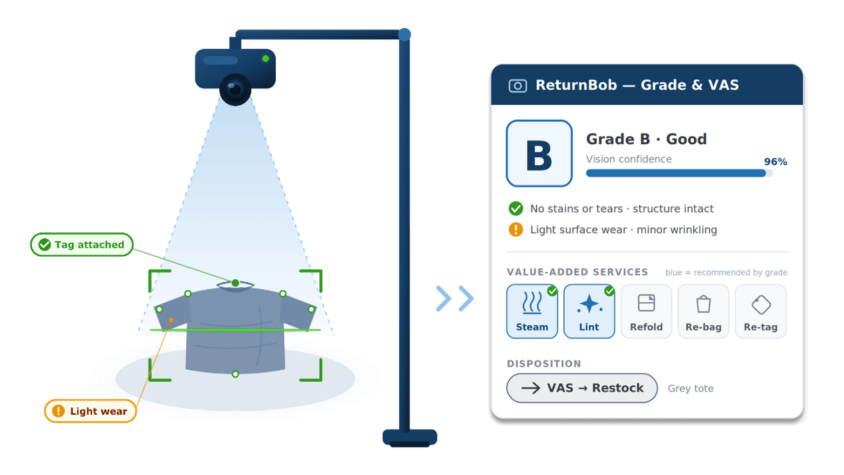
ShipBob has introduced AI-enabled returns grading to make objective calls about an item’s status.
2. Condition grading
Once an item passes intake, it needs a clear grade. Here’s a practical framework for grading returned clothing that eliminates per-unit deliberation:
| Grade | Condition | Disposition |
| Grade A | Like-new condition, tags on, immediately resellable | Restock with no rework needed |
| Grade B | Minor issues resolvable with light refurbishment (lint, wrinkles, needs re-bagging) | Route to refurbishment, then restock |
| Grade C | Not sellable (stained, worn, altered, missing tags, hygiene-flagged) | Route to quarantine, liquidation, or disposal |
Each grade maps to a clear disposition decision. The team doesn’t debate what to do with each unit. They inspect, assign a letter, and move on.
Speed matters here more than most brands realize. Apparel is seasonal. Every day a sellable returned unit sits ungraded is a day closer to a markdown or a missed selling window. A summer dress returned in July and graded in September is worth a fraction of what it was two months earlier.
For apparel brands with lean teams and focused catalogs, standardizing these grading decisions is one of the highest-impact operational improvements available. It costs almost nothing to implement, and it directly affects how much revenue you recover from your reverse logistics flow.
3. Refurbishment and reprocessing
Not every returned item needs to be written off. Grade B items can often be restored to sellable condition through a short set of value-added steps:
- Lint rolling
- Steaming or pressing
- Re-folding
- Re-bagging in polybags
- Re-tagging
These steps sound simple, but they’re the difference between recovered revenue and a markdown. A $45 t-shirt that comes back slightly wrinkled and missing its polybag doesn’t need to hit the clearance rack. Thirty seconds of steaming and a fresh bag put it right back into sellable inventory.
As an example, all apparel stored and fulfilled through ShipBob is required to be bagged and barcoded, and every unit must have a polybag to prevent dust.
ShipBob supports these value-added refurbishment services for apparel returns, including lint rolling, re-bagging, and re-tagging. By handling these steps within the fulfillment environment, brands get restored units back into inventory faster, reducing the gap between return receipt and resale readiness.
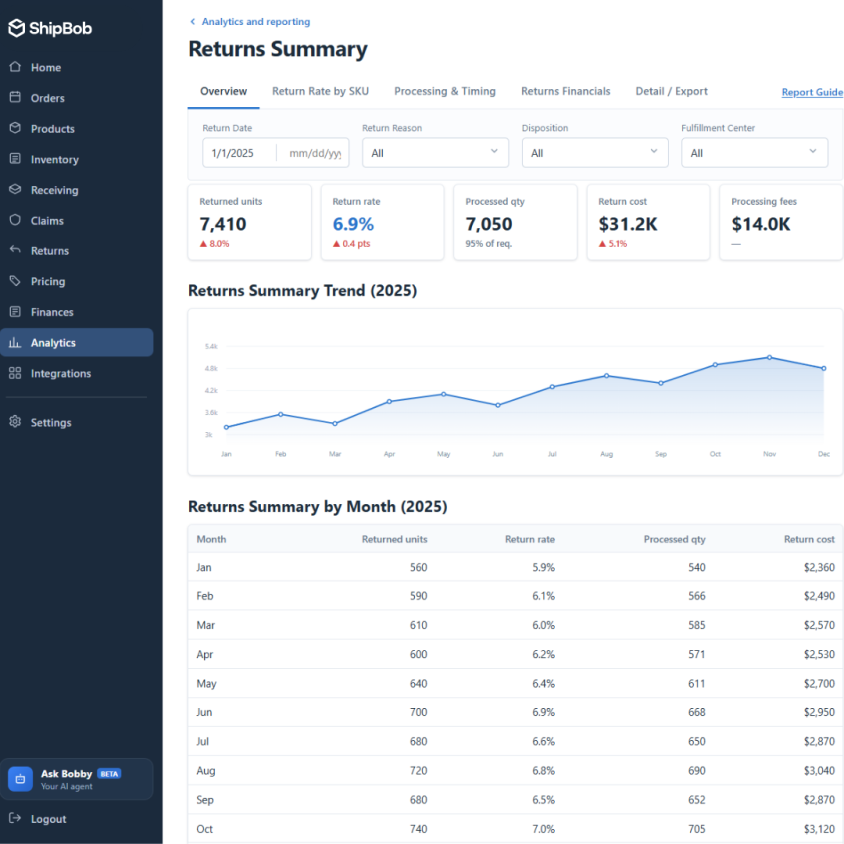
See detailed returns reporting in the ShipBob dashboard. Return rate by SKU, processing and timing updates, and return trends are available in real-time.
How ShipBob helps apparel brands manage and reduce returns
Apparel brands need a fulfillment partner that supports both return prevention through data visibility and return processing through inspection and grading workflows. Splitting these functions across separate providers creates operational fragmentation and slows down the entire cycle, here’s how ShipBob can help:
- Returns platform integrations. ShipBob integrates with Loop Returns and AfterShip to give brands a customer-facing returns and exchanges portal. ShipBob handles the physical receiving, inspection, and processing on the warehouse side.
- Customizable inspection grading and routing. Brands define inspection grades (such as Grade A, B, and C) and route returned units based on SKU, category, and inspection outcome. This keeps the decision framework consistent and gives operations teams a repeatable process instead of ad-hoc judgment calls.
- Dedicated Returns Hub. ShipBob’s Returns Hub centralizes reverse logistics so large return waves from bracketing or seasonal surges don’t overwhelm standard fulfillment workflows. This specialized facility processes high-volume returns efficiently while keeping forward fulfillment operations running smoothly.
- Distributed fulfillment network for restocked inventory. ShipBob’s network of dozens of fulfillment centers allows restocked units to be redistributed where demand is highest. A refurbished jacket doesn’t have to sit in a single warehouse waiting for a local buyer.
- Real-time returns visibility through ShipBob’s inventory dashboard. Brands get real-time visibility into return behavior by channel, SKU, and fulfillment location. When your ops team can see that a specific style in a specific color generates 3x the return rate of the rest of the catalog, they can act fast, coordinating with product and merchandising teams to fix the root cause.
“Since partnering with ShipBob, we now have an automated system for shipping and can focus our time on new product launches.”
Jason Ton, CFO of 100 Thieves
Get started with ShipBob
Ready to improve how your brand handles apparel fulfillment and returns? Request a custom quote or visit ShipBob’s apparel fulfillment page to learn more.
Apparel returns FAQs
What is the average apparel ecommerce return rate?

According to Statista Consumer Insights, 25% of US online shoppers returned clothing they purchased online in the past 12 months. However, this number varies significantly by subcategory. Some fashion retailers see rates in the 30–40% range depending on product type and customer segment.
Why are fashion ecommerce return rates higher than other categories?
Products that depend on size and fit, like clothing and shoes, typically see higher return rates than categories like furniture, books, or consumer electronics. Unlike standardized products, apparel carries inherent uncertainty around fit, fabric feel, and how the item looks on the buyer’s body. That drives returns even when the product itself is fine.
How can apparel brands decrease return rates without hurting the customer experience?
The most effective approaches target root causes rather than restricting returns. Detailed body-measurement-based size guides, fit notes on product pages, high-quality photography on diverse body types, and virtual try-on tools all reduce returns by helping customers make better purchasing decisions upfront. Offering free exchanges while charging for refunds is another strategy that preserves the customer relationship while reducing net returns.
What does the apparel returns grading process look like?
The process follows three stages. First, intake and inspection verify the returned item against the original order and check for tags, signs of wear, odor, stains, and alterations.
Second, condition grading assigns the item a grade: Grade A (like-new, immediately resellable), Grade B (minor issues fixable with light refurbishment), or Grade C (not sellable, routed to quarantine or disposal). Third, refurbishment restores Grade B items through steps like lint rolling, steaming, re-bagging, and re-tagging.
How does ShipBob handle apparel returns inspection and grading?
ShipBob receives returned items, inspects them against documented criteria, and assigns a condition grade based on the brand’s defined framework. Depending on the grade, items are restocked, quarantined, or disposed of. For Grade B items, ShipBob offers value-added refurbishment services like lint rolling, re-bagging, and re-tagging to restore sellable condition before the unit re-enters inventory.
Can ShipBob help convert apparel returns into exchanges?
Yes. ShipBob integrates with Loop Returns and AfterShip to provide a customer-facing returns and exchanges portal. Loop’s variant exchanges allow customers to easily swap their item for a different size or color with a few simple clicks, keeping the revenue in-house rather than processing a full refund.
How does ShipBob ensure returned apparel inventory is tracked accurately?
ShipBob uses barcode-based workflows and scans inventory throughout receiving, inspection, refurbishment, and restocking. This means brands can track returned units in real time across fulfillment locations.
Merchants can also set grading and disposition rules for returns, which helps approved items get back into sellable inventory quickly while routing other units to quarantine, liquidation, or disposal as needed.
What costs should apparel brands expect with ShipBob’s fulfillment and returns operations?
ShipBob provides custom quotes based on factors like order volume, storage profile, and service requirements. Merchants can access detailed billing breakdowns in the dashboard for clear visibility into what they’re being charged for.
Fulfillment pricing is typically structured as an all-in cost that includes the shipping label, packaging materials, labor, and included picks. Storage and value-added services such as return re-bagging or re-tagging are billed separately based on usage. Request your custom quote here.


