

If you’re evaluating fulfillment partners, you’ve probably noticed that shipping costs can vary significantly between providers. While some merchants worry that working with a fulfillment expert like ShipBob might increase their shipping expenses, the reality is often quite different.
Why some merchants think ShipBob has “high shipping costs”
When merchants express concerns about ShipBob’s shipping costs, they’re usually making a few assumptions:
- They’re comparing only the shipping label cost rate card, without considering the full picture of ALL fulfillment expenses.
- They assume all fulfillment partners have access to the same carrier rates and carriers, regardless of volume.
- They believe shipping from a single warehouse location is always cheaper than distributing inventory.
- They’re looking at shipping costs in isolation, rather than as part of their overall fulfillment spend.
These assumptions make sense on the surface, but they don’t account for how modern fulfillment actually works at scale.

How ShipBob improved shipping cost efficiency over time
ShipBob has built its global fulfillment network specifically to help brands reduce their shipping costs while improving delivery speed. By leveraging bulk shipping discounts across many national and regional carrier partners, distributed inventory placement and in-region fulfillment, and zone skipping, merchants often see significant savings compared to other fulfillment options.
The combination of ShipBob’s technology platform, strategic network design and scale, and high operational quality not only optimizes shipping spend but also significantly reduces fulfillment errors and costly hidden cost centers, helping brands grow their business smarter.
4 ways ShipBob helps to reduce merchants’ shipping costs
Let’s look at the specific ways ShipBob helps merchants manage and reduce their shipping expenses.
1. Distributed inventory placement saves money on every shipment
Strategic inventory placement is one of the most effective ways to reduce shipping costs if your volume justifies it compared to the number of SKUs you have.
What this means in practice
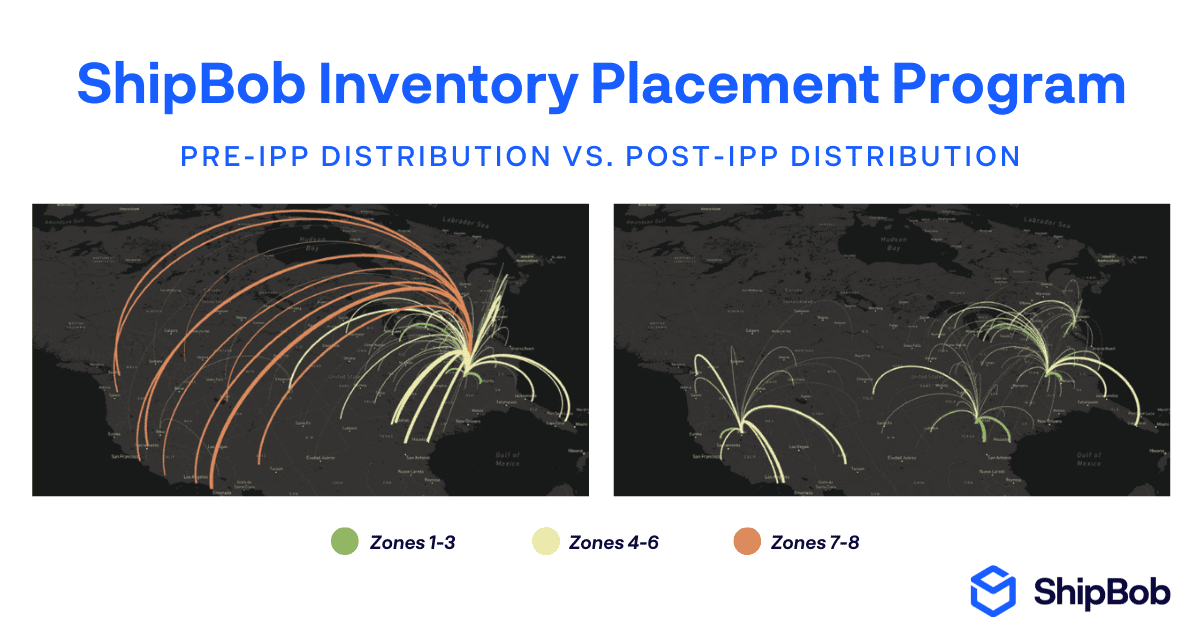
ShipBob’s Inventory Placement Program (IPP) allows brands to store inventory across multiple fulfillment centers throughout the US. So, instead of shipping every order from one location, brands are able to distribute inventory so it is closer to end customers. This lowers the average shipping zone because each order ships from the fulfillment center closest to each customer, which lowers shipping costs.
What changed
Over the past few years, ShipBob has expanded its fulfillment network to dozens of locations across the US (as well as dozens more across the globe). ShipBob developed IPP to automate the complex process of splitting inventory across multiple locations. As a result, brands simply send their inventory to one ShipBob regional hub location, and ShipBob distributes it to other regions and fulfillment centers based on demand patterns, the brand’s historical data, and customer locations.
Why it matters to merchants
- Lower shipping zones and shipping costs per order
- Get faster delivery times without paying for expedited shipping
- Increase delivery speed and customer satisfaction, and reduce customer service inquiries about order status and WISMO (“where is my order?”) questions
- Enable supply chain redundancy if issues arise in any region
Case study proof
Popular cookware brand, Our Place, saw dramatic results after implementing ShipBob’s distributed fulfillment strategy.
“Expanding our warehouse network from 2 to 4 warehouses has translated into substantial cost savings, amounting to $1.5 million in freight expenses for Our Place. Currently, only 2% of our parcels are reaching Zone 7 or Zone 8 collectively, indicating that 98% of our parcels are reaching Zones 1 through 6. By shipping locally to lower zones, we’re achieving the most significant reductions in outbound costs.”
Ali Shahid, COO of Our Place
2. All-in fulfillment pricing eliminates surprise fees
Understanding your true fulfillment costs shouldn’t require a spreadsheet and complex calculations.
What this means in practice
ShipBob provides an all-in fulfillment cost (a single price that includes packaging materials, labor, and the shipping label itself) and transparent, merchant-first pricing. Merchants know exactly what they’ll pay for each order, avoiding hidden fees like fuel surcharges, DAS, or extended DAS.
What changed
ShipBob uses a transparent pricing model to simplify billing and help merchants accurately forecast their fulfillment costs. You can also access detailed billing breakdowns through the ShipBob dashboard at any time, making it easy to understand exactly what you’re paying for.
Why it matters to merchants
- Predictable costs make financial planning easier
- There are no surprise fees for things like standard packing materials
- Simple billing reduces accounting complexity
- Real-time cost visibility is available in the dashboard
Case study proof
Jonathan Byrt, Director & Co-founder at memobottle, experienced this firsthand when switching to ShipBob.
“Our 3PLs before ShipBob were a total black box when it came to pricing — we’d just get one invoice with no line items, which made it impossible to work out what was what. With ShipBob, it’s very transparent billing and pricing, and now we know exactly what we’re being charged. Having the ability to view pricing in the ShipBob dashboard is nice to quote to retailers if we need to ship to a particular location.”
Jonathan Byrt, Director & Co-founder at memobottle
3. Bulk shipping discounts pass savings to merchants
Volume matters when negotiating with carriers, and ShipBob’s scale works in your favor with defensible, value-aligned pricing.
What this means in practice
ShipBob’s pricing structure offers the lowest total cost of ownership for brands. ShipBob also negotiates shipping rates based on its total network volume to a level that is much greater than what one individual brand could get on their own (or other 3PLs). With thousands of merchants shipping through ShipBob’s network, the company secures bulk discounts from carriers, with negotiated rates that get passed directly to merchants, who benefit from ShipBob’s collective buying power.
What changed
As ShipBob has grown to fulfill over a billion units and serve more upper mid-market brands, its aggregate shipping volume has increased dramatically. This growth has strengthened ShipBob’s position in carrier negotiations, resulting in better rates across all service levels. This also means pricing evolves with merchant growth and internal pricing strategy selection. Plus, the company uses rate-shopping technology to automatically select the most cost-effective carrier that meets the delivery promise.
Why it matters to merchants
- Access to enterprise-level shipping rates
- Greater cost predictability
- Automatic rate shopping finds the best price for each shipment
- Better rates as your volume grows
- Competitive pricing across multiple carriers
- Focus on the lowest total cost of ownership
Case study proof
Maria Osorio, Logistics and Operations Director at Oxford Healthspan, saw immediate benefits from ShipBob’s carrier relationships.
“Because of ShipBob’s overall order volume, they can negotiate bulk discounts with carriers that we simply couldn’t. By partnering with ShipBob, we get better quality fulfillment and shipping for a better price.”
Maria Osorio, Logistics and Operations Director at Oxford Healthspan
4. Logistics becomes a revenue driver, not just a cost center
Smart fulfillment strategies can actually increase revenue while reducing per-order costs.
What this means in practice
ShipBob’s infrastructure also enables easy expansion into new sales channels and geographic markets. When customers receive their orders quickly from their preferred sales channel, they’re more likely to buy again, increasing lifetime value and offsetting shipping costs through higher revenue.
What changed
ShipBob has developed its platform to support omnichannel selling, international expansion, and automated EDI B2B fulfillment (alongside traditional DTC orders). Brands can now reach customers wherever they shop without managing multiple fulfillment providers or complex logistics operations.
Why it matters to merchants
- Higher customer retention through better delivery experiences encourages repeat purchases, and transparent visibility into shipments
- Easy bundling and kitting capabilities for upsell opportunities and increased AOV
- Ability to capture more revenue during peak seasons through extended Q4 holiday cutoffs
- Easy expansion into new markets and channels
- Improved unit economics through increased order value
Case study proof
Our Place discovered that faster shipping directly impacted their bottom line during the holiday season.
“Being near our customers wasn’t just essential for delivering an exceptional customer experience; it also significantly boosted our revenue. Each day we can ship orders before a major holiday translates into over half a million dollars in revenue.
Pre-ShipBob, the last day customers could place orders and receive them by Christmas was around the 15th or 16th of December. Now, we can extend that to the 19th or 20th, confident that even with cost-effective ground shipping, we’ll deliver the items in time for the holiday. This extension allows us to capture an additional 4 or 5 days of revenue, totaling over two million dollars.”
Ali Shahid, COO of Our Place
See how much you could save with ShipBob
While shipping costs are a valid concern for any ecommerce brand, the right fulfillment partner can actually help you reduce these expenses while improving your customer experience. Through distributed inventory placement, transparent pricing, bulk carrier discounts, and revenue-driving logistics capabilities, ShipBob helps ecommerce brands optimize their shipping costs and grow profitably.
FAQs about how ShipBob supports cost-effective shipping
ShipBob’s all-in fulfillment pricing often results in lower total costs than providers who itemize every service. While exact savings vary by order volume and product type, many merchants report saving money after switching to ShipBob, especially when factoring in the reduced shipping zones from distributed inventory.
What order volume do I need to benefit from ShipBob’s shipping rates?

ShipBob works best for brands shipping over 1,000 orders per month, all the way up to 100,000. You’ll have access to their scale, competitive rates, and solutions like their Inventory Placement Program to further reduce costs. Pricing evolves with merchant growth as well.
Can ShipBob help reduce international shipping costs?
Yes, ShipBob offers global fulfillment from locations in the US, UK, Europe, Canada, and Australia. By fulfilling orders locally in these markets rather than shipping internationally from the US, brands often see significant cost savings on international orders.
How does ShipBob’s Inventory Placement Program work?
With IPP, you send your inventory to a single ShipBob hub, and ShipBob distributes it across multiple fulfillment centers in various regions for you. This saves you the time and complexity of managing multiple inbound shipments while positioning inventory closer to your customers.
How can I estimate my shipping costs with ShipBob?
Shipping costs vary based on product weight, dimensions, order destination, service level, and more. For a custom quote based on your specific products and order patterns, visit https://www.shipbob.com/quote/.


