

Table of Contents
** Minutes
Map traffic, tasks, and congestion hotspots before you change anything
How to build a warehouse traffic management plan (step-by-step)
Use ShipBob technology to reduce cross-traffic with system-driven tasking
Warehouses today are a hive of activity. Forklifts dart between aisles while pickers navigate crowded staging areas. Dock doors buzz with inbound and outbound shipments.
Every crossing and close call isn’t just a safety concern; it’s a potential bottleneck that slows fulfillment and puts throughput at risk.
Warehouse traffic management means designing and enforcing the flow of people, equipment, and goods to minimize congestion and keep operations moving safely.
When done right, it’s more than a compliance exercise; it’s a foundation for scalable, high-velocity fulfillment.
This guide walks you through auditing your current warehouse traffic, building a practical management plan, and applying system-driven tasking with ShipBob to drive both safety and operational speed.
Map traffic, tasks, and congestion hotspots before you change anything
Before making changes, it’s essential to understand where and how traffic moves in your warehouse.
Mapping current flows and identifying congestion points helps you target improvements that matter most for both safety and throughput.
Start by auditing where cross-traffic occurs. Common hotspots include fast-moving SKU aisles and replenishment lanes. They also occur at pack-out areas, dock doors, returns-to-stock zones, and employee entrances.
For each major workflow, document the actual paths people and equipment take. These workflows include receiving to putaway, replenishment, picking, and packing. They also cover shipping and trash runs.
Here’s what to look for in high-risk interactions:
- Blind corners and mixed-use aisles
- Narrow choke points and uncontrolled crossings
- Blocked aisles and delayed picks
- Missed shipping cutoffs and extra handling steps.
These issues often signal underlying traffic problems. Create a simple “hotspot map” using a color-coded legend: red for high-risk intersections, yellow for shared-use zones, and green for pedestrian-only areas. This visual becomes the foundation for everything that follows.
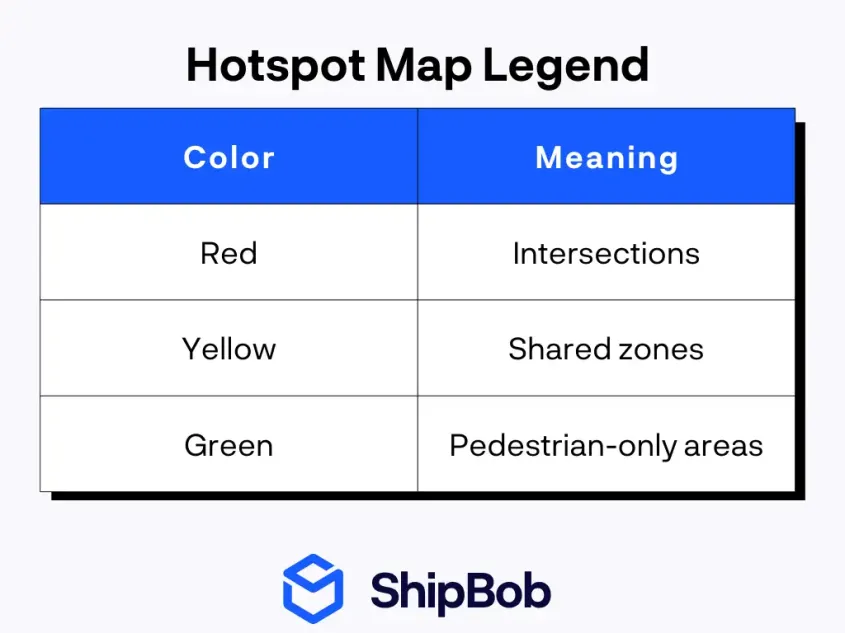
By mapping these flows and pain points, you’ll have a clear baseline to build your traffic management plan.

How to build a warehouse traffic management plan (step-by-step)
A warehouse traffic management plan should be easy for teams to follow and simple for managers to enforce. At its core, a complete warehouse traffic management plan includes these seven essential components:
- Traffic routes and flow patterns
- Right-of-way and behavioral standards
- Visual controls and signage standards
- Physical barriers and engineering controls
- Operational flow and throughput standards
- Hazard controls and emergency procedures
- Training, accountability and continuous improvement
By following these steps, you’ll create a traffic management plan that’s both comprehensive and practical—one that your team can actually use on the floor.
🚦 Step 1: Traffic routes and flow patterns
Defining clear travel paths is the backbone of any warehouse traffic management plan. Start by documenting where people and equipment can move throughout your facility.
Define these key elements for the first part of your plan:
- Designate pedestrian walkways that steer clear of pick faces and dock staging whenever possible.
- Assign equipment travel lanes to minimize aisle contention, especially between replenishment and picking.
- Create controlled crossing points for pedestrians who must cross equipment lanes.
- Specify one-way versus two-way aisles based on width, turning radius, and congestion risk.
- Enforce a “no cut-through” rule in high-density storage and pack-out areas.
These route assignments reduce confusion and help prevent collisions. They make the floor safer and more predictable.
👷 Step 2: Right-of-way and behavioral standards
Clear rules eliminate guesswork at intersections and crossings. Spell out who yields and how. Set clear standards for:
- Right-of-way rules for intersections, dock approaches, and aisle entry/exit.
- Crossing behaviors: full stop, look both ways, and proceed only when clear.
- Signal behaviors, such as horn use at blind corners, mirror checks, and speed reductions at intersections.
- Rules for backing up, turning into aisles, and passing (or forbid passing altogether).
- Clarification on who can enter exclusion zones and how access is controlled (e.g., operators only, authorized maintenance).
When everyone knows the rules, you reduce hesitation and keep traffic moving smoothly.
⚠️ Step 3: Visual controls and signage standards
Consistent visual cues help teams follow the plan without second-guessing, so you need to create a clear system for floor markings and signage. Your visual control system should include:
- A color-coded floor marking system: green for pedestrian lanes, yellow for equipment lanes, red for staging zones, and striped for exclusion areas.
- Speed limits and slow-zone warnings near docks, intersections, and crossings.
- Directional signage for one-way aisles and stop/yield points at intersections.
- Regular upkeep (replace worn tape, clean signs, and repaint high-wear areas).
Here’s a snippet of a floor marking style guide:
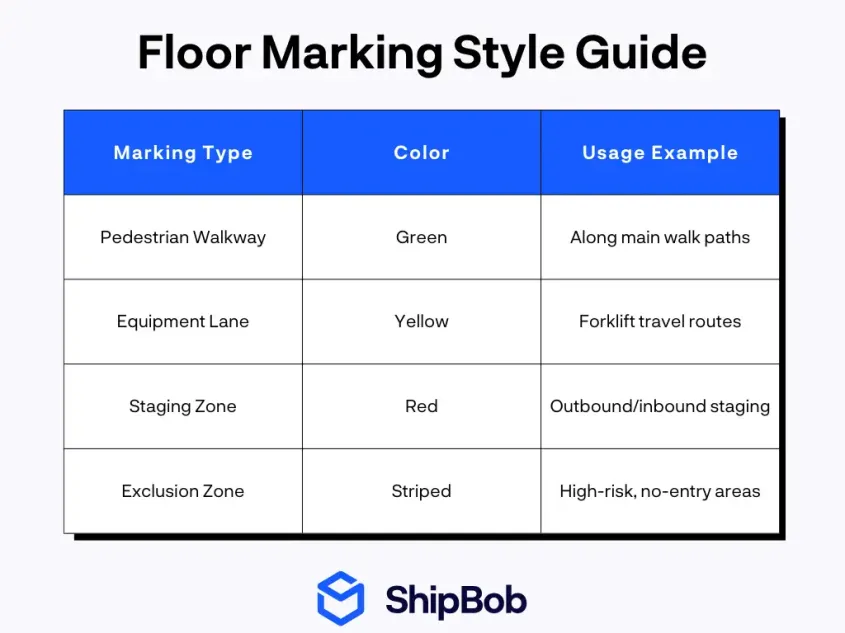
Consistent visuals make it easy for anyone, new or experienced, to navigate safely.
⚙️ Step 4: Physical barriers and engineering controls
Engineered solutions reinforce your plan and keep teams from drifting into unsafe habits. Focus on physical controls first, these include:
- Guardrails, bollards, and railings to protect pedestrians near docks and pack-out areas.
- Cones for temporary reroutes or to mark off maintenance zones.
- Wheel chocks and dock-area controls to keep staging lanes clear.
- Mirrors and intersection controls (stop lines, right-of-way signage) to reduce blind-corner risk.
Physical controls act as a constant reminder and a hard stop against unsafe shortcuts.
✅ Step 5: Operational flow and throughput standards
This is where safety planning meets operational throughput. Design traffic to support faster, more reliable fulfillment. Build your flow standards to include:
- Equipment routes around pick modules instead of through them to minimize intersections.
- One-way “loops” for high-traffic equipment paths to reduce congestion.
- Separate replenishment movement from active picking windows.
- Lane discipline: no parking in travel lanes, staging only in marked zones.
- Dock approaches, staging lanes, and “keep clear” zones to prevent last-minute gridlock.
- Clear outbound staging standards: where to stage, how to label, and how to avoid blocking doors.
- Escalation paths for overflow: who to call, where overflow goes, and what gets prioritized.
- Traffic rules connected to cutoff protection: identify which lanes must stay open near pack-out to avoid missed shipments.
By aligning traffic flow with fulfillment priorities, you boost both safety and speed.
‼️ Step 6: Hazard controls and emergency procedures
A comprehensive plan addresses more than just vehicle-pedestrian interactions. Broaden your focus to cover:
- The hierarchy of controls: prioritize engineering solutions, then administrative controls, and PPE.
- Slip and fall prevention: spill response near docks, regular floor checks at crossings, and clear housekeeping standards.
- Emergency preparedness: evacuation routes that avoid equipment lanes, designated muster points, and clear roles for who controls equipment during an evacuation.
This approach ensures your plan covers the full range of warehouse hazards.
📚 Step 7: Training, accountability and continuous improvement
A plan is only as strong as its execution. Build a system for ongoing success. Your accountability system should address:
- Onboarding and refresher training for both pedestrians and equipment operators, using the same rules and visuals.
- Ownership for the plan—who updates warehouse maps, approves changes, and audits floor conditions.
- Spot checks and coaching loops to maintain accountability without slowing operations.
- Plan reviews after operational changes, such as new SKUs, pick modules, or shift schedules.
- Leading indicators like near-miss reports, blocked-aisle events, and recurring congestion.
Once you’ve built the core components of your traffic management plan, the next step is translating those principles into clear, actionable rules your team can reference daily.
An operating blueprint serves as the practical bridge between your written plan and floor-level execution—giving supervisors, operators, and warehouse associates concrete examples of how traffic rules apply in real scenarios.
Below is a sample operating blueprint you can adapt to your facility’s layout and workflows:
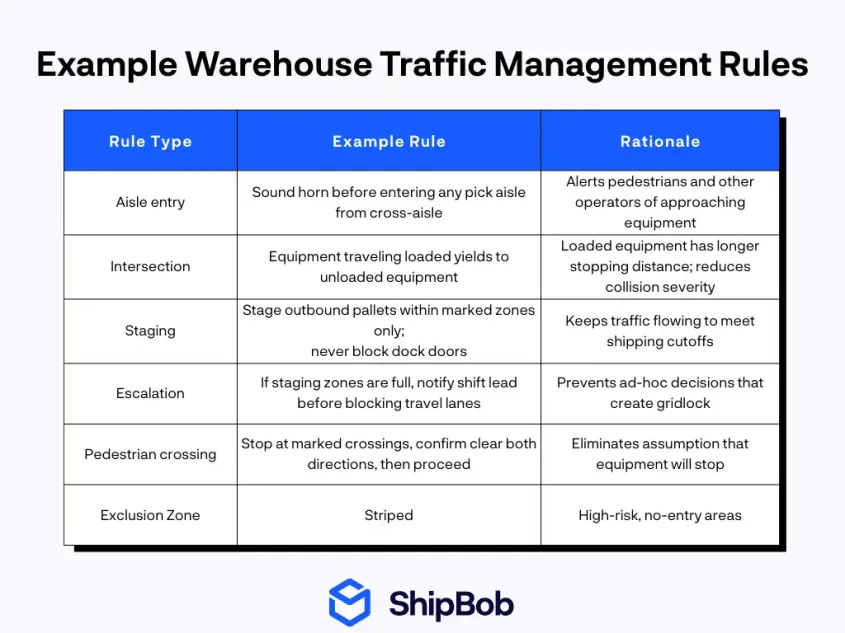
With these foundational elements in place, the next step is leveraging technology to reduce cross-traffic and optimize task execution across your operation.
Use ShipBob technology to reduce cross-traffic with system-driven tasking
System-driven tasking reduces unnecessary trips and keeps traffic away from congestion hotspots.
By optimizing pick paths and workflows, ShipBob’s technology helps brands and warehouse operators maintain smoother, safer, and more efficient operations.
ShipBob’s solutions for warehouse traffic management include:
ShipBob WMS
ShipBob’s WMS provides real-time, location-specific inventory visibility and intelligent pick-paths. This cuts unnecessary travel and reduces congestion in shared areas. Teams can see exactly where inventory is stored and plan routes that avoid bottlenecks.
“ShipBob WMS is so useful because it gives you more trust in your operations. You feel freer with picking and packing, because ShipBob’s system handles so much more of the tracking, and it does it really well.
Picking with ShipBob WMS is really well-designed – the system leverages batch and cluster picking to group multiple of the same orders and send your pickers through your aisles once (instead of all the way through for every order), which makes the process so much more efficient and yields endless results.”
Tucker Robinson, Warehouse Director at Savannah Bananas
Standardized, repeatable processes
ShipBob WMS supports consistent onboarding, training, and daily execution. Traffic rules and workflows hold up even as headcount changes or volume spikes.
“Once ShipBob trained us on the system and we understood how the WMS worked, everything fell into place. ShipBob WMS is incredibly intuitive and made our operations much more accurate than our previous system. We quickly learned how to label and manage inventory within the system, and it was easy for the whole team to use.”
Beth Welch, Co-Owner and Co-Founder, and Maddie Crawford, Fulfillment Manager, at Forest Ink and Groovy Things Co.
Hands-on onboarding and warehouse mapping
ShipBob’s team helps design efficient pick paths and slotting based on SKU velocity. This ensures high-traffic areas are managed proactively.
Full-stack fulfillment platform
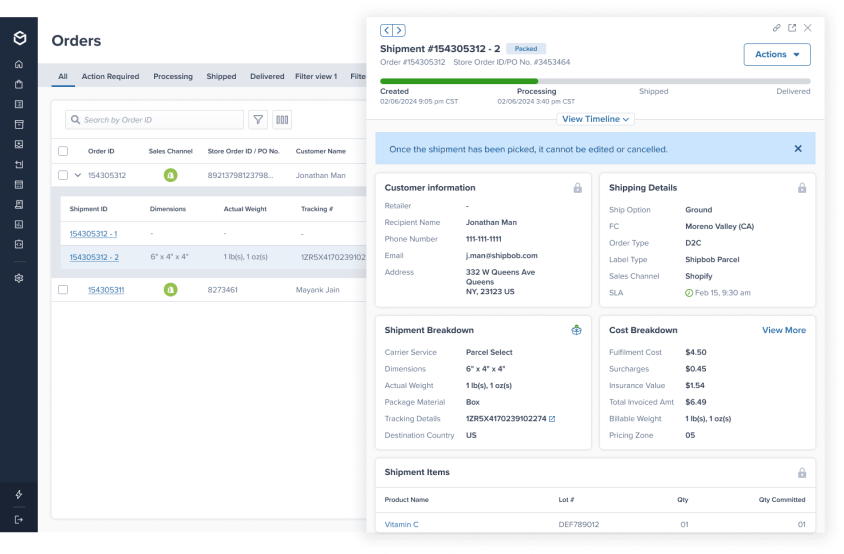
Offers a unified dashboard with shared metrics—order status, shipping times, cost per shipment. This aligns warehouse and shipping teams during high-volume periods and helps prevent last-minute congestion at docks.
ShipBob in Action: Case Studies
Results ShipBob customers have experienced show the impact of optimized warehouse traffic management.
Spikeball achieved 80% faster packing efficiency and eliminated 2,100 mispicks per year by using ShipBob WMS to streamline pick and pack workflows.
“We went from 3-4 people spending all day packing orders, and now we have our manager doing everything herself. She picks and packs orders from 7:00 am to noon, and then she’s done with DTC orders for the day.
We can rely on the automated system. All we have to do is scan the order, go where the system tells us, pick the item, then pack it. It’s way less stressful than our previous system. ShipBob has saved us time and labor costs.”
Adam LaGesse, Global Warehousing Director at Spikeball

Earthley doubled productivity and cut average lead time by 4 days, thanks to improved tasking and reduced cross-traffic.
“I’ve been super impressed with the system’s efficiency. I think a lot of that has to do with how the picking algorithms are built, and how the software groups and clusters like-items to streamline the process. The stowing process can be super simple, and ShipBob’s WMS still lets us pick and pack at least ten times faster than before.”
Ben Tietje, Co-Founder and CEO of Earthley


Pit Viper increased order accuracy from 92% to 99.7% and reduced labor by consolidating picking and packing workflows, minimizing unnecessary movement.
“Before we implemented ShipBob’s WMS, our order accuracy rate was around 92%. Now we’re at 99.7% for order accuracy, which equates to 2,100 less mispicks a year on average. When misshipments happen, we typically let customers keep the products because it’s more work to have them return the items. So ShipBob’s system for picking orders has cut down on labor costs, reduced lost inventory, and eliminated the need for double shipping. That’s been huge for us.”
Jourdan Davis, Operations Manager at Pit Viper


Our Place used real-time visibility to cut fulfillment and shipping times in half and save $1.5 million in freight costs, with better traffic flow and fewer dock bottlenecks.
“By leveraging ShipBob’s US fulfillment network, we’ve significantly reduced shipping times. Expanding our warehouse network from 2 to 4 warehouses has translated into substantial cost savings, amounting to $1.5 million in freight expenses for Our Place.
Currently, only 2% of our parcels are reaching Zone 7 or Zone 8 collectively, indicating that 98% of our parcels are reaching Zones 1 through 6. By shipping locally to lower zones, we’re achieving the most significant reductions in outbound costs.”
Ali Shahid, COO of Our Place


Each of these capabilities translates to smoother flow and less time on ad-hoc decisions, travel, and avoiding aisle conflicts, especially near critical dock lanes and pack-out areas.

Whether you’re running your own warehouse or exploring a fulfillment partner, ShipBob can help you build a safer, faster operation. Request a custom quote for fulfillment support today.
Warehouse traffic management FAQs
Here are answers to some of the most common questions about warehouse traffic management.
What is warehouse traffic management?

Warehouse traffic management is the process of designing, controlling, and enforcing the movement of people, equipment, and goods within a warehouse. It minimizes congestion, reduces risk, and supports efficient operations.
What should be included in a warehouse traffic management plan?
A warehouse traffic management plan should include:
- Mapped routes for pedestrians and equipment
- Right-of-way rules
- Standardized signage and floor markings
- Physical barriers
- Operational flow standards
- Hazard controls
- Emergency procedures
- Ongoing training and accountability measures
How do you separate pedestrians and forklifts in a warehouse?
You separate pedestrians and forklifts by creating dedicated walkways and using physical barriers or guardrails. Mark clear crossing points and enforce rules that limit pedestrian access to equipment lanes except at controlled intersections.
What are common warehouse traffic hazards besides forklift interactions?
Other hazards include slip and fall risks from spills and blocked aisles causing emergency egress issues. Congestion at dock doors and confusion during evacuations if routes cross equipment paths also pose risks.
How can warehouse traffic management improve pick and pack speed?
By reducing congestion and minimizing unnecessary crossings, warehouse traffic management helps teams move more efficiently. It also optimizes pick paths, helping teams avoid delays and hit shipping cutoffs consistently.
How does ShipBob WMS help reduce cross-traffic in high-velocity warehouses?
ShipBob WMS provides real-time inventory visibility, intelligent pick-paths, and standardized workflows. These features keep traffic away from congestion hotspots, enabling smoother flow and higher throughput as order volumes grow.


