
Table of Contents
** Minutes
What is multi-tier supply chain visibility?
Why is multi-tier supply chain visibility critical for ecommerce brands?
6 steps to implement multi-tier supply chain visibility
Multi-tier supply chain example: How it works in practice
Why multi-tier supply chain visibility enables 2-day shipping promises
How ShipBob helps you gain multi-tier supply chain visibility
Most supply chain problems don’t start with your suppliers. They start with your suppliers’ suppliers.
By the time your Tier 1 manufacturer flags a delay, the real issue originated two tiers back, and you’ve already lost your window to act. That’s the blind spot costing ecommerce brands stockouts, rushed shipments, and frustrated customers.
Multi-tier supply chain visibility fixes this. When you can see across your entire supplier network, from raw materials to finished goods, you stop reacting and start planning. You protect product availability, cut hidden costs, and deliver on the fast shipping promises your customers expect.
This guide breaks down how multi-tier visibility works, why it matters, and how to build it.
What is multi-tier supply chain visibility?
Multi-tier supply chain visibility is the ability to see beyond your direct suppliers and track activity across your entire supplier network, including your suppliers’ suppliers and the raw material producers further upstream.
Most brands know their Tier 1 suppliers well. What they miss is everything behind them.
Here is how the tiers break down:
- Tier 1 are your direct suppliers, the manufacturers, distributors, or vendors you buy from directly.
- Tier 2 are your suppliers’ suppliers, the companies providing materials or components to your Tier 1 partners.
- Tier 3+ are raw material producers and the foundational inputs that feed the entire chain.
With this comprehensive view, you can spot problems before they impact your business. So, for example, when a typhoon hits Southeast Asia, you’ll know immediately which suppliers are affected and can secure alternatives before stockouts occur.
This visibility isn’t just about risk management; it’s now essential for compliance with new European and North American supply chain laws requiring ethical sourcing verification. Plus, today’s consumers expect transparency about product origins, making deep supply chain visibility a competitive advantage.
Tier 1 vs multi-tier supply chain
Tier 1 suppliers are your direct partners. They’re the manufacturers, distributors, or vendors you buy from directly. While these immediate relationships are important, seeing only Tier 1 suppliers creates blind spots in your operations.
For example, imagine a beauty brand buying packaging from a direct supplier (Tier 1). When that supplier’s plastic manufacturer (Tier 2) faces problems with their resin producer (Tier 3), the beauty brand won’t learn about issues until weeks later and it’s too late to prevent stockouts.
This vulnerability affects all industries. Electronics retailers might track their device assembler perfectly, but miss problems with semiconductor manufacturers further up the chain. Home goods brands may monitor their woodworking partner while having no insight into lumber availability that ultimately determines their production capacity.
Most supply chain disruptions actually begin with these deeper-tier suppliers. Weather events, labor disputes, quality issues, and capacity constraints at these levels create ripple effects that ultimately prevent you from fulfilling customer orders on time.
That’s why visibility across all tiers has become a business necessity, not just a nice-to-have. Without it, you’re unable to spot problems or opportunities beyond your immediate supplier relationships.
Why is multi-tier supply chain visibility critical for ecommerce brands?
Ecommerce brands face unique challenges: customers expect two-day shipping, inventory must sync across multiple channels, and one supplier issue can greatly impact the customer experience. Multi-tier visibility gives you the transparency you need to stay competitive.
Basic tracking methods like spreadsheets are antiquated and are unreliable. Without seeing your entire supplier network, you miss disruptions and opportunities beyond immediate suppliers. Multi-tier visibility shifts you from reactive firefighting to proactive management.
Risk mitigation and resilience
With traditional supply chains, you learn about problems too late. By the time your direct supplier reports delays, you’re facing stockouts or expensive expedited shipping.
Multi-tier visibility gives you early warnings about upstream issues, whether it’s weather, labor strikes, or supplier financial problems. This advance notice lets you respond before inventory runs out.
During recent global disruptions, brands with multi-tier visibility spotted port congestion early and adapted quickly. While competitors struggled to explain delays, prepared brands maintained service by activating backup suppliers and repositioning inventory.
Operational efficiency and cost savings
Complete visibility improves supply chain efficiency. Without it, you’re likely overstocking inventory, paying to rush orders, and missing chances to optimize supplier relationships.
Multi-tier visibility makes forecasting data-driven. Understanding production schedules across all tiers lets you time orders based on actual capacity, which reduces safety stock and frees up capital.
You’ll also identify cost-saving opportunities throughout your supply chain. For instance, your Tier 2 supplier might have excess capacity during certain months, or consolidating orders across Tier 3 suppliers could unlock volume discounts.
This strategic coordination eliminates expensive last-minute fixes. Instead of paying for expedited shipping, you can align orders with production schedules and adjust timelines based on real capacity data, which creates significant cost savings.
Sustainability and environmental, social, and governance (ESG) compliance
Today’s customers want sustainable products, and governments increasingly require supply chain transparency through legislation (like the EU’s Corporate Sustainability Due Diligence Directive).
Multi-tier visibility lets you verify sustainability throughout your entire supply chain instead of relying on direct suppliers’ claims. This way, you can track carbon emissions, verify fair labor practices, and ensure environmental standards at every level.
This transparency becomes a marketing advantage. When you show customers their product’s journey from sustainable materials through ethical manufacturing, you build loyalty and trust.
It also protects your reputation by identifying problems at deeper supplier levels before they damage your brand, ensuring your supply chain truly reflects your values.
Faster shipping and better customer experiences
Meeting two-day shipping expectations requires orchestrating your entire supply chain to ensure products are available when and where needed.
Multi-tier visibility provides accurate production and transit timelines across all supplier levels. This lets you offer delivery estimates customers can trust, reducing service inquiries and building confidence.
By analyzing your complete supply chain, you can position inventory closer to anticipated demand before orders arrive. This means more orders qualify for economical ground shipping while still meeting 2-day delivery promises.
Most importantly, you can spot potential delays weeks in advance and take action before customers notice, whether activating backup suppliers, redistributing inventory, or communicating proactively about affected products. This maintains the consistent experience that keeps customers returning.
6 steps to implement multi-tier supply chain visibility
Building multi-tier visibility doesn’t require overhauling your operations overnight. Start with a strategic approach that grows with your business. By breaking it into manageable steps, even smaller brands can achieve comprehensive supply chain transparency.
Each step builds on the previous one, creating compounding benefits. With today’s technology partners, capabilities once reserved for enterprise companies are now accessible to growing ecommerce brands.
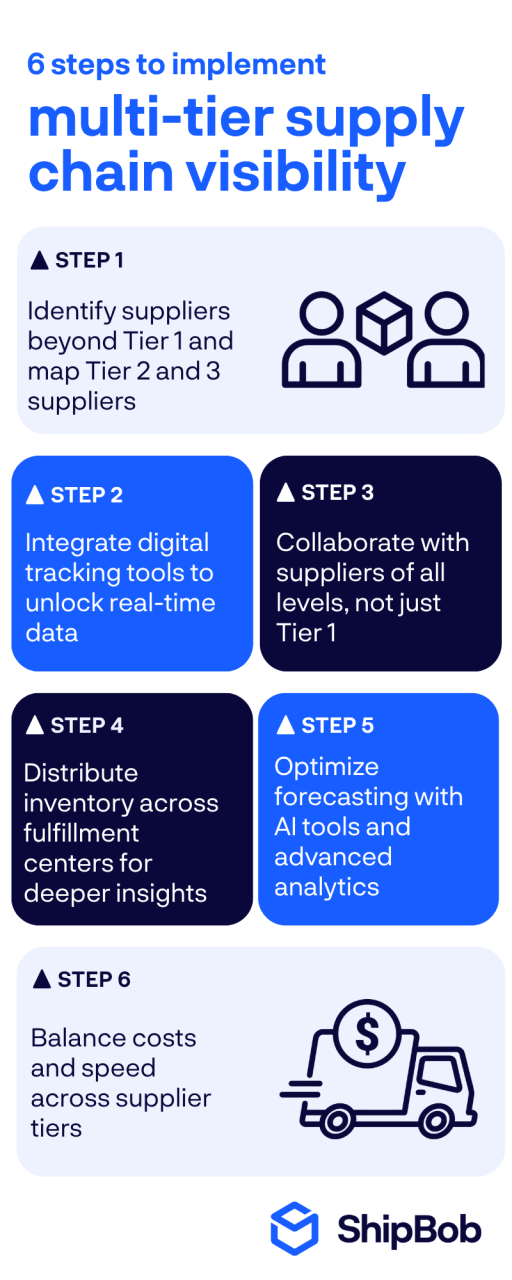
1. Map your sub-suppliers beyond Tier 1
Start by identifying who’s actually in your supply chain. Create a simple questionnaire asking your Tier 1 partners about their key suppliers. Focus on components that directly impact product quality and delivery times. Use industry databases to fill information gaps.
Build a visual supply chain map showing how materials flow from origin to fulfillment. Even a basic flowchart can reveal surprising dependencies you hadn’t considered.
Then, prioritize based on risk and impact. A supplier providing 80% of your bestseller’s key component deserves more attention than one supplying generic packaging. Focus first on suppliers whose disruption would significantly impact order fulfillment.
2. Integrate digital tools for real-time data
Manual tracking across multiple tiers quickly becomes unmanageable. Modern visibility platforms automate data collection, creating a centralized view of your entire network.
Options range from basic supplier portals to sophisticated IoT sensors and AI platforms that predict disruptions based on historical patterns.
Ensure your visibility tools connect with your existing tech stack (e.g., your ecommerce platform, inventory system, and fulfillment operations). Look for solutions with pre-built integrations for Shopify, Amazon, and major ERPs like NetSuite.
Start with cloud-based solutions that scale with your business. You don’t need enterprise systems immediately. Many platforms offer modular approaches where you add capabilities as you grow.
3. Collaborate with suppliers at all levels
Technology alone won’t create visibility. You also need supplier buy-in. Build collaborative relationships by demonstrating mutual benefits, not just demanding data.
Frame transparency as a partnership that improves their operations as well. Share forecasts to help suppliers plan production. Collaborate on sustainability initiatives that benefit their other customers.
Create clear data-sharing agreements specifying what information is needed and how it will be used. Standard templates ensure consistency across your supplier network.
4. Leverage distributed fulfillment for deeper insight
Distributed fulfillment creates natural visibility checkpoints throughout your supply chain. When inventory flows through multiple locations, you gain real-time data on customer order trends, movement patterns, and potential bottlenecks.
ShipBob’s network of 60+ global fulfillment centers provides this distributed visibility advantage. With our connected hub and spoke model, you gain insights into transit times, optimal inventory placement, and early warning signs of supply chain issues as inventory moves through the network.
This geographic distribution offers flexibility during disruptions. If a supplier problem affects one region, you can quickly reroute shipments from other fulfillment centers to maintain service levels.
The data reveals patterns that are invisible with a single warehouse (e.g., regional demand variations, seasonal trends, and shipping lane performance), enabling smarter decisions about supplier relationships.
5. Optimize forecasting with AI and advanced analytics
Raw visibility data becomes valuable when transformed into actionable insights. AI excels at identifying patterns across massive supply chain datasets.
Predictive analytics can spot potential disruptions by analyzing supplier financial health, customer demand fluctuations, and historical performance. These early warnings give you time to activate contingency plans before customers notice any impact.
ShipBob’s AI Decision Engine analyzes historical order data, as well as data across fulfillment centers and sales channels to optimize inventory levels and distribution. This prevents both stockouts and excess inventory, directly boosting your bottom line.
You’ll want to connect insights to actions. When AI identifies a potential delay at a Tier 2 supplier, your system should automatically suggest alternatives or recommend increasing safety stock for affected products.
6. Balance costs and speed across supplier tiers
Multi-tier visibility reveals true cost-speed tradeoffs. Often, seemingly cheaper suppliers create hidden costs through longer lead times or reliability issues.
Use your data to model different scenarios. What’s the real cost difference between a Tier 2 supplier with 30-day versus 15-day lead times? Factor in carrying costs, stockout risks, and the impact on 2-day shipping promises.
Position inventory strategically based on production and transit times across all tiers. This might mean paying slightly more for faster suppliers on bestsellers while optimizing costs on slower-moving items.
Also, create affordable contingency plans like pre-negotiated expedited shipping rates, backup supplier relationships, or strategic safety stock for critical components. The goal is to build resilience without high costs.
Multi-tier supply chain example: How it works in practice
Here’s an example of multi-tier supply chain in action. Imagine an activewear brand implementing multi-tier visibility to maintain fast, reliable shipping.
Their supply chain included fabric mills in Vietnam (Tier 3), textile manufacturers in Bangladesh (Tier 2), and a garment factory in China (Tier 1) before reaching North American customers.
Until they implemented multi-tier visibility, they only communicated with their Tier 1 manufacturer. When Vietnamese mills experienced shortages, they wouldn’t know until their Chinese manufacturer missed deadlines, which led to unexpected stockouts.
After mapping their supply chain and implementing visibility tools, they gained real-time insights across all tiers. So, when flooding threatened their Vietnamese mills, they received alerts weeks in advance, allowing them to:
- Activate backup fabric suppliers in Thailand
- Adjust production schedules with their Tier 1 manufacturer
- Redistribute inventory across fulfillment centers
- Communicate proactively about potentially affected products
As a result, they achieved:
- 95% product availability while competitors faced 3-4 week stockouts
- On-time delivery improvement from 87% to 96%
- 12-point increase in customer satisfaction
This visibility also revealed optimization opportunities. They discovered switching to a regional fabric supplier for North American products could reduce lead times by 10 days while decreasing costs by 8%. They also identified excess capacity at their Tier 2 manufacturer during certain months, allowing better off-peak rates.
Their inventory planning transformed from relying solely on Tier 1 estimates to incorporating fabric availability, production schedules, and raw material timelines. This comprehensive view enabled more strategic ordering, reduced rush shipping, and maintained inventory levels for fast fulfillment.
They also leveraged multi-tier visibility for sustainability initiatives, tracking environmental impacts and labor practices across all tiers. This transparency became a marketing differentiator, attracting environmentally conscious consumers who valued their commitment to ethical sourcing.
Why multi-tier supply chain visibility enables 2-day shipping promises
Fast shipping and supply chain visibility might seem unrelated at first. But consistent 2-day shipping actually depends on what happens long before products reach your warehouse.
Reliable 2-day shipping starts with understanding your entire supply chain timeline. When you know exactly how long each tier takes (from raw materials (Tier 3) through components (Tier 2) to final assembly (Tier 1)) you can plan backwards to ensure products are available precisely when customers need them.
This visibility lets you strategically place inventory for cost-effective, fast shipping. For example, when tracking shows summer products moving through production, you can position that inventory near West Coast fulfillment centers just as regional demand increases.
The biggest advantage comes during disruptions. When your system detects a delay with a Tier 3 supplier, you’ll know exactly which products will be affected and when. This early warning gives you time to redistribute inventory, activate backup suppliers, or adjust marketing, all before customers notice any delivery issues.
ShipBob’s network of 60+ fulfillment centers maximizes these benefits. With multi-tier visibility, you can route incoming products directly to optimal fulfillment locations, expanding your 2-day shipping coverage while reducing costs.
How ShipBob helps you gain multi-tier supply chain visibility
ShipBob delivers comprehensive supply chain visibility through our proprietary warehouse management system (WMS), strategic fulfillment network, and deep integrations, providing the transparency your brand needs.
ShipBob’s real-time inventory tracking across 60+ fulfillment centers captures inventory movement, regional demand, and shipping performance data you need to make informed decisions.
Our integration ecosystem unifies your operational stack across Shopify, Amazon, and other sales channels to provide a complete supply chain view. These connections extend to retail partners, ERP systems, and supplier platforms, creating seamless information flow across all tiers.
ShipBob’s AI Decision Engine identifies patterns, spots seasonal trends, predicts potential stockouts, and recommends optimal inventory distribution strategies to keep your supply chain running smoothly.
For brands wanting multi-tier visibility without massive investment, our partnership approach gives you immediate access to enterprise-level capabilities while you focus on growing your business, not managing complex technology.
FAQs about multi-tier supply chain visibility
Here are answers to common questions about implementing and managing multi-tier supply chain visibility for your ecommerce brand.
How do I integrate multi-tier supplier data into my ecommerce platform?

Modern visibility platforms offer pre-built integrations with major ecommerce systems like Shopify and Amazon. These connect via APIs to sync inventory, production timelines, and shipping data into a unified dashboard.
Start by connecting your primary visibility platform to your store, then gradually add supplier connections. Choose solutions that accommodate various technical capabilities, from advanced APIs to simple spreadsheet uploads.
ShipBob simplifies this process by acting as a central hub. One connection gives you real-time inventory data access, automated reorder alerts, and inbound shipment visibility without building custom integrations for each supplier.
How does visibility contribute to sustainability goals?
Multi-tier visibility enables meaningful sustainability initiatives by providing the measurement foundation. You can track environmental impact across your entire supply chain, monitoring carbon emissions, verifying fair labor practices, and ensuring environmental compliance at every level.
Brands use this data to verify sustainability claims, meet certification requirements, and satisfy consumer demand for transparency. It also enables smarter operational decisions: reducing air freight by better planning, minimizing inventory waste, and selecting suppliers based on both performance and environmental metrics.
How can SMB ecommerce brands implement multi-tier visibility?
SMB brands should start small with their most critical products (e.g., bestsellers or items with long lead times). Focus first on Tier 1 and Tier 2 suppliers for these key products before expanding.
Build visibility requirements into new supplier relationships from the start. Create simple templates for information sharing, beginning with basic metrics like production schedules before advancing to more complex data points.
Leverage technology partners instead of building capabilities in-house. Many platforms offer SMB-friendly pricing, and fulfillment partners provide built-in visibility tools. ShipBob gives SMB brands access to enterprise-level capabilities without enterprise-level investment.
How does ShipBob’s technology connect with upstream suppliers?
ShipBob’s platform connects suppliers to your fulfillment operations. Using our WRO process, suppliers can schedule deliveries, provide shipping notices, and share tracking information, which gives you real-time visibility into incoming inventory.
The platform integrates with various supplier communication methods to capture production dates, shipping details, and quantities that automatically update your forecasts.
ShipBob’s analytics identifies patterns and flags issues like consistently late shipments or incorrect quantities, allowing you to address problems before they affect customer orders and improve supplier performance across your network.
What metrics should I track to measure multi-tier supply chain performance?
Key metrics to track include:
- Supplier lead time
- Accuracy across tiers
- Inventory velocity
- Total cycle time (from raw materials to delivery)
- On-time-in-full rates (for both direct and sub-tier suppliers)
- Risk indicators (like financial health scores and single-source dependencies)
Connect these metrics to business outcomes. Better lead time accuracy improves inventory planning, reducing both stockouts and excess costs. Monitor how visibility improvements affect perfect order rates, shipping consistency, and fulfillment costs.


