

For ecommerce businesses, seasonal inventory can be a powerful growth lever or a major liability. When managed well, it helps you capture demand spikes, increase sales, and boost customer satisfaction; without a solid strategy, it can lead to stockouts, excess inventory, and missed revenue.
At ShipBob, we’ve helped thousands of brands navigate the highs and lows of seasonal demand, from holiday rushes to off-season slowdowns. The key to success? Smart forecasting, strategic inventory placement, and logistics systems that can flex with demand.
In this guide, we’ll show you how to build a seasonal inventory strategy that supports sustainable growth. You’ll learn how to:
- Forecast demand more accurately.
- Manage storage costs.
- Prepare your fulfilment operations to handle spikes with ease.
- Leverage ShipBob’s industry-leading platform and global fulfilment network to stay agile and profitable all year long.
What is seasonal inventory?
Seasonal inventory refers to products that experience predictable spikes in demand during specific times of the year, such as holidays, weather-related events, or special occasions.
Unlike regular inventory, which maintains relatively consistent demand throughout the year, seasonal inventory requires unique planning, storage, and fulfilment strategies to ensure the right products are available when customers want them most.
Examples:
- A retailer selling Halloween costumes may see a surge in orders leading up to October 31st.
- A brand offering beach umbrellas and swimwear will likely experience peak demand during the summer months.
- School supplies, like backpacks and notebooks, tend to fly off the shelves in August and September as students prepare for the new academic year.
Managing seasonal inventory effectively is crucial for maximising sales and minimising costs during these high-stakes periods. Brands must accurately predict demand, secure adequate storage space, and optimise fulfilment operations to handle the influx of orders without sacrificing speed or accuracy.
Get it right, and you can capitalise on the seasonal rush to boost profits and customer loyalty. Get it wrong, and you risk stockouts, overstocking, and disappointed shoppers who may turn to competitors for their seasonal needs.
The importance of seasonal inventory management
Effective seasonal inventory management is crucial for ecommerce businesses looking:
- Maintain a healthy bottom line: To get the most ROI on your inventory, you’ll need to capitalise on peak demand periods. Poor planning can lead to costly overstocking, understocking, and missed sales opportunities.
- Keep customers happy and preserve brand reputation: Shoppers expect fast, reliable fulfilment during peak periods, and failing to deliver can lead to negative reviews and lost loyalty.
By investing in the right strategies, tools, and partnerships, ecommerce businesses can turn seasonal demand into a year-round competitive advantage.
Understanding seasonal demand patterns
To effectively manage seasonal inventory, it’s crucial to understand the unique demand patterns that drive sales for your products.
Seasonal demand can be influenced by a variety of factors, including holidays, weather, events, and consumer trends. For example, retailers selling outdoor gear may see a surge in demand during the summer months, while those offering holiday decorations will experience peak sales leading up to Christmas.
By identifying your specific seasonal patterns, you can make informed decisions about when to stock up, how much inventory to carry, and when to wind down.
One of the most powerful tools for uncovering seasonal demand patterns is historical sales data. When you analyse past performance, you can identify trends and anticipate future demand.
Look for consistent spikes and dips in sales volume, and note any external factors that may have influenced those fluctuations.
Major retailers often plan their seasonal merchandise rollouts months in advance, using a combination of historical data, market research, and trend forecasting. They create detailed seasonal planning calendars that outline key milestones, such as when to place orders with suppliers, when to begin receiving inventory, and when to launch promotional campaigns.
To help you stay organised and proactive, consider creating your own seasonal planning calendar. This should include major retail seasons relevant to your business, along with typical lead times for ordering and receiving inventory.
In mapping out your seasonal timeline, you can help ensure that you have the right products in stock when demand is highest.
The seasonal inventory lifecycle
Managing seasonal inventory is an ongoing process that involves multiple stages. Understanding the seasonal inventory lifecycle can help you plan and execute more effectively.
Planning and forecasting
The cycle begins 6-12 months ahead of the season. During this time, you’ll analyse historical data, assess market trends, and create demand projections to guide your inventory decisions.
Pre-season preparation
Next, you’ll need to place orders with suppliers, optimise your warehouse layout, and train staff on seasonal procedures. As the season approaches, you’ll begin receiving and stocking inventory; take time and ensure you have sufficient quantities on hand to meet anticipated demand.
Execution
Once the season is in full swing, your focus will shift to executing your sales and fulfilment strategies. This involves closely monitoring inventory levels, processing orders efficiently, and replenishing stock as needed. Agility is key during this phase, as you may need to adjust your approach in real-time based on actual demand.
Clearance and analysis
As the season winds down, this is when you’ll implement strategies to sell through remaining inventory, such as markdowns or bundling. You’ll also review your performance data to identify areas for improvement and inform future planning.
7 strategies for seasonal inventory management
1. Data-driven forecasting and planning
Accurate forecasting is the foundation of effective seasonal inventory management. By analising historical sales data, market trends, competitor activity, and economic indicators, you can predict future demand with greater precision.
To build a robust seasonal inventory plan, follow these steps:
- Gather and clean historical sales data for the relevant season(s).
- Identify key demand drivers and trends.
- Incorporate market insights and economic factors.
- Create a baseline forecast using statistical models.
- Adjust the forecast based on current trends and real-time data.
- Build in buffers for unexpected demand spikes.
- Monitor and update the plan throughout the season.
Remember to avoid common forecasting pitfalls, such as relying too heavily on a single data point or ignoring external factors that could impact demand.

2. Strategic inventory distribution
Distributing your seasonal inventory across multiple fulfilment locations globally can significantly improve your ability to meet customer demand and reduce shipping costs. Placing products closer to your customers unlocks faster delivery times, lower shipping fees and overcomes cross-border duty complications.
To optimise your inventory distribution strategy:
- Analyse customer location data to identify high-demand areas.
- Evaluate the capacity and capabilities of potential fulfilment centres.
- Consider the impact of shipping distance and transit times on delivery speed and cost.
- Allocate inventory based on regional demand patterns and product popularity.
- Continuously monitor and adjust inventory levels at each location.
Partnering with a fulfilment provider like ShipBob, which offers a strategically distributed network of fulfilment centres, can simplify the process of strategically placing your seasonal inventory.

3. Real-time inventory visibility
In the fast-paced world of seasonal selling, real-time inventory visibility is critical. When you have instant access to inventory levels across all channels and locations, you can make informed decisions quickly and prevent overselling or stockouts.
Integrated inventory management systems that connect your sales channels, warehouses, and fulfilment partners provide a centralised view of your seasonal inventory. These systems update inventory levels in real-time as orders are placed and fulfilled, allowing you to monitor stock levels and adjust replenishment plans as needed.
With real-time data at your fingertips, you can:
- Identify and address potential stockout risks before they impact sales.
- Reallocate inventory between locations to meet shifting demand patterns.
- Adjust pricing and promotions based on real-time sales performance.
- Make data-driven decisions to optimise your seasonal inventory strategy.

4. Optimised warehouse organisation
Efficient warehouse organisation is essential for managing the high volume of seasonal orders. By optimising your warehouse layout and processes, you can streamline order fulfilment, reduce handling time, and minimise the risk of errors during peak periods.
Consider these best practices for organising your seasonal inventory:
- Dedicate specific areas of your warehouse to seasonal products.
- Use clear labelling and signage to identify seasonal items.
- Store high-demand products in easily accessible locations.
- Implement efficient picking paths to minimise travel time.
- Use technology to guide pickers and packers through the fulfilment process.
- Establish clear protocols for handling and packaging seasonal items.
Regularly review and adjust your warehouse organisation as seasonal demand patterns shift to ensure optimal efficiency throughout the peak period.

5. Flexible storage and staffing solutions
During peak seasons, ecommerce businesses often face the challenge of accommodating increased inventory levels and fulfilling a higher volume of orders. Flexible storage and staffing solutions can help you scale efficiently and cost-effectively during these high-demand periods.
One option for temporary storage expansion is to leverage on-demand warehousing. This model allows you to rent additional space on a short-term basis, avoiding the long-term costs and commitments of traditional warehousing. On-demand solutions are particularly well-suited for seasonal inventory needs, as you can scale up and down quickly based on your specific requirements.
When evaluating on-demand warehousing options, consider factors such as:
- Location and proximity to your customers.
- Flexibility of rental terms and pricing.
- Ability to integrate with your existing inventory management systems.
- Security and quality control measures.
In addition to flexible storage, scaling your labour force efficiently is crucial for managing seasonal demand. Strategies for ramping up staffing during peak periods include:
- Hiring temporary or seasonal workers to handle increased order volume.
- Cross-training existing staff to perform multiple functions during busy times.
- Implementing performance-based incentives to motivate and retain seasonal staff.
- Partnering with staffing agencies that specialise in providing skilled warehouse labour.
Automation can also play a role in reducing reliance on seasonal staff. Technologies such as robotic picking systems, automated guided vehicles (AGVs), and conveyor systems can streamline high-volume fulfilment processes and minimise the need for additional labour during peak seasons.
6. Proactive inventory management
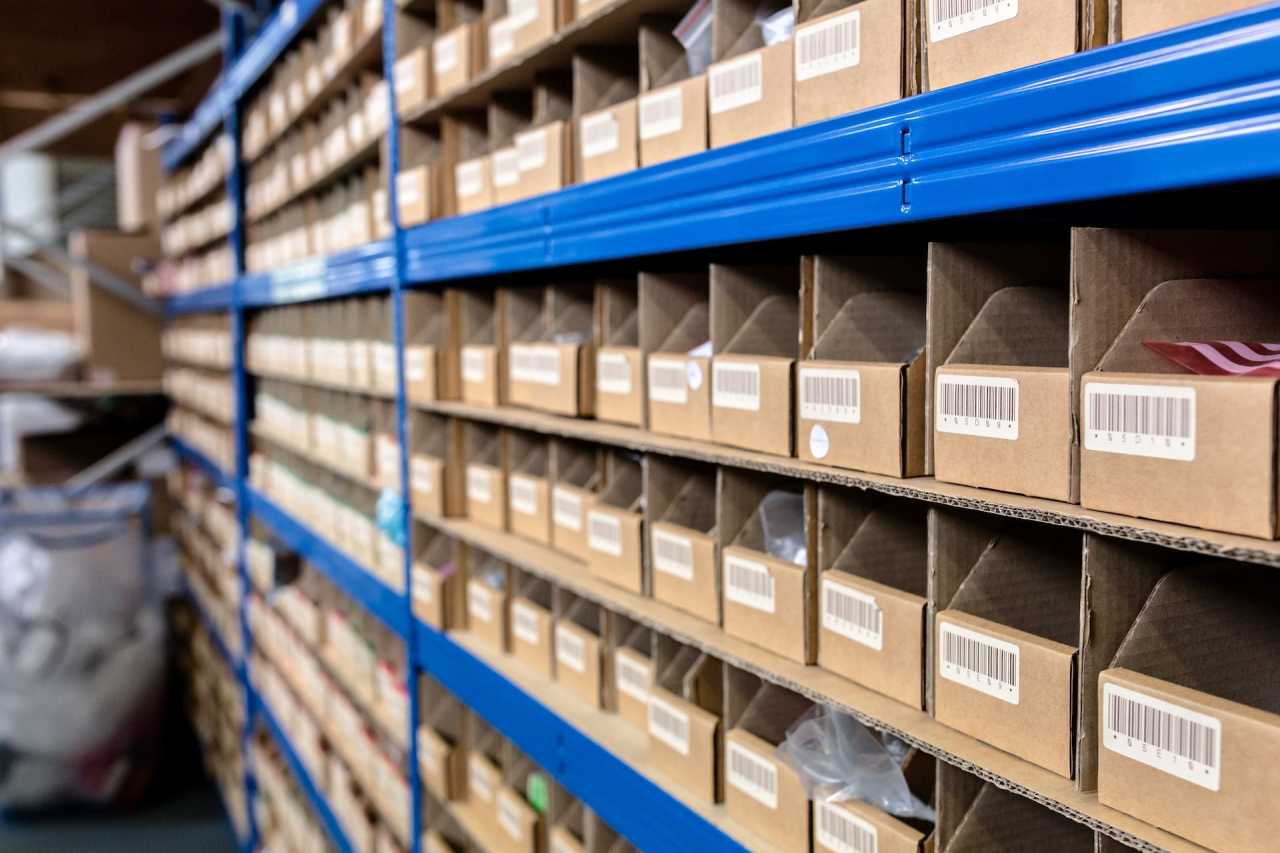
Effective seasonal inventory management requires a proactive approach to monitoring stock levels and adjusting replenishment plans in real-time. By setting appropriate reorder points and safety stock levels, you can minimise the risk of stockouts while avoiding the costs of overstocking.
To determine optimal reorder points for your seasonal products, consider factors such as:
- Historical sales data and projected demand.
- Lead time for replenishment from suppliers.
- Variability in demand and supply chain disruptions.
- Desired service level (i.e., the percentage of orders you aim to fulfil from stock).
Safety stock is an additional buffer of inventory held to mitigate the risk of stockouts due to unexpected spikes in demand or supply chain delays. When calculating safety stock levels for seasonal items, account for the increased variability and shorter sales window compared to year-round products.
Once your seasonal inventory is in stock, closely monitor sell-through rates to identify fast-moving items and adjust replenishment orders accordingly. Regularly review your inventory turnover and weeks of supply metrics to ensure that you’re not holding excess stock or risking stockouts.
For slow-moving seasonal items, proactively implement strategies to avoid accumulating dead stock. These may include:
- Bundling slow-movers with fast-selling items to encourage sales
- Offering targeted promotions or discounts to liquidate excess inventory
- Exploring alternative sales channels, such as online marketplaces or flash sale sites
- Donating or recycling unsold merchandise to minimise holding costs

7. Manage post-season inventory effectively
As the seasonal rush winds down, ecommerce businesses must have a plan in place to handle leftover stock, process returns efficiently, and learn from their performance data to improve future seasonal strategies.
Strategies for handling leftover stock
Unsold seasonal inventory can tie up valuable storage space and working capital, so it’s essential to have a clear strategy for dealing with leftover stock. Options may include:
- Markdowns: Offering progressive discounts to encourage sales and clear out remaining inventory.
- Bundling: Combining slow-moving seasonal items with complementary products or fast-sellers to create attractive packages.
- Storage: If the products have a longer shelf life and are likely to sell next season, consider holding them in storage until the following year. However, carefully weigh the holding costs against the potential future revenue.
To determine the best approach for your leftover seasonal stock, analyse factors such as the product’s shelf life, storage costs, and projected demand for the following season. In some cases, it may be more cost-effective to liquidate the inventory at a discount rather than holding it for an extended period.
Rapid return management & reverse logistics
After the seasonal peak, ecommerce businesses often experience a surge in returns as customers send back unwanted gifts or impulse purchases. An efficient returns process is crucial for maintaining customer satisfaction and quickly returning seasonal items to sellable condition.
To streamline your post-season returns process:
- Ensure that your return policy is clearly communicated and easy to find on your website.
- Provide customers with pre-printed return labels and detailed instructions to simplify the process.
- Leverage technology to automate return authorisations and tracking.
- Train your staff to quickly process, inspect, and restock returned seasonal items.
- Consider partnering with a returns management provider to handle the end-to-end process.
Learn from seasonal data
Finally, take the time to analyse your seasonal performance data to identify areas for improvement and inform future planning. Key metrics to review include:
- Sales volume and revenue by product, channel, and region
- Inventory turnover and sell-through rates
- Stockout incidents and lost sales
- Fulfilment accuracy and speed
- Customer satisfaction and return rates
Conduct a thorough post-season inventory review to assess what worked well and where you faced challenges. Use this data to refine your forecasting models, adjust your inventory distribution strategy, and optimise your fulfilment operations for the next seasonal peak.
What are the right KPIs for managing seasonal inventory?
Tracking the right key performance indicators (KPIs) is essential for effectively managing seasonal inventory. These metrics provide valuable insights into your inventory health, sales performance, and operational efficiency during peak seasons.
Here are some of the most important KPIs to monitor.
| Metric | What it measures | How to calculate it | Healthy benchmarks |
| Sell-through rate | The percentage of seasonal inventory sold during a specific period. | Divide the number of units sold by the number of units received, then multiply by 100. | 80% or higher |
| Weeks of supply | How long your current seasonal inventory will last based on projected sales. | Divide your current inventory by your average weekly sales forecast. | 2-4 weeks for fast-moving seasonal items |
| Inventory turnover | How quickly you sell through your seasonal inventory. | Divide your cost of goods sold (COGS) by your average inventory value for the season. | 4-6 times per season |
| ROI | Evaluates the profitability of your seasonal inventory investment. | Subtract your total seasonal inventory costs from your gross seasonal sales, then divide by your total seasonal inventory costs. | 20% or higher |
Tracking these KPIs manually can be time-consuming and error-prone. ShipBob’s analytics dashboard simplifies the process by providing real-time data on key seasonal inventory metrics.
With intuitive visualisations and customisable reports, brands can easily monitor performance, identify trends, and make data-driven decisions to optimise their seasonal inventory management.
Advanced strategies for seasonal inventory success
For brands looking to take their seasonal inventory management to the next level, here are some advanced strategies and best practices to consider:
🌎 Localised seasonal fulfilment strategies
Distributing your seasonal inventory across multiple regional fulfilment centres can significantly reduce shipping times and costs during peak periods.
To optimise your inventory placement, analyse regional demand patterns using historical sales data and customer location insights. Identify high-demand areas and allocate seasonal inventory accordingly.
🔎 Real-time inventory visibility for seasonal flexibility
Integrated inventory management systems that provide real-time visibility across all sales channels and fulfilment locations empower brands to make agile decisions when forecasts change or unexpected demand spikes occur.
Look for systems that offer intuitive dashboards and proactive alerts to help you monitor seasonal inventory levels, identify potential stockouts, and reallocate inventory as needed.
📦 Scaling storage options on demand
Seasonal demand fluctuations often require flexible storage solutions that can accommodate variable inventory levels without long-term commitments. Look for fulfilment partners that offer a range of storage options, such as bins, shelves, and pallets, and allow you to scale your storage footprint as needed.
By avoiding year-round warehouse commitments for seasonal needs, you can optimise your storage spend and allocate resources more efficiently.
🛍️ Seasonal inventory bundling and kitting opportunities
Bundling and kitting are powerful strategies for streamlining seasonal fulfilment and increasing average order value. By pre-assembling holiday gift sets or seasonal product bundles, you can reduce picking and packing time, minimise errors, and create attractive upsell opportunities.
How ShipBob helps brands master seasonal inventory
ShipBob is a leading omnichannel fulfilment and supply chain partner that empowers ecommerce brands to navigate the challenges of seasonal inventory management with confidence.
With a global network of fulfilment centres, advanced technology, and expert support, ShipBob provides the infrastructure and tools needed to optimise seasonal inventory performance.
Automated inventory placement
ShipBob’s Inventory Placement Program helps brands selling across the US strategically distribute their seasonal inventory to reduce shipping costs and improve delivery times. By analysing historical sales data and regional demand patterns, ShipBob recommends optimal inventory allocation across its nationwide network of fulfilment centres.
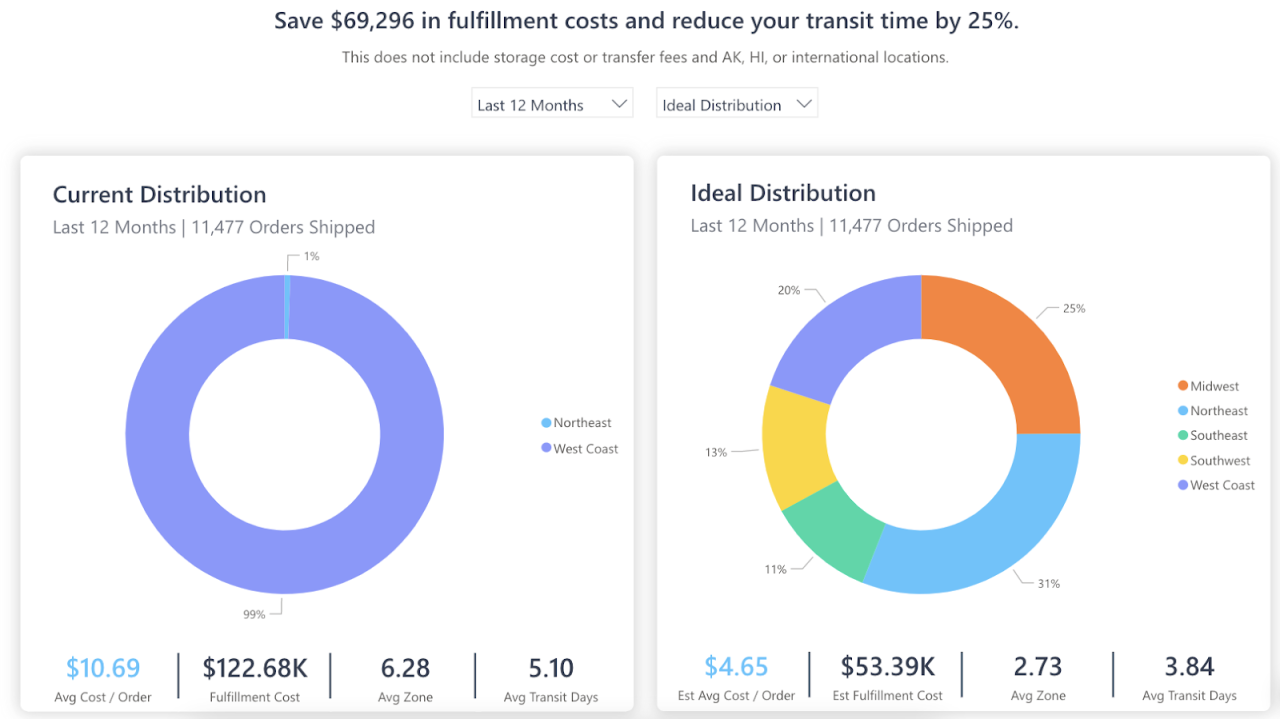
For example, a brand selling winter coats could place a larger portion of its inventory in ShipBob’s fulfilment centre on the East Coast and Midwest, while allocating more swimwear to West Coast and southern locations.
This targeted approach minimises shipping distances, reduces transit times, and ensures that seasonal products are always close to the customers who want them.
“Stonehenge Health is based in California, and 20% of our business is there, but the majority of the US population is on the East Coast. To reach customers in both regions cost-effectively, we needed a more centrally located fulfilment centre, or better yet, multiple across the country. But with our previous 3PL, the ability to have multiple locations was always a question mark; while they could conceivably support that expansion, it felt really weak.
With ShipBob, having multiple locations was never a question. Through the Inventory Placement Program, we went from using one warehouse in Southern California to being in multiple regionally located fulfilment centres, which drastically reduced our out-the-door shipping cost.
The ShipBob dashboard even provides detailed reporting on our average shipping costs, and transit time by location, and we can optimise our inventory distribution based on that data.”
Gregory Frye, VP of Operations at Hi-Altitude Brands
Industry-leading distributed fulfilment network
With over 60 fulfilment centres across the UK, Europe, United States, Canada, and Australia, ShipBob’s global network is designed to support seasonal selling on an international scale. Distributing inventory across multiple locations lets brands reduce shipping costs, improve delivery speed, and mitigate the risk of stockouts during high-volume periods.
ShipBob’s technology automatically routes each order to the fulfilment centre closest to the end customer, ensuring the most efficient and cost-effective shipping option. This distributed approach allows brands to offer fast, affordable delivery to a wide range of customers, even during peak seasonal demand.
“Peak season was awesome for us! Our SLAs are constantly at 99%, and it was no different during peak. Even if that’s something other fulfilment partners could do, ShipBob still set itself apart because of how they enabled us to meet demand.
We went on a very fast production run during November and December this past year, and ShipBob expedited receiving for a lot of new inventory that supported our sales. It was a huge operation that required a ton of cooperation between manufacturing, trucking, shipping to all the facilities, and stowing – plus everything had to be expedited to have stock arrive in fulfilment centres by peak.
But ShipBob didn’t miss a beat. They worked with us tirelessly to make sure we had the right inventory where we needed it, when we needed it. In the end, we didn’t have a single stockout of any item during all of peak season.”
Nadav Haras, VP of Supply Chain at Particle
Data-enriched inventory management software
ShipBob’s proprietary software provides real-time visibility into seasonal inventory levels, empowering brands to make informed decisions and prevent stockouts. With features like real-time stock tracking, low-inventory alerts, and automated reorder notifications, the platform helps brands stay ahead of seasonal demand fluctuations.
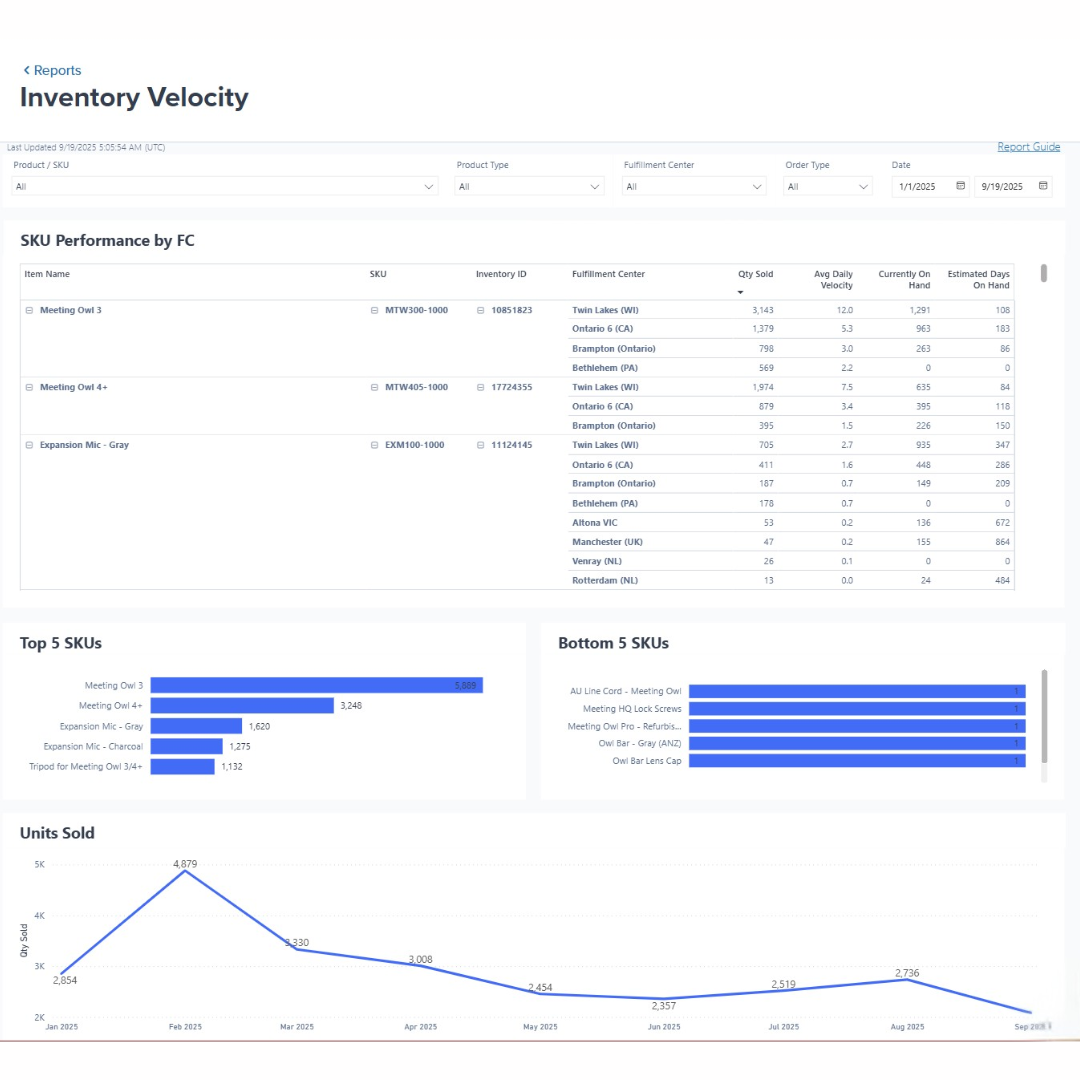
The software seamlessly integrates with popular ecommerce platforms, allowing for automatic inventory updates and order syncing. This ensures that stock levels are always accurate across all sales channels, reducing the risk of overselling during peak seasons.
“All of the reporting ShipBob offers is amazing. Our old 3PL’s reporting was essentially non-existent, so we had to download whatever minimal data we could get and try to figure it out ourselves. We also had no visibility into where an order was in fulfilment from beginning to end.
With ShipBob, it’s the opposite. They have reporting on storage, fulfilment, inventory, and shipping, and the transparency is complete. I’m a data person, and the analytics dashboard is so easy to use. If I ever want to export reports to slice and dice them in Excel, I can do that, too. ShipBob’s integration with Shopify Plus is also very good, so the data flows seamlessly between platforms and updates everything in real time.”
Gregory Frye, VP of Operations at Hi-Altitude Brands
For more information about how ShipBob can help you optimise your seasonal inventory management and fulfilment, click the button below to get in touch.
FAQs about seasonal inventory
Here are answers to some of the most common questions about seasonal inventory.
What are the most common seasonal inventory challenges for ecommerce brands?

Ecommerce brands often struggle with accurately forecasting demand for seasonal products, overstocking and stockouts, and limited storage space.
When should I start planning for seasonal demand?
The ideal time to start planning for seasonal demand depends on the specific products and retail seasons involved.
As a general rule, it’s best to begin forecasting and preparing at least 6-12 months in advance of major seasonal peaks like the holiday shopping season.
For smaller seasonal events or weather-dependent products, a shorter planning horizon of 3-6 months may suffice.
How do I prevent overstocking or understocking during peak seasons?
To strike the right balance between overstocking and understocking:
- Focus on improving the accuracy of your demand forecasts.
- Analyse historical sales data, market trends, and competitor activity to develop a clear picture of expected demand.
- Build in safety stock buffers to account for unexpected spikes, but avoid excessive overstocking.
- Monitor sell-through rates and inventory levels in real-time throughout the season, adjusting reorder quantities and timing as needed.
Consider leveraging inventory management software with automated alerts and replenishment features to help maintain optimal stock levels.
What technology is essential for managing seasonal inventory effectively?
An integrated inventory management system is crucial for keeping track of seasonal stock across multiple sales channels and fulfilment locations. Look for software that provides real-time visibility into inventory levels, order status, and demand patterns, as well as insight into key metrics like sell-through rate and inventory turnover.
How can I reduce seasonal inventory carrying costs?
One effective strategy for reducing seasonal carrying costs is to leverage on-demand warehousing solutions instead of committing to long-term storage contracts. This allows you to scale space up or down as needed without paying for unused capacity during off-peak periods.
Optimising your inventory distribution across multiple fulfilment centres can also help minimise carrying costs by keeping stock closer to end customers. This reduces the need for costly expedited shipping and allows for more efficient inventory turnover.
What are the best strategies for liquidating excess seasonal inventory?
If you find yourself with excess seasonal inventory after a peak period, consider the following liquidation strategies:
- Run targeted clearance sales or promotions to quickly move surplus stock.
- Bundle slow-moving items with complementary products to increase overall order value.
- Explore bulk sales opportunities with discount retailers or liquidation platforms.
- Donate excess inventory to charitable organisations for a potential tax write-off.
The key is to act quickly to minimise the carrying costs associated with holding onto excess stock for an extended period.
How does ShipBob help with seasonal inventory management?
ShipBob offers a range of solutions designed to simplify seasonal inventory management for ecommerce brands. With a network of fulfilment centres across the US, Canada, the UK, Europe, and Australia, ShipBob enables brands to distribute inventory strategically and reduce shipping times during peak seasons.
ShipBob’s software provides real-time visibility into inventory levels across all locations, with reorder thresholds and automated alerts to prevent stockouts. Flexible storage options allow brands to scale up or down as needed, while ShipBob’s data analytics tools provide insights into seasonal performance metrics.


