

Table of Contents
** Minutes
What is delivered duty paid (DDP) shipping?
Key Takeaways
1
Delivered Duty Paid (DDP) shipping requires the seller to handle all risks and costs associated with transporting goods until they reach the buyer, making it a favorable option for buyers in international shipping.
2
DDP is preferred over Delivered Duty Unpaid (DDU) because it eliminates unexpected fees for buyers, enhancing the customer experience by covering all duties and taxes upfront.
3
Sellers using DDP must account for various fees, including shipping, customs duties, VAT, and potential storage costs, which can impact profitability if not managed properly.
4
ShipBob offers a DDP solution that simplifies international shipping by automating optimal fulfilment centre selection and providing competitive shipping rates, reducing post-purchase issues for global customers.
Delivered duty paid (DDP) shipping is a type of delivery where the seller takes responsibility for all risk and fees of shipping goods until they reach their destination. Mainly used for international shipping, DDP is a common shipping method developed by the International Chamber of Commerce which helps to standardize shipping options throughout the world.
Many companies will only use DDP when shipping goods by air or sea freight. Buyers benefit heavily from DDP because they assume less risk, liability, and costs. Although DDP is a good deal for the buyer, it may be a big burden for the seller because it can quickly reduce profits if handled incorrectly.
Due to the complex rules associated with international shipping and each country having its own set of rules and laws for customs formalities, DDP is best for high-value items (i.e., an average order value of greater than $30). Incoterms are internationally recognised shipping terms. These incoterms include DDP shipping being a common practice when shipping across borders.
What is delivered duty paid (DDP) shipping?
Delivered duty paid (DDP) shipping is a delivery agreement between buyers and sellers that places the risks and responsibilities of transportation on the seller until the buyer receives them. With DDP, buyers are not liable for the actual shipping costs, making them more likely to purchase products without fear of being scammed or having to pay high taxes. DDP shipping is used to protect the buyer, as well as hold the sender responsible until the customer receives their product.
Incoterms: DDP vs. DDU vs. DAP
Incoterms are logistics specific terms that many of which are acronyms and can be confusing. Here are some relevant terms for you to know. DDP, DDU, and DAP. So what are they and what’s the difference?
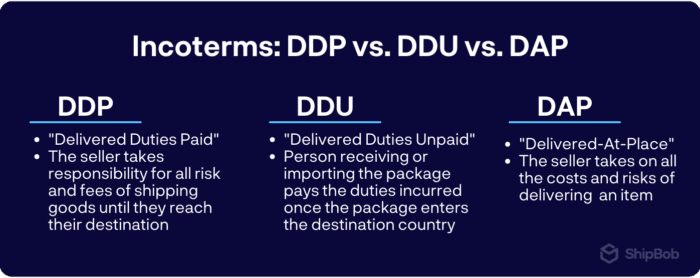
The difference between DDP and delivered duty unpaid (DDU) is that DDU requires the end consumer or person receiving or importing the package to pay the duties incurred once the package enters the destination country.
With DDU, customs will contact the customer once their package arrives, and the customer may even have to go to the local post office to pick it up. Too often, the customer doesn’t realize their order was DDU and will contact the merchant’s customer support line, cancel the order, or refuse to get it and return it to the sender.
DDP is considered the better customer experience, as it is a cross-border option that takes all fees into consideration upfront, allowing the merchant to still choose whether they pass those fees to the customer by increasing the product pricing or simply eat those costs.
DAP, or delivered-at-place, means the seller takes on all the costs and risks of delivering an item.
Why is DDP used?
Here are the top reasons sellers choose to use DDP over DDU shipping.
1. To protect the buyer
DDP shipments help the buyers not get swindled. Since the seller’s responsibilities assume all the risk and cost of shipping products, it’s in their best interest to make sure customers actually receive what they ordered. The time and cost associated with DDP shipping are too big of a burden for scammers to even consider using it.
2. To ensure safe delivery to the place of destination for international trade
So much can go wrong when exporters ship packages halfway around the world. Every country has its own laws regarding transport, import duties and shipping fees. DDP makes the seller become diligent on only sending packages on the best and safest routes.
3. To ensure safe delivery by sea or air freight
Depending on the type of product and where it’s sold, safe delivery by air or sea can be difficult. DDP is essentially a shipping agreement that ensures sellers don’t take the money and run. .
4. To hold sellers responsible for international fees
If a buyer has to pay customs fees, there’s a chance the sale won’t happen because they don’t know the cost of these fees. With sellers and shippers paying international fees, DDP allows for a smoother purchasing experience because the buyer doesn’t have to worry about paying the fees.
The DDP timeline
DDP follows a simple supply chain timeline. The seller retains most of the liabilities until the products arrive to the buyer. There are four major steps involved.
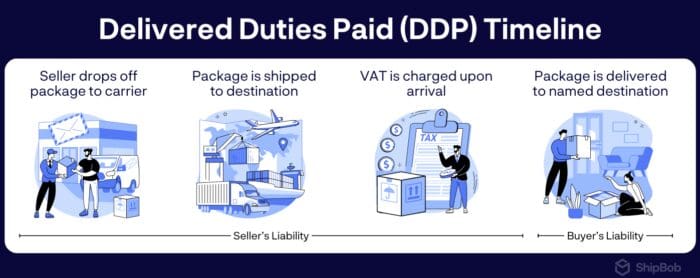
1. Seller drops off the package with a carrier — seller liability
The seller will drop off the package with a trusted carrier, or the carrier might pick it up. Sellers are incentivized to use trusted couriers because it reduces the overall cost of shipping.
2. The package is shipped to its place of delivery — seller liability
Packages can be shipped via any method of transportation including ships, planes, and vehicles. With a trusted shipping partner, the seller incurs less risk and can be certain the package is actually delivered.
3. The package arrives at the destination and is charged Value Added Tax (VAT) — seller liability
One of the benefits of DDP shipping is the buyer doesn’t have to pay VAT. The takes on the cost of the VAT for the shipment.
4. The package is dropped off at a named destination — liability transfers to the buyer
Once the package arrives, the buyer is now responsible for the actual product. For D2C companies, this is when you can expect to hear from the customer if there are any issues with the delivery.
Sellers beware: DDP fees
Though DDP is a popular option for sellers, it comes with a high amount of fees. To determine if DDP shipping is right for your business, calculate the fees you’ll have to pay and if you’ll make profits from your sales.
Sellers assume responsibility for ALL these fees:
1. Shipping fees
Shipping products via sea or air can be expensive. You’ll want to take the time to calculate how much it will be to ship products internationally. Click here for rate calculators provided by different couriers.
2. Import and export custom duties
If DDP is handled poorly, inbound shipments are likely to be examined by customs, which causes delays. Late shipments may also occur if you end up choosing a less reliable transportation service because its the cheapest option.
3. Damage fees
Any damage incurred to products is a cost paid for by the seller. As the seller, you will have to pay for any damage done to the products, and even have to ship them again to their destination.
4. Shipping insurance
Although shipping insurance is not obligatory, most sellers prefer to purchase insurance to lower risk.
5. VAT
DDP assigns the seller the responsibility of paying the VAT. However, it is possible to change with the consent of the buyer and seller. The VAT can be expensive, sometimes 15-20% of the value of the goods plus duty. In many cases and depending on what they do with the goods, the buyer may be eligible for a VAT refund. VAT refunds accrue to the buyer. This means that, at best, you have to absorb the VAT; at worst, you absorb the VAT while your customer gets a VAT refund.
6. Storage and Demurrage
Under DDP, the seller must absorb the costs associated with customs clearance. This includes any storage or demurrage charges incurred due to delays by customs authorities, other government agencies, delivery drivers, and air/ocean couriers. Since these are unanticipated costs, they can quickly eat into your profits or completely negate them.
ShipBob’s DDP shipping
ShipBob DDP, our Delivered Duty Paid solution is available throughout all dozens of fulfilment centres in the United States and United Kingdom (and even for brands with their own warehouse that use ShipBob’s WMS to power their in-house fulfilment, in the US).
ShipBob customers can convert more shoppers globally, enabling them to ship to more than 250 destinations while bypassing the complexities of VAT and other taxes and streamlining customs clearance.
ShipBob’s AI-powered technology automatically selects the most optimal fulfilment centre, then delivers the best shipping rates based on their carrier network and guaranteed DDP options, allowing brands a truly seamless way to reach a global market.
Without DDP, consumers in many countries face surprise fees, long delivery times and delays at customs. ShipBob’s DDP solution eliminates these post-purchase issues for a more streamlined approach to international order fulfilment, while reducing customer service inquiries.
This native integration is available for Shopify and Bigcommerce stores, with third-party integrations available for other platforms like Woocommerce and by using ShipBob’s Developer API.
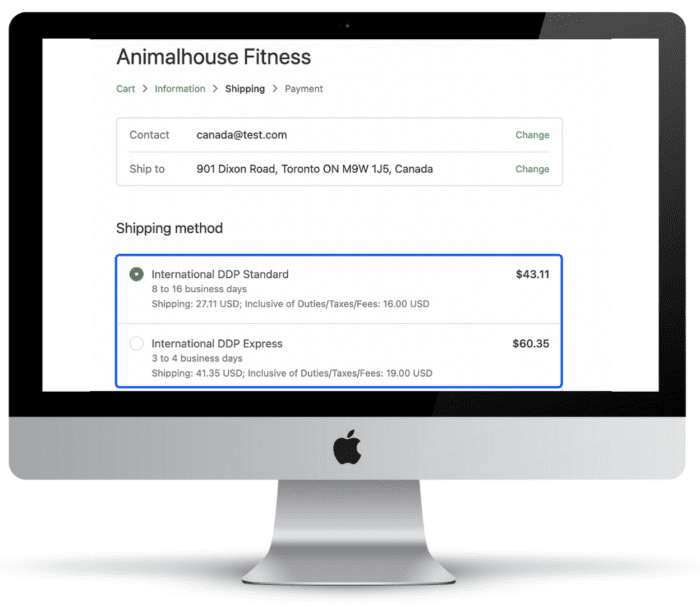
Branded tracking links are also provided to show both the first and last mile tracking. Shopify stores can even break out duties from shipping costs on the shipping methods step of checkout to drive further conversions.
Hear from a ShipBob DDP customer
As told to ShipBob by Paul Jackson, Co-Founder at Animalhouse Fitness.
As our business was rapidly expanding, we knew we needed a fulfilment partner that was capable of fulfilling our orders in a sufficient and timely manner. Additionally, we wanted to find a partner who could assist with global expansion and growing our business internationally. It was clear that ShipBob was more than capable of helping us make that happen. The icing on the cake was ShipBob’s integrated and well-organised solution that brought all of our logistics needs onto one platform.
We implemented ShipBob’s DDP shipping solution to test out international shipping from a US fulfilment centre. This way, we are able to assess certain regions before expanding into global fulfilment centres there. We tried using DDU shipping to Canada and realized what a pain it was from a customer experience and customer service standpoint. DDP shipping was a perfect solution. Now, we can test all global markets and customers will receive their orders in a timely manner with no hidden fees.
Our favorite aspect of ShipBob’s DDP shipping solution is being able to ship our products around the world to those who really need them. We’d love to open up fulfilment centres in every country, but it is quite tough to expand everywhere. DDP shipping allows us to serve everyone immediately!
“Before we started using DDP we were only shipping in North America. For months, customers were begging us to ship to their country. Our product is new and innovative, so this was a big trend in our customer service tickets. Since implementing DDP shipping, we have seen a drastic drop in these types of inquiries and a lift in revenue of almost 25%!”
– Paul Jackson, Co-Founder at Animalhouse Fitness
I love how well integrated the ShipBob software is throughout the entire ecommerce ecosystem and how fast and reliable of a service it is. It is extremely empowering to not have to worry about the fulfilment side and be able to focus on our core competencies in the business. Not to mention we have awesome merchant success managers who are always ready to answer whatever questions we throw their way!
Conclusion
DDP remains one of the most popular shipping options for international businesses because of its popularity with buyers. They assume less risk for the products until they’re delivered, so it’s in their best interest. However, the costs associated with DDP for sellers can make it unprofitable if there are too many issues.
If you run an ecommerce business and want to partner with a US fulfilment company that offers international shipping capabilities, get in touch with ShipBob. We have a global fulfilment presence in the United States, Canada, the UK, EU, and Australia, and offer discounted international rates and partner with companies that provide DDP services.
DDP shipping FAQs
Here are answers to the most frequently asked about how mid-market brands fulfil orders.
Does DDP include delivery?

In DDP shipping the seller is responsible for everything up until the point of delivery, which includes delivery.
Is DDP shipping door to door?
DDP shipping includes door-to-door delivery provided by the seller, as well as duties, insurance, and taxes.
Is DDP shipping safe?
DDP shipping is safe in general, however make sure to do your research on customs and where you are shipping or receiving product from.
Does ShipBob offer DDP shipping?
Yes, ShipBob offers DDP shipping for international orders going throughout its network.
What is the ShipBob DDP (Delivery Duty Paid) setup process?
Getting started with ShipBob’s DDP solution for brands that already outsource fulfilment to ShipBob involves choosing a ShipBob DDP partner and completing their onboarding process. Once set up, you musy ensure DDP rates and shipping options are properly configured in your ecommerce store. The, only orders mapped to ShipBob’s DDP shipping option will qualify for DDP.
For a step-by-step overview, please review the ShipBob DDP shipping Help Centre article here.
Which of ShipBob’s facilities are enabled for DDP shipping?
How can I fix high costs and low conversion rates for international shipping?
Plug DDP but also moving to more global fulfilment options
Does ShipBob have a Passport DDP integration?
Yes, learn more about setting up ShipBob and Passport for DDP shipping here.
Does ShipBob’s Shopify Managed Markets integration support DDP shipping?
Yes, learn more about setting up ShipBob and Shopify Managed Markets for DDP shipping here.
Does ShipBob have a Flavorcloud integration?
Yes, learn more about setting up ShipBob and FlavorCloud for DDP shipping here.
Does ShipBob have an Open Border integration?
Yes, learn more about setting up ShipBob and Open Border for DDP shipping here.
How does ShipBob quote and manage DDP (Delivered Duty Paid) shipments for cross‑border e‑commerce?
ShipBob offers DDP shipping to simplify cross-border ecommerce. With DDP, duties and taxes are paid upfront, which prevents surprise fees for international customers and ensures a more transparent shopping experience.
DDP shipping is available for orders shipped from ShipBob’s fulfilment centres in the:
- US
- UK
- EU
- Canada
- Australia
To manage these shipments, ShipBob’s technology integrates with ecommerce platforms to process international orders seamlessly, including automatically loading customs documents.
When sending inventory to ShipBob’s international fulfilment centres, merchants must ship it DDP and list themselves as the Importer of Record (since ShipBob does not assume this role). This process helps prevent customs delays and ensures a smoother delivery experience for customers.
What documentation and customs procedures does ShipBob handle under DDP terms?
ShipBob helps simplify cross-border shipping by automatically generating key customs documents for international orders, while leaving full customs compliance with the merchant.
- Commercial invoices: For international B2C parcel orders, ShipBob automatically creates and attaches invoices with tariff codes, product value, detailed descriptions, and country of origin.
- Platform integration: This information is pulled from your ecommerce platform or the product details stored in your ShipBob dashboard.
- Limitations: ShipBob is not a licensed customs broker and doesn’t file customs entries, pay import duties, or provide customs advice.
- Inbound inventory: When shipping inventory to ShipBob’s international fulfilment centres, merchants must send goods Delivered Duty Paid (DDP) and act as the Importer of Record. Learn more here.
While ShipBob can offer guidance and introductions to specialists in markets like Canada and the UK, including non-resident importer setup and introductions to duty-and-tax specialists, the responsibility for customs compliance and costs always remains with the merchant.
How does ShipBob’s DDP service differ from DAP and DDU in liability and cost transfer?
ShipBob’s Delivered Duty Paid (DDP) service is designed to eliminate surprise fees for customers and create a smoother international shopping experience. Here are the differences:
- DDP (Delivered Duty Paid): The seller (shipper) covers all costs and risks, including duties, taxes, and customs clearance, until the order is delivered. Buyers are not liable for extra fees. ShipBob offers DDP from fulfilment centres in the US, UK, EU, Canada, and Australia.
- DDU (Delivered Duty Unpaid): The seller ships the parcel, but the buyer is responsible for duties, taxes, and customs clearance. ShipBob does not cover these costs, and using DDU for inbound inventory shipments can result in fees and delays.
- DAP (Delivered at Place): While not supported by ShipBob, DAP generally falls between DDP and DDU, where the seller delivers the goods but the buyer handles import duties and taxes.
By choosing ShipBob’s DDP option, brands ensure faster customs clearance, prevent delivery delays, and give customers a transparent final cost upfront.
While ShipBob can offer guidance and introductions to specialists in markets like Canada and the UK, including non-resident importer setup and introductions to duty-and-tax specialists, the responsibility for customs compliance and costs always remains with the merchant.
What does DDP mean for international sellers and their customers?
Delivered Duty Paid (DDP) is an international shipping term that shifts responsibility to the seller, ensuring buyers receive a smooth and transparent delivery experience. Under DDP, the seller pays for all duties, taxes, and customs clearance fees upfront, so the buyer doesn’t face unexpected costs when their package arrives.
For ecommerce brands, DDP means:
- Seller responsibility: The seller covers shipping costs, import duties, taxes, and customs paperwork until the order reaches the customer’s door.
- Fewer delivery surprises: Customers avoid paying extra fees at delivery, which improves trust and reduces cart abandonment.
- Faster customs clearance: Prepaid duties and taxes help prevent delays at the border, leading to quicker delivery times.
- Global growth potential: Offering DDP makes it easier to reach international customers by providing a more reliable cross-border shopping experience.
In short, DDP benefits both sides: sellers gain happier customers and fewer failed deliveries, while buyers enjoy a seamless checkout with all costs included upfront.
Who is responsible for duties and taxes under DDP Incoterms?
Under Delivered Duty Paid (DDP) Incoterms, the seller takes on full responsibility for covering duties, taxes, and customs clearance costs until the shipment reaches the buyer. This makes DDP one of the most customer-friendly shipping terms because it eliminates surprise fees at delivery.
Here’s how it works:
- Seller liability: The seller pays all import duties, taxes (like VAT or GST), and customs clearance fees.
- Buyer benefit: The buyer receives their order without being asked to pay additional charges upon arrival.
- End-to-end coverage: Responsibility extends beyond shipping costs to include handling risks, paperwork, and compliance requirements at the destination country.
- Transparency: Because costs are prepaid, the total landed cost is clear to the buyer at checkout.
In short, DDP puts the burden of duties and taxes on the seller, making the purchasing process easier and more predictable for international customers.
What are the pros and cons of offering DDP at checkout?
Delivered Duty Paid (DDP) can be a powerful tool for brands selling internationally, but it’s not without trade-offs. Here’s a breakdown:
Advantages of DDP:
- Clear costs for shoppers: Duties and taxes are included in the checkout price, which increases trust and reduces abandoned carts.
- Fewer delivery issues: Since fees are prepaid, packages move through customs faster with fewer delays.
- Customer-friendly experience: Buyers aren’t hit with unexpected charges, which improves satisfaction and loyalty.
Drawbacks of DDP:
- The seller must calculate and pay all duties, taxes, and clearance costs.
- It adds operational complexity, especially when selling into multiple countries.
- Covering these costs without accurate pricing may cut into profit margins.
For many ecommerce brands, the benefits outweigh the challenges, particularly when aiming to expand globally and build customer trust. However, sellers should carefully evaluate whether they have the right tools and partners in place to manage the added responsibilities.


