

Table of Contents
** Minutes
An introduction to warehouse management challenges
8 common operational warehouse challenges
Advanced solutions for warehouse management challenges
Running a warehouse isn’t just about moving boxes; it’s about orchestrating speed, accuracy, and efficiency at scale. But as ecommerce operations grow, so do the challenges: inventory miscounts, labour shortages, layout inefficiencies, rising costs, and missed delivery windows can all derail your fulfilment process and customer satisfaction.
Without the right systems in place, your warehouse can run into problems that quickly shift operations from an asset to a liability.
In this guide, we’ll unpack the most common warehousing problems – and more importantly, how to solve them.
An introduction to warehouse management challenges
Warehouse management is a complex and multifaceted process that involves coordinating various activities, resources, and systems to ensure the efficient flow of goods from receiving to shipping.
As ecommerce businesses grow and evolve, they often encounter a range of challenges that can hinder their ability to operate effectively and meet customer expectations.
Some of the most common warehouse management challenges include:
- Inventory inaccuracy
- Space utilisation issues
- Labor management difficulties
- Inability to adapt to fluctuating demand.
These challenges can lead to a variety of problems, such as stockouts, overstocking, inefficient picking and packing processes, and shipping delays. Ultimately, these issues can negatively impact customer satisfaction, brand reputation, and profitability.
At ShipBob, we have extensive experience helping ecommerce businesses overcome these challenges and optimise their warehouse operations. Our team of experts understands the unique needs and pain points of online retailers, and leveraging our insights and expertise, businesses can streamline processes, reduce costs, and improve the overall efficiency of their warehouse management.
Why getting warehouse management right matters
Effective warehouse management is critical to the success of any ecommerce business.
❌ Warehouse management done wrong:
When warehouse operations are not optimised, it can lead to a range of downstream effects that can seriously impact the bottom line. For example:
- Poor inventory management can result in stockouts, which can lead to lost sales and disappointed customers.
- Overstocking can tie up valuable capital and lead to increased carrying costs.
- Inefficient warehouse processes can cause shipping delays that damage a brand’s reputation and lead to increased customer churn.
- Inefficient operations can drive up costs, eroding profit margins and hindering a business’s ability to invest in growth.
✅Warehouse management done right:
When warehouse management is done right, it can become a powerful enabler of growth and success. For instance:
- Efficient operations allow businesses to fulfil orders faster, more accurately, and at a lower cost, which can lead to happier customers and increased loyalty.
- A well-run warehouse can provide valuable data and insights that can inform product development, marketing strategies, and other key business decisions.
From a cost centre to a growth enabler
Traditionally, many businesses have viewed warehouse management as a necessary cost centre – an overhead expense that must be minimised in order to maximise profits. However, this mindset can actually limit a business’s potential for growth and success.
Instead, ecommerce companies should look to transform their warehouse operations into a strategic asset that can drive business performance.
By investing in the right technology, processes, and people, businesses can turn their warehouses into highly efficient, data-driven operations that enable faster, more accurate fulfilment and better customer experiences.
For example, by implementing a robust warehouse management system (WMS), companies can gain real-time visibility into inventory levels, streamline picking and packing processes, and optimise labour management. This can lead to significant improvements in key metrics like order accuracy, on-time shipping, and cost per order.
Moreover, the data generated by a well-run warehouse can provide valuable insights into customer behaviour, product performance, and other key business drivers. In analising this data, businesses equip themselves to make more informed decisions about everything from product assortment to marketing spend. Warehouse management becomes not just a cost centre, but a strategic growth enabler.
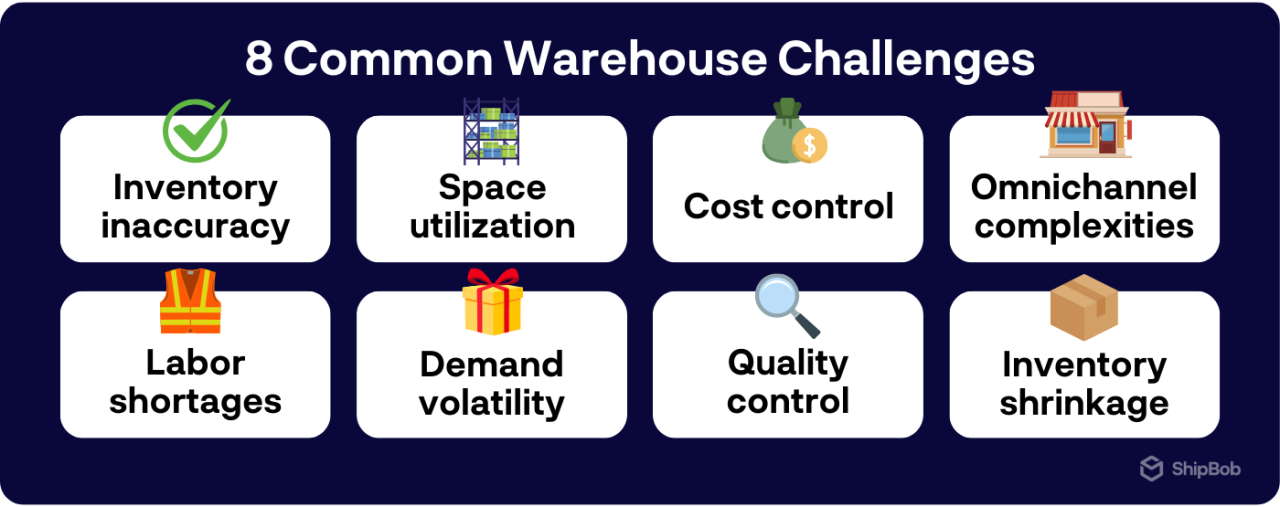
8 common operational warehouse challenges
Running a warehouse is a complex operation that involves managing many moving parts simultaneously, so challenges are a dime a dozen. Here’s a closer look at some of the most common operational warehouse challenges ecommerce businesses face today.
1. Inventory inaccuracy and visibility issues
One of the most significant challenges in warehouse management is maintaining accurate inventory counts. Manual counting errors, incorrect product placement, and poor receiving processes can all contribute to discrepancies between recorded and actual stock levels.
These inaccuracies can lead to stockouts, overselling, and disappointed customers who receive delayed or canceled orders.
To combat these issues, businesses can implement:
- Cycle counting procedures, which involve regularly verifying portions of inventory on a rotating schedule.
- Barcode scanning technology to help improve accuracy by reducing human error during receiving and picking processes.
- Real-time inventory tracking systems that provide visibility into stock levels across multiple locations, enabling proactive reordering and reducing the risk of stockouts.
2. Labor shortages and workforce management
Finding and retaining skilled warehouse staff is an ongoing challenge for many ecommerce businesses. High turnover rates, seasonal demand fluctuations, and competition for labour can make it difficult to maintain optimal staffing levels. Inadequate training and inefficient workflows can further compound these issues, leading to lower productivity and increased errors.
To address these challenges, businesses must:
- Create a positive work environment that encourages employee engagement and retention (often by offering competitive wages, providing opportunities for advancement, and investing in ongoing training programs).
- Implement standardized workflows and use technology to guide workers through tasks and improve efficiency and reduce the learning curve for new hires.
- Adopt labour management systems that optimise scheduling based on historical data and real-time order volumes, ensuring that the right number of staff is available when needed.
3. Space utilisation and warehouse layout problems
Inefficient warehouse layouts can lead to wasted space, longer picking routes, and increased labour costs.
As businesses add new products and expand their inventory, it’s common for warehouses to become cluttered and disorganized over time. Poor slotting practices, such as storing high-velocity items in hard-to-reach locations, can further exacerbate these issues.
Optimising warehouse layout starts with analising product velocity and creating a slotting plan that places fast-moving items in easily accessible locations. This can involve using ABC analysis to categorize products based on their sales volume and adjusting storage locations accordingly.
Vertical storage solutions, such as mezzanines and multi-level racking, can also help maximise cubic space utilisation. Implementing zone-based picking strategies can also improve efficiency by reducing travel time between picks.
4. Demand volatility and seasonal fluctuations
Managing inventory levels in the face of unpredictable demand and seasonal fluctuations is a constant challenge for ecommerce businesses. Overstocking can tie up working capital and lead to increased carrying costs, while understocking can result in lost sales and frustrated customers. Accurately forecasting demand is essential for maintaining optimal inventory levels and avoiding these pitfalls.
To improve forecast accuracy, businesses can:
- Leverage historical sales data, market trends, and customer insights to predict future demand.
- Employ advanced forecasting methodologies, such as machine learning algorithms, can help identify patterns and adjust predictions based on real-time data.
- Establish safety stock levels for each product to provide a buffer against unexpected spikes in demand while still minimising carrying costs.
- Use technology solutions that enable dynamic inventory allocation across multiple channels and locations, ensuring that stock is positioned where it’s needed most.
5. Cost control and operational efficiency
Managing costs is a constant challenge in warehouse operations. Labor, space, and technology investments can quickly eat into profit margins if not carefully controlled. To maintain efficiency, it’s essential to have a clear understanding of your operational costs per order and to continuously look for opportunities to reduce waste and improve throughput.
Some key strategies for controlling costs and improving efficiency include:
- Implementing lean inventory management practices to reduce carrying costs.
- Optimising picking routes and storage locations to minimise travel time.
- Investing in automation technologies that reduce labour requirements and improve accuracy.
- Regularly auditing processes to identify bottlenecks and improvement opportunities.
- Providing ongoing training and incentives to encourage worker productivity.
When evaluating technology investments or process changes, it’s important to calculate the expected return on investment (ROI). This involves comparing the upfront and ongoing costs with the projected labour savings, productivity gains, and other benefits. A thorough ROI analysis can help prioritize initiatives and justify the necessary investments to stakeholders.
6. Quality control and damage prevention
Ensuring that products reach customers in perfect condition is essential for maintaining brand reputation and customer loyalty. Damaged or defective products can lead to costly returns, negative reviews, and lost business, so implementing rigorous quality control processes and damage prevention measures is a critical component of effective warehouse management.
Some key strategies for maintaining quality and preventing damage include:
- Implementing incoming quality checks to identify defects before products are stored
- Establishing clear handling and packaging procedures to minimise the risk of damage
- Providing ongoing training to workers on proper handling techniques and quality standards
- Implementing outbound quality checks to verify order accuracy and packaging integrity
- Utilising dunnage and other protective materials to cushion products during transit
- Documenting and analising damage patterns to identify root causes and implement corrective actions
Technology can also play a role in quality control and damage prevention. For example, automated inspection systems can quickly identify defects or inconsistencies in products, while sensors and monitoring devices can alert workers to potential damage risks during storage and handling.
7. Managing complex omnichannel operations
Managing inventory and fulfilling orders across multiple channels can be a complex and time-consuming process. Each channel may have its own unique requirements for packaging, labelling, and shipping, making it difficult to maintain consistency and efficiency.
Understanding and managing inventory availability and allocation across each channel requires a centralised system that provides real-time visibility into stock levels, order statuses, and shipping requirements.
Some key strategies for managing omnichannel complexity include:
- Implementing a WMS that integrates with all sales channels and provides unified inventory visibility
- Establishing clear processes for allocating inventory to each channel based on demand and priority
- Utilising automation technologies to streamline order processing and reduce manual intervention
- Providing ongoing training to workers on channel-specific requirements and processes
- Regularly auditing operations to identify inconsistencies or inefficiencies across channels
8. Inventory shrinkage and security concerns
Inventory shrinkage is a significant challenge for many warehouses, with losses from theft, damage, and administrative errors costing businesses hundreds of millions of dollars each year.
In addition to the financial impact, inventory shrinkage can also lead to stockouts, delayed orders, and customer dissatisfaction.
Maintaining tight security and implementing effective loss prevention measures is essential for minimising these risks.
Some key strategies for preventing inventory shrinkage and improving security include:
- Implementing access controls and monitoring systems to track worker and visitor activity
- Conducting regular cycle counts and audits to identify discrepancies and potential theft
- Providing ongoing training to workers on security protocols and loss prevention best practices
- Utilising technology solutions like RFID tracking and video surveillance to monitor inventory movement
- Establishing clear investigation and reporting procedures for suspected theft or fraud
- Implementing background checks and other screening measures for new hires
Advanced solutions for warehouse management challenges
Sometimes, warehouse management challenges aren’t so simple to fix. Here are some more advanced strategies businesses can employ to further enrich their warehousing and fulfilment outputs.
Leverage warehouse management systems (WMS)
A robust warehouse management system (WMS) serves as the foundation for operational excellence in today’s ecommerce landscape.
By providing real-time visibility, automated workflows, and data-driven insights, a WMS empowers businesses to optimise their warehouse operations and overcome common challenges.
Key features of a comprehensive WMS include:
- Real-time inventory tracking across multiple locations.
- Intelligent order management and routing.
- Dynamic labour planning and task assignment.
- Advanced reporting and analytics capabilities.
Integrating a WMS with other critical business systems, such as ERP and ecommerce platforms, enables seamless data flow and eliminates manual entry errors. This connectivity provides a single source of truth for inventory, orders, and customer information, allowing for more informed decision-making and proactive problem-solving.

Data-driven demand forecasting and inventory planning
Accurately predicting future demand is critical for optimising inventory levels and minimising carrying costs.
Businesses can leverage historical sales data, seasonal trends, and external factors such as marketing campaigns and competitor activity to develop more precise forecasts and make informed purchasing decisions.
Advanced demand forecasting methodologies, such as time-series analysis and machine learning algorithms, can help identify patterns and anticipate shifts in customer behaviour.
These insights enable businesses to proactively adjust inventory levels, avoiding stockouts and overstocking scenarios.

Implement warehouse automation and technology
Warehouse automation has become increasingly accessible and affordable, offering businesses of all sizes the opportunity to streamline operations and reduce labour costs. From basic conveyor systems to advanced robotics, there is a spectrum of automation options available to suit various budgets and operational needs.
When considering automation investments, it’s essential to evaluate the potential return on investment (ROI) and develop a phased implementation plan to minimise disruption. Key factors to consider include:
- Current order volume and projected growth.
- Labor costs and availability.
- Facility layout and infrastructure.
- Integration with existing systems and processes.
Successful automation implementations often involve a combination of hardware and software solutions. For example, a conveyor system paired with a pick-to-light system can significantly improve order picking efficiency, while a robotic storage and retrieval system (AS/RS) can optimise space utilisation and reduce labour requirements.

Optimise worker safety and productivity
Even with the most advanced automation, your workforce remains the heart of your warehousing operation.
Investing in ergonomic workspaces, comprehensive training programs, and performance incentives can go a long way in improving safety, job satisfaction, and overall productivity.
Some strategies for optimising worker safety and productivity include:
- Designing workstations with adjustable heights, anti-fatigue mats, and proper lighting to reduce strain and fatigue.
- Implementing clear safety protocols and providing ongoing training on proper lifting techniques, equipment handling, and emergency procedures.
- Using labour management software to track individual performance, identify training needs, and gamify productivity improvements.
- Offering incentives and recognition programs to reward top performers and encourage continuous improvement.
- Fostering a culture of open communication and collaboration between workers and management.
Technology can also play a role in enhancing worker safety and productivity. For example, wearable devices can monitor worker movements and alert supervisors to potential safety risks. Voice-directed picking systems can reduce the need for workers to constantly refer to paper pick lists, improving efficiency and reducing errors.

Streamline returns and reverse logistics
Returns are a fact of life in ecommerce, but managing them efficiently can be a major challenge for many warehouses.
Processing returns quickly and accurately is essential for maintaining customer satisfaction and minimising losses, but it requires a well-organised and streamlined reverse logistics process.
Some key strategies for streamlining returns and reverse logistics include:
- Implementing a clear and easy-to-use returns policy and process for customers.
- Utilising technology solutions and automated return labels to simplify the returns process.
- Establishing dedicated returns processing areas and workflows within the warehouse.
- Providing ongoing training to workers on returns handling procedures and quality control measures.
- Implementing data analytics and reporting to identify trends and opportunities for improvement.
- Partnering with specialized reverse logistics providers to handle complex or high-volume returns.

The blended fulfilment model: A strategic approach
As businesses grow and evolve, their fulfilment needs often become more complex and varied. Some products may require specialized handling or storage, while others may have unpredictable demand patterns or seasonal spikes. In these cases, a one-size-fits-all approach to fulfilment may not be the most efficient or cost-effective solution.
This is where a blended fulfilment model can provide a strategic advantage. By combining in-house operations with outsourced 3PL services, businesses can create a flexible and scalable fulfilment network that adapts to their changing needs.
Some key benefits of a blended fulfilment model include:
- Flexibility to handle a wide range of product types and order volumes.
- Ability to scale up or down quickly in response to demand fluctuations.
- Cost savings from outsourcing non-core or low-volume products.
- Improved speed and accuracy from leveraging 3PL technology and expertise.
- Reduced capital investment and overhead costs for in-house operations.
To implement a successful blended fulfilment model, you’ll need a clear strategy for determining which products to fulfil in-house and which to outsource. This may involve analising factors such as order volume, product complexity, storage requirements, and shipping destinations.
You’ll also need a fulfilment partner that supports a hybrid fulfilment model. ShipBob, for example, lets brands powering their in-house operations with our WMS while also outsourcing some fulfilment to any of our 60+ fulfilment centres (which also run on ShipBob’s WMS). This delivers seamless, standardized fulfilment operations, no matter whether it’s your facility or ours.
Looking for help with your warehouse management challenges?
Managing a warehouse is a complex and ever-evolving challenge, with new technologies, regulations, and customer expectations emerging all the time. Keeping up with these changes while also managing day-to-day operations can be a daunting task, especially for businesses with limited resources or expertise.
This is where working with an experienced fulfilment partner like ShipBob can provide a significant advantage. By leveraging our technology, infrastructure, and expertise, businesses can overcome common warehouse management challenges and focus on growing their core business.
ShipBob offers brands the capabilities they need to master warehousing and fulfilment, including:
Access to a global network of fulfilment centres
“Right now we’re currently leveraging three of ShipBob’s fulfilment centres, including two in different regions of the US from our warehouse and one in the UK. Shipping to UK customers from a facility within the UK saves us $6 per shipment on average, which is huge! England is a big market for us, so those per-order cost-savings really add up, and our international customers are getting a much faster and less expensive delivery thanks to ShipBob’s global presence.”
Rachel Tannenholz, President, and Melissa Mosheim, Director of Logistics at Aroma360
Best-in-class WMS technology with real-time inventory visibility and order management
“All in all, we have 4,000 SKUs. Most of our merchandise is apparel, so lots of our SKUs have multiple variants for size, colour, team, and more. It can be challenging to keep them all straight – but ShipBob WMS makes it so much easier.
First, the interface is really easy to use. So many WMS systems are just archaic and confusing, because they’re built by engineers – not by the people who really utilise it. ShipBob’s WMS is different: the technology is great and works well, but it’s sleek and intuitive to navigate, too.
Second, it gives us the inventory tools we need. ShipBob’s WMS has built-in inventory management features, and I’m constantly discovering new ways to take advantage of the technology. We’re actually doing cycle counts now; before ShipBob, we had some cycle counting, but you couldn’t trust any of it. As we’ve spent more time on ShipBob WMS, our trust is going up, and our inventory accuracy is improving with it.”
Tucker Robinson, Warehouse Director at Savannah Bananas
Customizable fulfilment solutions that adapt to your unique products and order profiles
“We have several rules set up in our ShipBob dashboard to make sure the right orders get the right customizations. When an order comes in, it gets tagged based on what kind of order it is. Then ShipBob’s system will automatically add the right customizations for each tag to each order, and the packer will know what inserts to include or packaging to use. As long as we’re using the appropriate tags, it’s seamless. In the past, there’s no way we could have achieved and automated the level of customisation we wanted, and had it actually work successfully – but with ShipBob Plus, we can.”
Oscar Gutierrez, Operations Fulfilment Manager at goPure
Dedicated account management and support from a team of fulfilment experts
“A lot of our decision to join ShipBob Plus comes down to the personal touch. With ShipBob, you have someone – if not multiple people – in the organisation that is available to you. We actually have someone to reach out to all the time. If something goes wrong, I have a dedicated ShipBob Merchant Success Manager who can help me out; I’m not trying to reach someone in the warehouse who doesn’t have any idea who I am or what I’m talking about. Our Merchant Success Manager knows everything about our business and does so much for us, which makes managing fulfilment very easy and helps me keep my team lean.”
Nadav Haras, VP of Supply Chain at Particle
Detailed performance reporting and analytics to drive continuous improvement
“ShipBob’s reporting is very robust and meets all of our needs. We get visibility into receiving, order volume, SKU availability – everything from inbounds and inventory transactions to individual order statuses (whether it’s on hold, in processing, an exception order, and other detailed descriptions). All this data is real-time, meaning that we’re always seeing the most accurate, up-to-date information. Having this real-time data is crucial for my team, so the fact that there’s not hours of lag time waiting for data to update is huge.”
Ryan Steffenson, Senior Manager, Channel Operations at Tonies
Whether you’re looking to outsource your entire fulfilment operation or create a blended model that combines in-house and 3PL capabilities, ShipBob has the technology and expertise to help you succeed.
Our team of fulfilment experts will work closely with you to understand your unique needs and create a customised solution that optimises efficiency, cost, and customer satisfaction.
To learn more about how ShipBob can help you take your warehouse management to the next level, click the button below to get in touch.
Warehouse management challenges FAQs
Below are answers to some of the most common questions about warehousing challenges and problems.
How do I measure the ROI of my warehouse operations?

Measuring the ROI of your warehouse operations involves tracking key metrics such as cost per order, order accuracy, inventory turns, and labour efficiency.
To calculate cost per order, divide your total warehouse costs (including labour, facilities, and equipment) by the number of orders processed in a given period. Order accuracy is the percentage of orders picked and shipped without errors, while inventory turns measure how quickly you sell through your stock.
Labor efficiency can be assessed by tracking units processed per labour hour. Improvements in these metrics directly impact your bottom line by reducing costs and increasing customer satisfaction. Regularly monitoring and benchmarking these KPIs will help you identify areas for optimisation and track the impact of process improvements over time.
What role does technology play in solving warehouse management problems?
Technology is a critical component in solving warehouse management problems by providing real-time visibility, automating manual processes, and delivering data-driven insights. At a basic level, barcode scanning and inventory management systems eliminate manual data entry and reduce errors. More advanced solutions like mobile picking tools and conveyor systems streamline workflows and improve labour efficiency.
Integrated systems break down data silos, enabling end-to-end visibility and better decision-making. For example, a warehouse management system (WMS) integrated with your ecommerce platform can automatically route orders to the optimal fulfilment location based on inventory availability and shipping costs. By leveraging technology to automate and optimise processes, businesses can significantly reduce costs, improve accuracy, and scale operations more effectively.
How can a WMS help with omnichannel fulfilment?
A warehouse management system (WMS) is a powerful tool for managing omnichannel fulfilment by providing unified inventory visibility and order routing capabilities across multiple sales channels. With a WMS, you can view real-time stock levels and order statuses from a single platform, regardless of whether an order originated from your website, a marketplace, or a retail store.
Advanced order routing features allow you to define business rules for fulfilling orders based on factors like item availability, shipping costs, and customer location. This ensures that each order is fulfilled from the optimal location, reducing costs and improving delivery times. Furthermore, a WMS can help manage channel-specific packaging and labelling requirements, ensuring compliance with retailer guidelines while maintaining efficient operations.
When should I consider outsourcing fulfilment vs. managing my own warehouse?
The decision to outsource fulfilment or manage your own warehouse depends on factors such as order volume, product complexity, and growth trajectory.
In general, outsourcing to a 3PL is more cost-effective for businesses with lower order volumes, as it allows them to leverage shared resources and expertise without investing in their own infrastructure.
As your business grows and order volumes increase, the economics may shift in favour of managing your own warehouse, giving you more control over operations and costs. However, a blended approach using both in-house and outsourced fulfilment can provide the best of both worlds, allowing you to maintain control over certain products or channels while leveraging a 3PL’s scalability and expertise for others. Ultimately, the right approach will depend on your unique business needs and goals.
How does ShipBob support businesses that manage their own warehouses?
ShipBob offers a range of solutions to support businesses that manage their own warehouses, including a powerful warehouse management system (WMS) that can be implemented in merchant-operated facilities. With ShipBob’s WMS, businesses can benefit from advanced features like real-time inventory tracking, order routing, and labour management tools, all within their own warehouse.
For businesses looking to expand their fulfilment capabilities, ShipBob’s WMS powers ShipBob’s entire global fulfilment network, enabling a blended and international approach to fulfilment. This allows merchants to maintain control over their in-house operations while leveraging ShipBob’s distributed inventory model and expertise for faster, more cost-effective shipping. By combining the flexibility of ShipBob’s technology with the scale and reliability of their fulfilment network, businesses can optimise their supply chain and deliver a best-in-class customer experience.


