
While seemingly straightforward, choosing the right shipping partners requires careful analysis of service levels, costs, timeframes, and specialized capabilities to avoid delays, damages, and customer dissatisfaction.
Strategic courier selection is a key differentiator in today’s competitive market. Customers demand fast, affordable, reliable shipping, so meeting these expectations is crucial for your brand reputation and profitability.
This guide covers everything from courier types and common selection mistakes to evaluation criteria and technology solutions. You’ll learn how to balance cost, speed, and reliability while leveraging tools like courier selection software and multi-warehouse optimisation to streamline operations.
What is courier selection?
Courier selection is the strategic process of choosing shipping partners that align with your business needs and customer expectations. You must evaluate service levels, costs, delivery timeframes, and specialized capabilities to find the right fit for your ecommerce operations.
Consider these three main courier types:
- National couriers: Major providers like UPS, FedEx, and USPS with broad coverage and diverse service options. While competitive for many shipments, they may not be the most cost-effective for certain products or regions.
- Regional couriers: Smaller, localised providers offering flexible service and better rates within specific geographic areas. Ideal for businesses with concentrated customer bases but limited for nationwide operations.
- Specialized couriers: Providers handling specific product types like hazardous materials, temperature-controlled items, or freight. They provide necessary expertise but typically at higher costs with more limited coverage.
Today, courier selection directly impacts your profitability, customer satisfaction, and brand reputation. The right courier mix gives you a competitive advantage by optimising shipping operations and meeting customer expectations.
The importance of courier diversification
Modern shipping strategy emphasizes using multiple couriers instead of relying on a single provider. This approach offers key benefits:
- Flexibility: Select the best courier for each shipment based on cost, transit time, and delivery location.
- Redundancy: Protect against disruptions by quickly switching couriers when issues arise.
- Negotiating power: Secure better rates as couriers compete for your shipping volume.
- Scalability: Grow more easily by leveraging different couriers’ regional strengths and specialized services.
While managing multiple couriers can be challenging, technology solutions like transportation management systems (TMS) and multi-courier shipping software automate selection, rate shopping, and performance tracking to simplify decisions.
By strategically diversifying your courier mix and using technology for data-driven decisions, you can build resilient, cost-effective shipping operations that satisfy customers and support long-term growth.
“Even during other periods of uncertainty, ShipBob is able to ensure our operations are seamless and quickly adapt. During the recent Canada Post strike, ShipBob handled the situation with such grace, shipping orders with alternative couriers without interruption. I didn’t even have to think about it. ShipBob is our built-in supply chain control tower, proactively finding solutions to problems, which is wonderful.”
– Jessica Stoller, Director of Supply Chain and Operations at Arrae
Why is researching couriers before making a selection important?
Thorough courier research directly impacts your bottom line, customer experience, and operational efficiency. Without it, you risk product damage, delivery failures, and excessive costs that hurt your business.
Today’s shipping market offers more options than ever, creating better rates but making selection more complex. Effective research means analising key metrics like on-time delivery rates and service quality, with many couriers publishing performance data to help your evaluation.
The wrong courier choice can damage your brand reputation through mishandled packages and missed deadlines, driving frustrated customers to competitors. For specialized shipments like temperature-controlled or hazardous items, verifying proper certifications and equipment is essential to avoid compliance issues and product damage.
Strategic research helps you find partners that meet your core requirements while aligning with your brand values, including sustainability initiatives like eco-friendly packaging. By investing time in courier research now, you’ll create a solid foundation for your shipping strategy and avoid costly mistakes down the road.

7 common courier selection mistakes
Selecting the right shipping couriers is a complex process that requires careful consideration of multiple factors. However, many ecommerce businesses make common mistakes that can lead to increased costs, delivery delays, and customer dissatisfaction.
1. Focusing solely on cost
Many businesses choose couriers based only on price, but the cheapest option often costs more in the long run. Budget couriers may sacrifice reliability and service quality, leading to hidden expenses from delays and damages.
For example, a courier with attractive base rates might add substantial fees for fuel, residential deliveries, or weekend service that quickly eliminate any savings.
Instead, adopt a total cost approach that considers on-time delivery rates and customer satisfaction. A slightly more expensive courier with proven reliability typically delivers better overall value.
2. Overlooking specialized shipping needs
Don’t ignore your products’ specific shipping requirements. Hazardous materials, temperature-sensitive items, and oversized packages need couriers with proper certifications and equipment.
Using standard couriers for specialized shipments risks compliance issues and product damage. For instance, shipping temperature-sensitive pharmaceuticals with a general courier could lead to spoilage and safety concerns.
Before selecting couriers, identify your unique shipping needs and find partners with the expertise and infrastructure to handle them properly.
3. Neglecting reliability and on-time performance
While searching for quick, affordable shipping, many businesses overlook reliability.
Couriers with histories of delays and damages quickly erode customer trust. According to ShipStation, 69% of consumers won’t shop with a retailer again after a poor delivery experience.
Track key metrics like on-time delivery percentages and exception rates when evaluating couriers. Prioritize consistent reliability, as it directly impacts your reputation and revenue.
4. Underestimating compliance requirements
Shipping involves numerous regulations from customs requirements to hazardous materials restrictions. Ignoring these can result in delays, fines, and legal issues.
Incorrect tariff codes or missing documentation can cause border delays and extra fees. Improperly packaged hazardous materials might be refused by couriers or result in penalties.
When selecting couriers, evaluate their regulatory expertise and ability to provide proper documentation support for your specific shipping needs.
5. Ignoring sustainability factors
Sustainable shipping is no longer optional; it’s a business necessity. Overlooking environmental practices can disadvantage your brand with eco-conscious consumers.
Nielsen reports 73% of consumers would change their habits to reduce environmental impact. In response, many couriers now offer green initiatives like electric vehicles and carbon offset programs.
Choose couriers committed to sustainability to reduce your carbon footprint, appeal to environmentally aware customers, and stand out in a competitive market.
6. Missing out on multi-warehouse advantages
Relying on a single warehouse location limits your shipping options and efficiency. As your business grows, this approach leads to higher costs and slower deliveries.
Distributing inventory across multiple locations reduces shipping distances and transit times by fulfilling orders from facilities closest to customers. This strategy also lets you leverage regional couriers for better rates and service.
Multi-warehouse distribution provides flexibility when couriers face constraints or disruptions. Choose couriers that integrate well with distributed fulfilment networks and maintain consistent service across locations.
7. Overcomplicating the brand experience
Using too many different couriers creates an inconsistent customer experience. When packages arrive via multiple couriers with varying tracking capabilities and delivery practices, it confuses customers and weakens brand trust.
Inconsistent handling also affects packaging presentation and product integrity, potentially disappointing customers during unboxing.
Streamline your courier mix and maintain clear communication throughout the shipping process. Consider couriers’ packaging options, tracking capabilities, and delivery notifications to create a unified brand experience from checkout to delivery.
6 top criteria for choosing the right shipping couriers
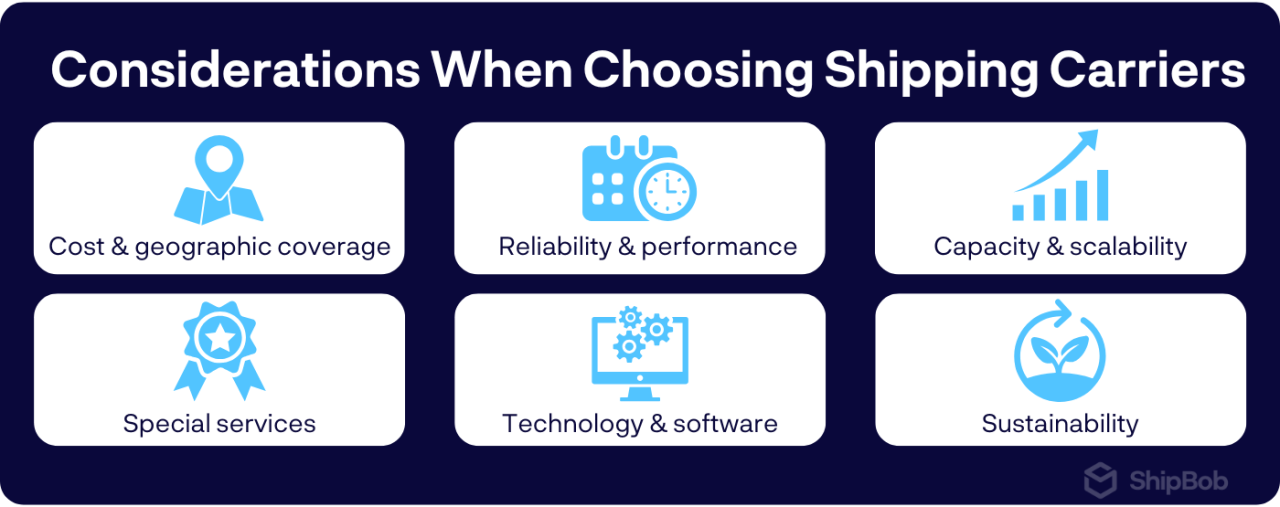
Selecting the right shipping couriers directly impacts your bottom line, customer satisfaction, and operational efficiency. Here are six essential factors to consider when evaluating potential shipping partners.
1. Cost and geographic coverage
Look beyond base rates to assess the full cost structure, including fuel surcharges, residential delivery fees, and accessorial charges. Calculate the total cost for your common shipment types and consider dimensional weight pricing and minimum package charges.
Evaluate each courier’s geographic coverage against your customer distribution. Choose couriers with strong presence in regions where your customers are concentrated for better delivery speed and reliability. For international shipping, assess global networks and customs clearance capabilities.
When negotiating rates, leverage your shipping volume and growth potential. Provide data on your shipping patterns and projected growth to demonstrate your value. Compare offers from multiple couriers to secure the best rates and service levels.
2. Reliability and on-time performance
Reliability directly affects customer satisfaction and loyalty. Late or damaged deliveries lead to complaints, returns, and lost customers, damaging your reputation and revenue.
Track key metrics like on-time delivery percentage, exception rates, and average transit times. Research courier performance through industry reports, customer reviews, and third-party logistics providers.
Look for couriers with consistent service, especially during peak seasons. Consider implementing a courier scorecard system to hold partners accountable and track performance over time.
3. Capacity and scalability
Choose couriers that can grow with your business and adapt to changing needs. Assess their ability to handle your current volume and projected growth by asking about network capacity, fleet size, and planned infrastructure investments.
Evaluate their peak season planning and contingency management. Ask how they prepare for volume spikes and what measures ensure on-time deliveries during busy periods. Inquire about volume caps that might affect capacity during peak times.
Mitigate capacity risks by partnering with multiple couriers or working with a fulfilment provider like ShipBob that can distribute volume across a courier network. This creates a more resilient shipping strategy that adapts to changing market conditions.
4. Special service capabilities
Evaluate couriers’ specialized services beyond standard ground delivery. For premium shipping options like overnight or same-day delivery, look for couriers with strong expedited service records, comprehensive network coverage, and reliable delivery guarantees.
For international shipping, assess global networks, customs clearance capabilities, and expertise in navigating trade regulations. Choose couriers with strong presence in your key international markets.
If your products need special handling (temperature control, hazardous materials, fragile items), verify couriers have the necessary equipment, trained personnel, and certifications. Matching your shipping needs with specialized courier capabilities ensures better customer experiences with fewer problems.
5. Technology and courier selection software
Choose couriers with robust technology platforms and integration capabilities. Courier APIs and web services enable real-time rate shopping, label printing, and tracking updates, reducing manual work and improving accuracy.
Consider implementing courier selection software or a transportation management system (TMS) to automate shipping decisions.
Look for features like:
- Real-time rate comparison across multiple couriers
- Automated courier selection based on your business rules
- Integration with your ecommerce platform and other systems
- Comprehensive reporting and analytics
- Customizable shipping documents that meet all requirements
These tools help you make data-driven decisions while reducing manual effort and improving accuracy.
6. Sustainability and green shipping initiatives
As consumers prioritize environmental responsibility, sustainability is becoming crucial in courier selection. Evaluate couriers’ commitment to eco-friendly practices, including electric vehicles, route optimisation, and sustainable packaging.
Offer green shipping options like carbon-neutral delivery or eco-friendly packaging to appeal to environmentally conscious customers. Many couriers now provide carbon offset programs that can enhance your brand reputation.
Balance sustainability with cost and speed by implementing a multi-courier strategy that includes both traditional and green options. Give customers choices and highlight the environmental benefits of each option to appeal to different preferences.
Prioritizing sustainability helps align your operations with customer values, differentiate your brand, and contribute to a more sustainable future for logistics.

Understanding courier selection software and TMS solutions
Courier selection software and transportation management systems (TMS) automate shipping decisions and operations. These tools compare rates and select couriers automatically, saving time and reducing errors.
The software connects to your ecommerce platform to provide real-time shipping visibility. It automatically selects the best courier for each order based on your rules for speed, cost, and reliability.
Key features to look for:
- Real-time rate comparison across couriers
- Customizable rules for courier selection
- Integration with major and regional couriers
- Automated label printing
- Unified tracking for all shipments
- Performance and cost analytics
Full TMS solutions offer additional capabilities like route optimisation and freight payment processing for more complex operations.
When choosing a solution, consider:
- Scalability: Will it grow with your business?
- Usability: Is it easy to learn and use?
- Integration: Does it work with your existing systems?
- Courier network: Does it support your needed couriers?
- Reporting: Does it provide useful insights?
Benefits include:
- Lower shipping costs through automatic rate optimisation
- Faster, more reliable deliveries
- Better customer experience with accurate tracking
- Time savings from automation
- Greater visibility into shipping operations
These tools offer substantial ROI by cutting costs, improving efficiency, and enhancing customer satisfaction, helping you stay competitive in today’s market.
“What impressed me most was their robust software, which also has all of the courier’s rates and courier selection logic. For example, if we want to sell a certain product, we can see which courier can send it the cheapest: DHL, FedEx, USPS, and even others. The ability to have variable costs and competitive pricing for shipping is important to us. That’s ultimately why we chose ShipBob. Compared to fulfilling orders from our warehouses, our shipping costs have come down since partnering with ShipBob.”
– John Lewis, President and COO of Vision Investments
The outsourced advantage: Removing complexity for ecommerce brands
Brands can simplify courier management by outsourcing fulfilment. Fulfilment partners act as intermediaries between your business and shipping couriers and combine shipping volume from multiple merchants to negotiate better rates than you could get alone.
Key benefits of working with a fulfilment partner:
- Discounted rates across multiple couriers
- Automated courier selection based on your requirements
- Unified platform with integrated tracking and reporting
ShipBob’s courier selection algorithm allows us to rate shop to find you the most optimal shipping option for each order. This approach eliminates manual rate comparison, providing customers with reliable shipping options, and gives you access to pre-negotiated rates without the need to manage courier relationships yourself. With ShipBob, you can focus on growing your business instead of managing complex shipping logistics.
“Because of ShipBob’s overall order volume, they can negotiate bulk discounts with couriers that we simply couldn’t. By partnering with ShipBob, we get better quality fulfilment and shipping for a better price.”
– Maria Osorio, Logistics and Operations Director at Oxford Healthspan
How multi-warehouse optimisation streamlines courier selection
Multi-warehouse fulfilment strategies meet elevated customer expectations by distributing inventory across multiple locations to reduce shipping distances, costs, and transit times.
This approach offers several advantages for courier selection:
- Reduced shipping distances by storing inventory closer to customers
- Access to cost-effective regional couriers specialized in specific geographic areas
- Improved flexibility and resilience against disruptions in any single region
- Ability to test and optimise courier performance across different regions
ShipBob’s fulfilment network puts this strategy into action with strategically located centres across the US, Canada, the UK, the EU, and Australia. Their technology automatically routes each order to the optimal fulfilment centre and courier combination based on inventory availability, destination, and delivery requirements.
For example, a Los Angeles customer’s order might route to ShipBob’s Moreno Valley facility using regional couriers, while a New York order ships from our Bethlehem, Pennsylvania fulfilment centre. This intelligent routing happens automatically without requiring merchant intervention.
By partnering with ShipBob’s multi-warehouse network, merchants can optimise courier selection without complex analysis or manual work. This data-driven approach helps businesses reduce shipping costs, improve delivery times, and create exceptional customer experiences that drive growth.
Scaling global fulfilment: Cross-border considerations
As ecommerce continues to break down geographic barriers, many businesses are looking to expand their reach and tap into new international markets. However, scaling global fulfilment and optimising cross-border shipping can be a complex and challenging endeavor, with numerous factors to consider when selecting couriers and managing logistics.
One of the primary challenges of international shipping is navigating the complex web of customs regulations, tariffs, and documentation requirements that vary by country and region. Each market has its own unique set of rules and regulations governing the import and export of goods, and failure to comply with these requirements can result in delays, additional costs, and even legal penalties.
When selecting couriers for international shipping, it’s essential to look for providers with deep expertise in cross-border logistics and a proven track record of successfully navigating customs clearance and compliance. Couriers with a strong global network and established relationships with local customs authorities can help ensure smooth and efficient processing of international shipments, minimising the risk of delays or additional costs.
Want to outsource courier selection to a leading fulfilment partner?
Managing couriers, negotiating rates, and optimising shipping takes time and expertise many ecommerce brands lack. Partner with ShipBob to eliminate these headaches while accessing enterprise-level shipping capabilities.
Eliminate complexity with automated courier selection
ShipBob simplifies shipping decisions. Instead of comparing couriers for every order, just map your store’s shipping options (like “Standard” or “2-Day”) to our service levels. Our system automatically selects the best courier based on destination, service level, and package details.
Access discounted rates unavailable to individual merchants
As a high-volume shipper, ShipBob negotiates better rates with national, regional, and specialized couriers than merchants could get alone. We pass these savings directly to you, boosting your margins while maintaining quality service.
Leverage intelligent technology for optimised shipping
When customers select “Standard Shipping” at checkout, our system instantly evaluates all courier options to find the most cost-effective solution that meets the delivery promise. This ensures optimal courier selection without any manual work on your part.
Enjoy simple setup with seamless customer experience
To start, map your existing shipping options to ShipBob’s service levels in our dashboard. This one-time setup keeps your customer experience consistent while our technology handles the complex decisions behind the scenes.
Focus on growth while we handle logistics
By letting ShipBob manage your couriers, you free up valuable time for product development, marketing, and other growth initiatives. Our merchants save significant time by eliminating courier management tasks like rate negotiation and performance tracking.
Maintain control with customisable shipping rules
Need specific courier preferences? Our platform offers customisable rules that let you prioritize certain couriers for specific regions, products, or service levels while still optimising all other shipments.
Start shipping with ShipBob
Ready to simplify your shipping operations? Request a quote today to learn how ShipBob can help you deliver faster, more reliable shipping at lower costs.
FAQs about courier selection
Below are answers to common queries and challenges experienced by merchants when exploring their courier selection options.
How do specialized shipments factor into courier selection?

For specialized shipments (hazmat, temperature-controlled, or oversized items), you need couriers with specific capabilities and certifications. These couriers often charge premium rates, so balance these costs against your product requirements.
Choosing the wrong courier can result in compliance issues, product damage, and delivery delays that harm your reputation. Consider partnering with a fulfilment provider like ShipBob that has established relationships with specialized couriers to ensure safe, efficient shipping without managing these complex relationships yourself.
What role does data play in optimising courier selection?
Data provides critical insights into courier performance, costs, and customer satisfaction. By tracking metrics like on-time delivery rates and shipping costs, you can make smarter courier choices.
Real-time data helps you quickly adapt to changing courier performance or market conditions. ShipBob’s platform automatically optimises courier selection for each shipment by analising delivery speed, cost, and reliability factors, ensuring the best courier is always chosen.
What role does data play in optimising courier selection?
Data provides critical insights into courier performance, costs, and customer satisfaction. By tracking metrics like on-time delivery rates and shipping costs, you can make smarter courier choices.
Real-time data helps you quickly adapt to changing courier performance or market conditions. ShipBob’s platform automatically optimises courier selection for each shipment by analising delivery speed, cost, and reliability factors, ensuring the best courier is always chosen.
How can small businesses negotiate better courier rates?
Small businesses can overcome limited negotiating power by:
- Partnering with a fulfilment solution like ShipBob that pools shipping volume from multiple merchants to secure better rates
- Looking beyond base rates to evaluate the true cost of shipping, including surcharges, residential fees, and dimensional weight pricing
These strategies help small businesses access competitive shipping rates that would otherwise be unavailable to t
How does courier selection impact customer experience?
Courier selection directly affects how customers perceive your brand. On-time deliveries and undamaged packages build trust and loyalty, while late or damaged shipments lead to complaints and lost customers.
Choosing couriers with proven reliability, tracking capabilities, and careful handling practices ensures consistent, positive delivery experiences. Poor courier choices can quickly damage your reputation through negative reviews and social media feedback.
How does ShipBob handle courier selection for merchants?
ShipBob simplifies courier selection through:
- Negotiated rates with multiple couriers for cost-effective shipping options
- Easy mapping of your store’s shipping options (Standard, Expedited) to ShipBob’s services
- Automated courier selection based on delivery requirements, cost, and performance
- Strategically located fulfilment centres that reduce shipping distances
This approach streamlines courier relationship management, ensuring each order ships via the optimal courier without manual intervention


